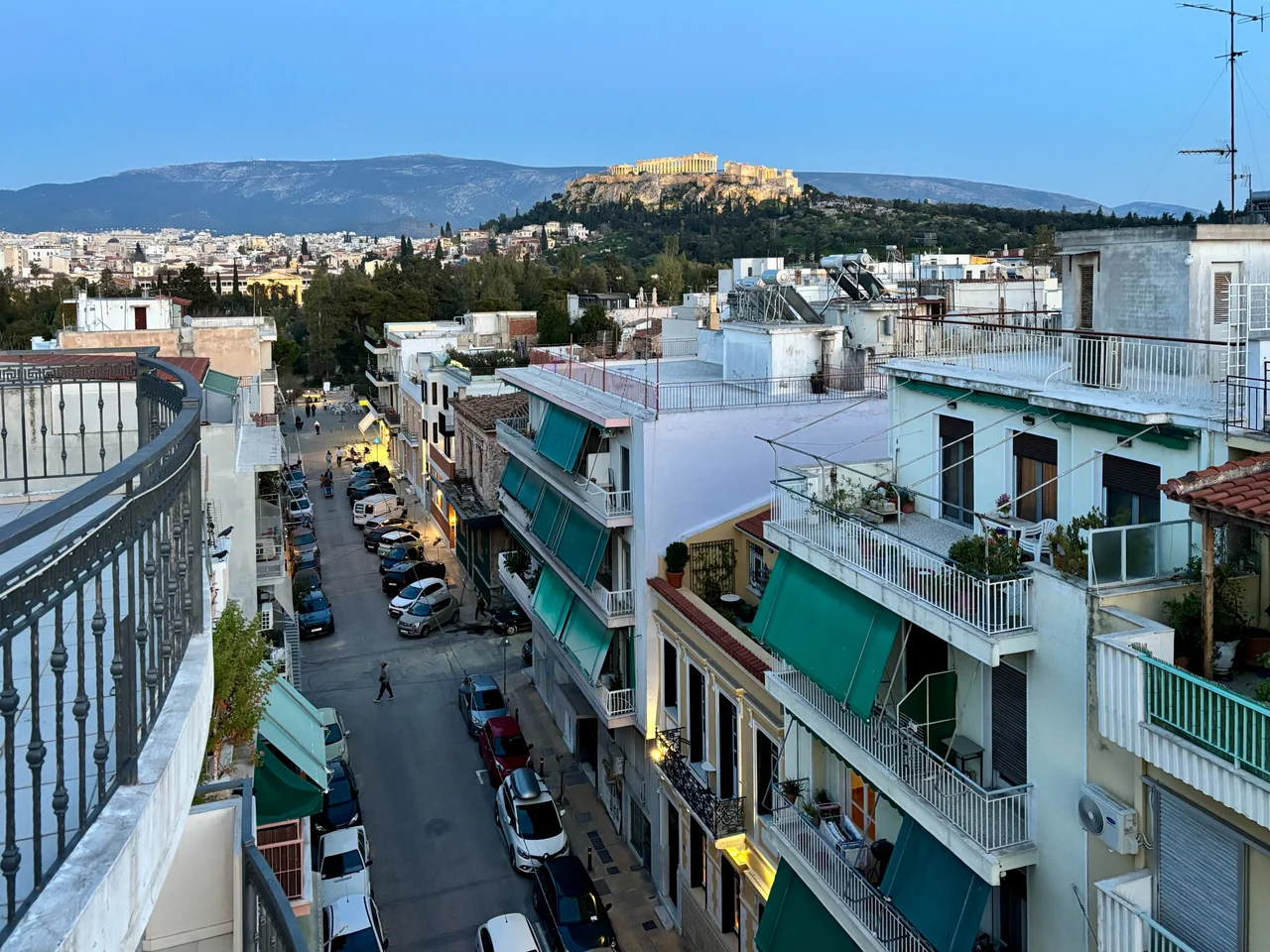

Thiseio
The neighbourhood carries the wrong name, and has for centuries. Thiseio takes its title from a temple long believed to honour Theseus, the mythical king of Athens, when it actually belongs to Hephaestus, the smith-god of fire and the forge. The mistake stuck, and so a corner of the old city is named for a hero who was never worshipped here. It hardly matters. The temple it points to, the best-preserved in all of Greece, still stands intact on its low hill, and the neighbourhood around it is among the most beguiling in Athens.
Living Among the Ruins
Thiseio sits northwest of the Acropolis, hemmed in by some of the most storied ground on earth. The Ancient Agora, where Socrates once argued, opens directly from the neighbourhood. So does the Temple of Hephaestus, the Stoa of Attalos, and the cemetery of Kerameikos. A short walk reaches the Pnyx, the bare hill where the citizens of Athens gathered to vote and where the practice of democracy first took shape. Few places let you wander so casually past the foundations of Western civilisation. Here it is simply the texture of the neighbourhood, glimpsed between cafés and restored houses.
A Neighbourhood on Foot
What makes Thiseio rare in a crowded capital is that the cars are mostly gone. Apostolou Pavlou Street, pedestrianised and lined with cafés, meets Dionysiou Areopagitou to form a long walking promenade that loops the archaeological sites from Thiseio all the way to the Acropolis. Athenians come here to stroll in the evening, drifting along narrow serpentine lanes that twist between neoclassical houses. From the rocky height of the Areopagus the views open up, the whole illuminated Acropolis floating above the city. Locals will tell you the panorama is finest at night, when the floodlit Parthenon seems to hover over the rooftops.
Faiths and Memory
The neighbourhood holds layers of worship older than its cafés. Byzantine churches like Agia Marina and the eleventh-century Agii Assomati stand among the lanes. Thiseio is also home to both of modern Athens' synagogues, the Romaniote Etz Chaim and the Sephardic Beth Shalom, facing each other across a quiet street, along with the city's Holocaust Memorial. Older still, inside the Agora itself, lie the remains of an ancient synagogue. Few districts hold so much religious history in so small a space, and fewer still wear it so lightly.
Watching the Sky
On the Hill of the Nymphs, above the rooftops, sits the National Observatory of Athens, home to the oldest meteorological station in Greece and one of the oldest in southern Europe. Records have been kept from this hill since 1858, when the observatory's first director began systematic meteorological observations, and the station became a formal national institution in 1890. For well over a century, the weather of Athens has been measured from this hill, a quiet scientific outpost looking down on a neighbourhood that has watched empires come and go. From up here the city spreads out, the Acropolis on one side and the sea beyond, the same horizon the ancients knew.
From the Air
Thiseio lies at 37.975 N, 23.7167 E in the old city of Athens, immediately northwest of the Acropolis and bounded by the Ancient Agora, Kerameikos, and the Pnyx. From the air, look for the green pedestrian corridor and the intact Temple of Hephaestus on its low rise near the Agora. The Acropolis rock just to the southeast is the primary landmark. Athens International Airport (LGAV) is about 20 nm east-southeast. Clear conditions reward a low pass over the historic centre.
Nearby Stories
- Great Sand Beach 5 km away
- Battle of Delium 7.7 km away
- Tower of Aliartos 9 km away
- HMHS Britannic 10 km away
- Saronic Gulf 15 km away
- Sousaki Volcano 17 km away
- Sanctuary of Apollo Maleatas 24 km away
- Skyros 66 km away