
Thorpeness
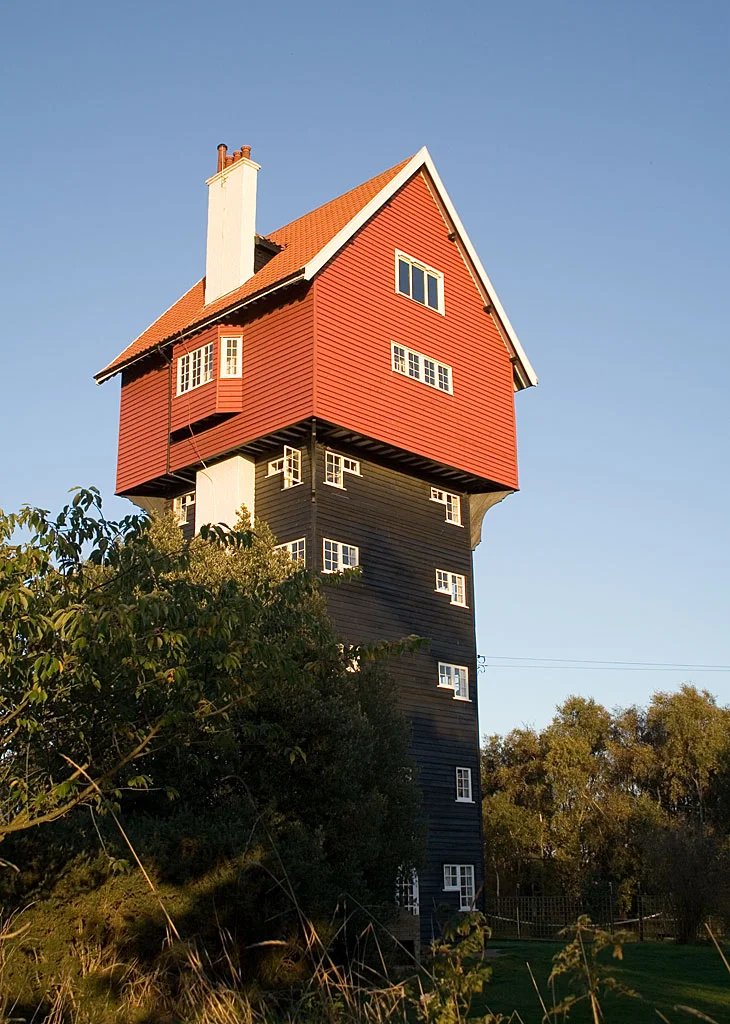
There is a five-storey house balanced on a wooden tower above the village, and it is not a house. It is a water tank, clad in 1923 to disguise the eyesore of the village's water supply by making the tank look like a small cottage perched in the clouds, with a separate mill house pumping water up to it. The villagers called it the House in the Clouds and the name stuck. When mains water arrived later in the century, the tank came out and the top of the tower was converted into a games room with views over the land from Aldeburgh to Sizewell. This is Thorpeness in miniature: an entire seaside village built as someone's personal fantasy, played out in wood and lath.
Glencairn Stuart Ogilvie's Idea
Glencairn Stuart Ogilvie was a Scottish barrister whose father had made a fortune building railways around the world. In 1910 he increased the family's Suffolk estates to cover the entire coast from north of Aldeburgh past Sizewell, up the coast and inland to Aldringham and Leiston. Most of that land stayed in farming. The hamlet of Thorpeness, a former fishing village on the dunes with folk tales of smugglers running goods up into East Anglia, became something else entirely. Ogilvie developed it as an elite private fantasy holiday resort and invited the families of his friends and colleagues each summer. An exclusive country club went up with tennis courts and a swimming pool. A golf course designed by the eminent James Braid was laid out alongside its own clubhouse. Holiday homes followed in Jacobean and Tudor Revival styles, half-timbered villas pretending to be older than they were. The Great Eastern Railway opened Thorpeness station just days before the outbreak of the First World War, expecting an expanding resort. The station was little used except by golfers and closed in 1966.
The Meare and Peter Pan
An artificial boating lake called the Meare sits on the site of an old Elizabethan shipping haven that had silted up. Ogilvie laid it out with islands, jetties, and named features taken from a book whose author was a personal friend of the family: J. M. Barrie's Peter Pan. Children rowed Wendy's House and Pirates' Lair and the Crocodile, and the geography of the lake quietly mapped a stage script onto the Suffolk shore. It was a Edwardian father's gift to his guests' children and a place that has never quite stopped being childish in the best sense. Boats can still be hired today. The water is rarely more than waist deep. The illustrator Edward Ardizzone borrowed Thorpeness into Little Tim and the Brave Sea Captain in 1936, the local lifeboat crew rescuing his small hero from the waves.
Inheritance and Erosion
Thorpeness stayed mostly in private Ogilvie ownership for three generations, with houses sold only to friends as holiday homes. In 1972 Alexander Stuart Ogilvie, Glencairn's grandson, died on the Thorpeness golf course. The death duties forced the sale of many houses, the golf course, and the country club, and Thorpeness opened up. Most of the dream survived intact. The House in the Clouds. The mock-Jacobean villas around the Meare. The West Bar water tower, designed like a castle keep, has been refurbished into luxury accommodation. The 1920s almshouses designed by W. G. Wilson still serve their original purpose. To the south lies the North Warren RSPB reserve, an area of wildlife and habitat conservation with SSSI and SPA status, run by the Royal Society for the Protection of Birds. The fantasy and the wetland coexist.
The Sea Returns
Like much of Britain's East Coast, Thorpeness has had recurring problems with coastal erosion. One house had to be demolished in 2022. Two more came down in late 2025, and a third required demolition in early 2026. The cliff edge keeps moving. Discussions continue about further defences. The village is also affected by infrastructure projects landing here, with offshore wind cables coming ashore, the SeaLink interconnector under planning, and the construction of Sizewell C two miles north. Significant local opposition has organised under Suffolk Energy Action Solutions, the worry being that what made Thorpeness Thorpeness, the careful Edwardian quiet and the half-imaginary landscape, will not survive a decade of heavy plant. The House in the Clouds still stands. The land underneath it does not, in places, hold.
From the Air
Thorpeness sits at 52.179 N, 1.615 E on the Suffolk coast about a mile north of Aldeburgh. From 1,500-3,000 feet the village's clearest visual landmark is the House in the Clouds, a tall narrow tower with the disguised cottage at the top, standing inland of the seafront. The Meare boating lake shows as an irregular pond just south of the village. Sizewell A and B's distinctive box and dome are two miles north along the coast. Nearby airfields: Wattisham (EGUW) 25 miles west, Norwich (EGSH) 35 miles north.
Nearby Stories
- Beccles 7.6 km away
- The Food Museum 8.6 km away
- Old Buckenham Airfield 13 km away
- White House Farm murders 20 km away
- Walton-on-the-Naze 22 km away
- Four Days' Battle 22 km away
- Southern Bight 51 km away
- Battle of Lowestoft 56 km away