![Photo: Koeln_1945.jpg: U.S. Department of Defense. Department of the Army. Office of the Chief Signal Officer. [1] | Public domain](https://commons.wikimedia.org/wiki/File:Koeln_1945-sharpened-resized.jpg)
Timeline of Cologne
In the year 90, Cologne had 45,000 people, a Roman aqueduct bringing in spring water from the Eifel hills, and the title of capital of the province of Germania Inferior. Roughly thirteen centuries later, in 1473, masons finally put down their tools on the unfinished west front of Cologne Cathedral, leaving a wooden crane on the south tower that would stand there, untouched, for the next four hundred years. The city of Cologne does not measure time the way younger cities do. It is one of the very few places in northern Europe where you can stand inside a continuously inhabited Roman foundation and watch trams cross a Rhine bridge built in 1959. Here is the through-line.
Roman Capital on the Rhine
Germanicus, nephew of the emperor Tiberius, made the small Ubian settlement on the west bank his military headquarters in 13 CE. Two years later it became the administrative capital of Germania Inferior. In the year 50 the Romans formally established Colonia Claudia Ara Agrippinensium, the colony that gave Cologne its eventual name, in honour of the empress Agrippina the Younger, who had been born here. Roman engineers built the Eifel Aqueduct around 80 CE to deliver fresh water to the rapidly growing town. By 260 Cologne was briefly the capital of the breakaway Gallic Empire, and by 310 a stone bridge crossed the Rhine. Then in 451 the Huns under Attila sacked the city. In 459 the Ripuarian Franks took power, and by 475 the place had become a residence of the Frankish king Childeric I.
Twelve Great Churches
From the late tenth century onward, Cologne built churches with a confidence that took some of medieval Europe's breath away. Great St. Martin was founded in 960, St. Andreas consecrated in 974, St. Pantaleon in 980. St. Maria im Kapitol opened around 1065, St. Gereon's Basilica reached its dome in 1227, and in 1248 work began on the cathedral that would dominate everything else. The twelve great Romanesque churches of the inner city date from this surge. The cathedral choir was consecrated in 1322. Then the money ran out. In 1473 the west front was abandoned, the wooden crane on the south tower visible in nearly every drawing of the city for the next four hundred years. The city joined the Hanseatic League around 1260, became a Free Imperial City in 1475, and in 1709 Giovanni Maria Farina launched Eau de Cologne, the floral citrus blend that would carry the city's name around the world.
Prussian Cologne
The French First Republic annexed the city in 1796 and closed the medieval University of Cologne two years later. The Treaty of Lunéville in 1801 made Cologne formally French. After Napoleon fell, the Congress of Vienna handed the city to Prussia in 1815, and it began a century of explosive growth. In 1842 a citizens' association called the Central-Dombauverein restarted construction on the cathedral that had stood half-finished for four hundred years. Köln Hauptbahnhof opened in 1859. The zoo was founded in 1860. Stollwerck started making chocolate in 1839. The cathedral was finally completed in 1880. Five years later the medieval city walls were dismantled to allow expansion. Population in 1849 had been about 94,789; by 1900 it stood at 370,685, by 1925 at 705,477. Konrad Adenauer, the future Chancellor of West Germany, became mayor in 1917.
The City Erased and Rebuilt
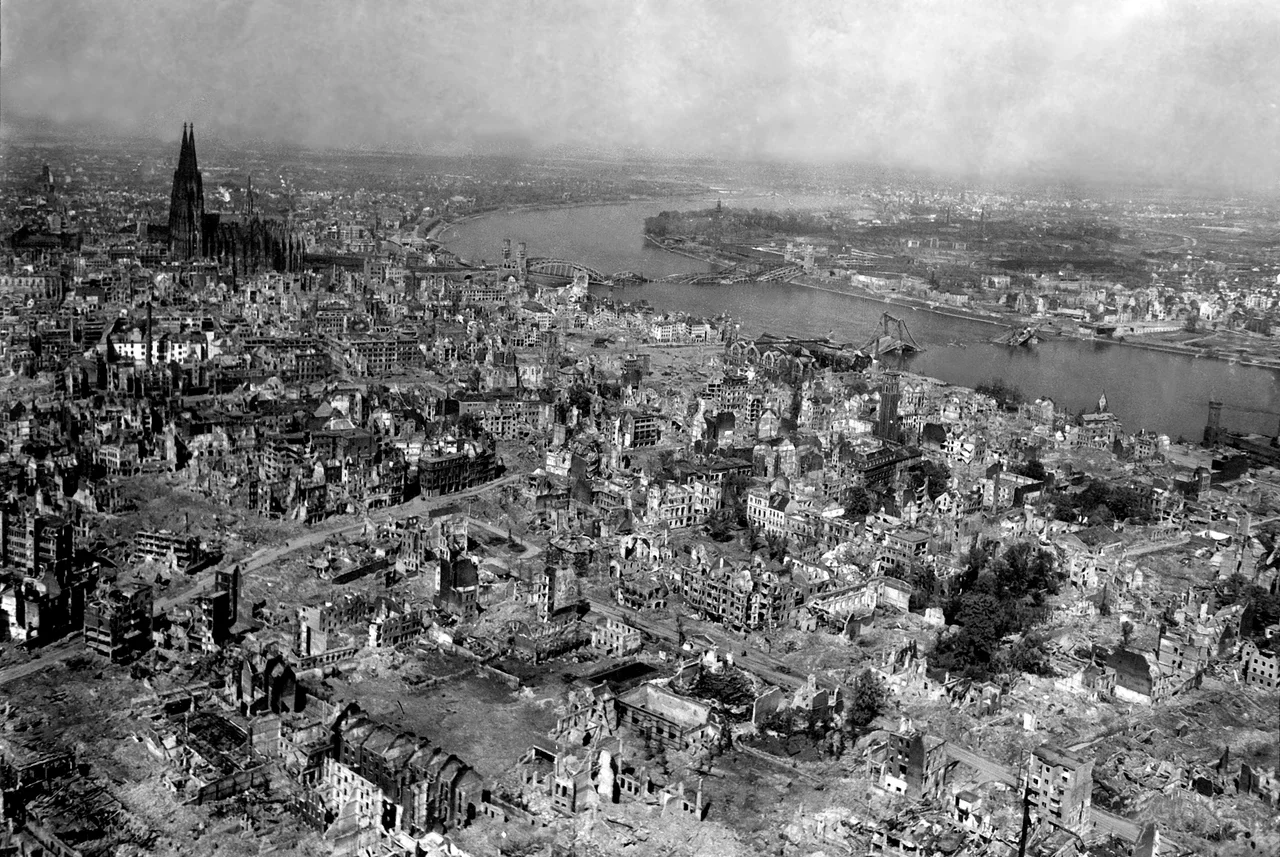
The bombing of Cologne began in 1940 and continued for almost the entire war. The Nazi state established forced-labour camps in and around the city: the III SS construction brigade in 1942, the Köln Stadt subcamp of Buchenwald in August 1944, the Westwaggon subcamp the next month. Most of the prisoners in those camps were Eastern Europeans, Poles, and Soviets who had been deported from their homes. By the time American troops took the city in March 1945, ninety percent of the medieval centre lay in rubble, the cathedral standing improbably among it. Reconstruction took decades. Cologne Bonn Airport opened in 1951. The Central Station was rebuilt in 1957. The new Severinsbrücke crossed the Rhine in 1959. Population passed 800,000 in 1960, broke a million in 2010. Museum Ludwig opened in 1976. The KölnTriangle, the city's modern tower across the river in Deutz, was completed in 2006.
The Recent City
On 9 June 2004 a nail bomb planted by neo-Nazis exploded in a Turkish neighbourhood in Mülheim, injuring twenty-two people; investigators eventually traced it to the National Socialist Underground. In 2015 Henriette Reker became the first female mayor of Cologne, sworn in one day after she was stabbed at a market in Braunsfeld by an attacker motivated by her work supporting refugees. The 2015-16 New Year's Eve assaults around the cathedral square triggered a national reckoning over policing and migration. The Cologne Central Mosque, designed to hold up to 1,200 worshippers, was completed in 2017. A terrorist plot was foiled in June 2018; a hostage-taking at the main station followed that October. In November 2025 Torsten Burmester of the SPD became mayor. Through all of it, the cathedral's twin spires still rise above the city, and the Roman aqueduct stones can still be found embedded in the foundations of houses that no Roman ever saw.
From the Air
Cologne city centre, approximately 50.94 N, 6.96 E, on the west bank of the Rhine. The cathedral's twin 157-metre spires are the dominant landmark; the green Hohenzollern railway bridge runs directly behind them. The Rhine arc through the centre is recognisable from cruising altitude. Cologne/Bonn airport (EDDK) is 14 km southeast. Düsseldorf (EDDL) is 35 km north. The Rhine valley funnels haze and low cloud; mid-morning typically offers the clearest visibility.
Nearby Stories
- Diamond Interchange: How a Simple Idea Reshapes Towns Like Julich 2.8 km away
- Dusseldorf-Unterbach 6.1 km away
- Baumwollspinnerei Ermen & Engels 11 km away
- RAF Bruggen 15 km away
- Hagen Open-air Museum 21 km away
- Belgium 130 km away
- Marcinelle Mining Disaster 173 km away
- Zwingenberg Castle 178 km away