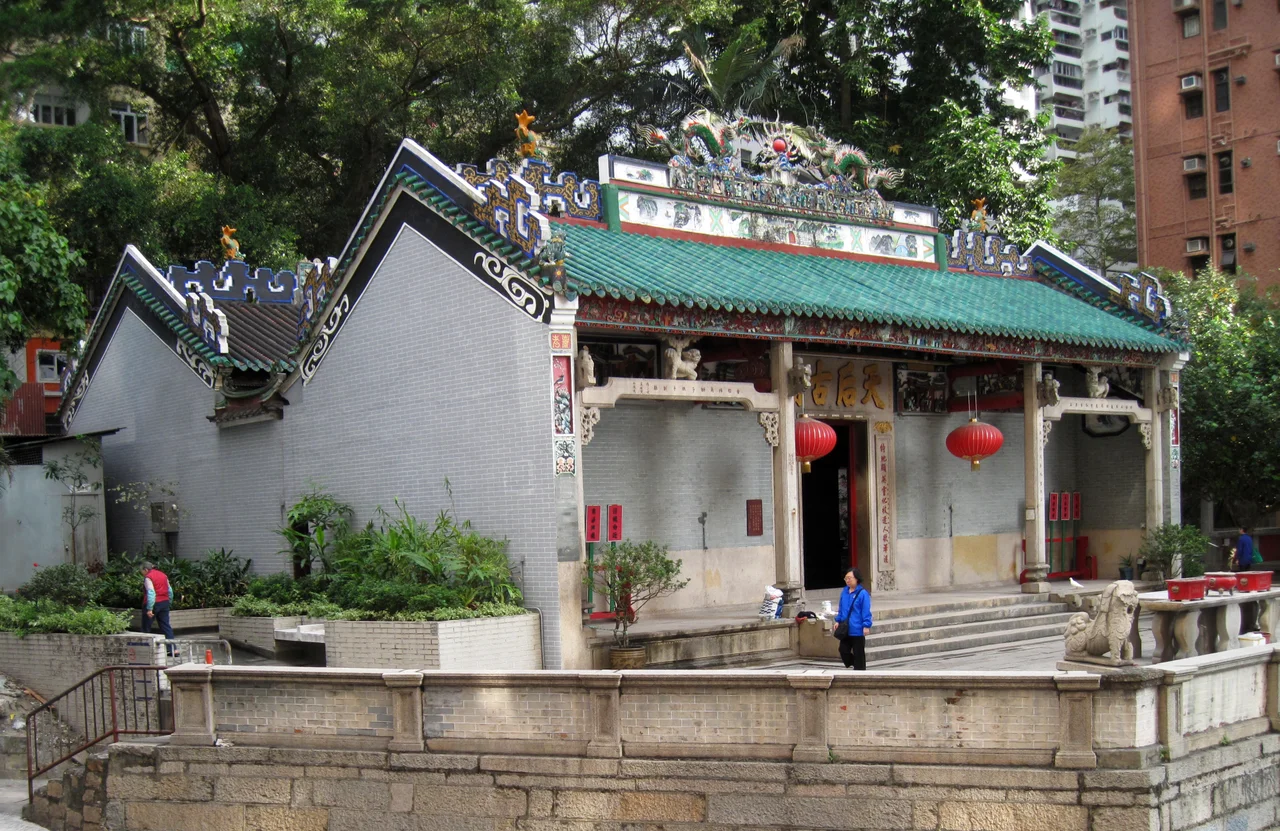

Tin Hau Temple, Causeway Bay
In 1747, the Tai family — Hakka settlers who had come from Guangdong and first settled in Kowloon — built a temple on the Causeway Bay waterfront for Tin Hau, the Goddess of the Sea. The bell they hung that year still exists, and its date is how historians know when the original temple was founded. The building that stands today dates from 1868, a reconstruction that has been renovated several times since but retains much of its original form. What cannot be retained is the temple's original relationship to the water: land reclamation has pushed the sea hundreds of meters north of where it once lapped at the temple's foundations. A temple built for seafarers now stands in an inland neighborhood named, in part, for the goddess it houses.
A Goddess for Seafarers
Tin Hau — known in Mandarin as Mazu — is one of the most widely venerated deities in southern Chinese maritime culture. She is the patron and protector of sailors, fisher families, and all who make their living on the water. Her origin story places her in Fujian province in the tenth century: a young woman named Lin Mo who, according to tradition, died young but whose spirit continued to guide boats safely through storms. Over centuries, her cult spread with the migration of Fujian and Cantonese communities across Southeast Asia. In Hong Kong, which was built on fishing villages and maritime trade, Tin Hau temples proliferated along every harbor and bay. The Causeway Bay temple is among the oldest surviving examples. Inside, the main altar and several side altars are dedicated to her. The stone carvings around the entrance and the Shek Wan ceramic figurines on the roof and eaves are considered among the finest examples of that craft in any Hong Kong temple.
What the Bell Records
The 1747 bell is the oldest surviving artifact in the temple and one of the dated anchors in Hong Kong's pre-colonial history. The Tai family who built the original structure were Hakkas — part of the wave of migrants from Guangdong who settled the New Territories and the islands before British administration began in 1842. Their presence on this particular stretch of what would become Causeway Bay reflects the fishing economy that once dominated this part of the island's northern shore. The current building, dating to 1868, was constructed during the early colonial period, after the British had established their settlement but before the major waves of land reclamation that would reshape the harbor over the following century. That the temple has survived relatively intact while the neighborhood around it transformed completely is itself a kind of historical record.
The Sea That Retreated
Land reclamation in Hong Kong has been ongoing since the mid-nineteenth century. Piece by piece, the harbor has been narrowed and the coastline pushed outward to create space for a city that has never had enough room for its ambitions. For the Causeway Bay Tin Hau Temple, this process meant that the sea it was built to face receded as fill was added to the north. Worshippers who once arrived by boat to pray to the Goddess of the Sea now arrive by MTR. The station serving the temple — on the Island Line — is named Tin Hau, after the goddess. So is the neighborhood. In this way, the 1747 temple has given its name to a transit node and an entire stretch of the urban grid, its spiritual geography having become the practical geography of a modern city.
A Declared Monument, Still in Use
The temple is a declared monument of Hong Kong, recognized for its historical significance and for the quality of its craftsmanship. It sits at 10 Tin Hau Temple Road, east of Victoria Park in the Eastern District. Renovation work carried out over the decades has been careful to preserve what makes it distinctive: the carved entrance surrounds, the ceramic roof ornaments from Shek Wan in Guangdong, the interior altars. The Antiquities and Monuments Office documented a major renovation project in September 2003. Despite its protected status, the temple functions as an active place of worship. On festival days — particularly the annual Tin Hau Festival, celebrated on the twenty-third day of the third lunar month — worshippers come in large numbers to pray, burn incense, and maintain their relationship with a goddess who has been watching over this stretch of the South China Sea for nearly three hundred years.
From the Air
The Tin Hau Temple in Causeway Bay is located at approximately 22.2822°N, 114.193°E, at 10 Tin Hau Temple Road, east of Victoria Park on Hong Kong Island. From the air on approach to VHHH (Hong Kong International Airport), the island's north shore presents as a continuous band of dense urban development. The large rectangular green space of Victoria Park is one of the most identifiable features in the Causeway Bay–Tin Hau area at low altitude — the temple sits just east of the park's boundary. Recommended viewing altitude: 1,500 to 2,000 feet. The airport is at Chek Lap Kok on Lantau Island, approximately 40 kilometers to the west-northwest.
Nearby Stories
- Lok Ma Chau Loop 2.3 km away
- Portas do Cerco 2.3 km away
- Kweilin Incident 17 km away
- Wanshan Archipelago Campaign 34 km away
- Nanxiong Formation 115 km away
- Battle of Nanpeng Island 148 km away
- Heyuan 169 km away
- Cape Maobitou 632 km away