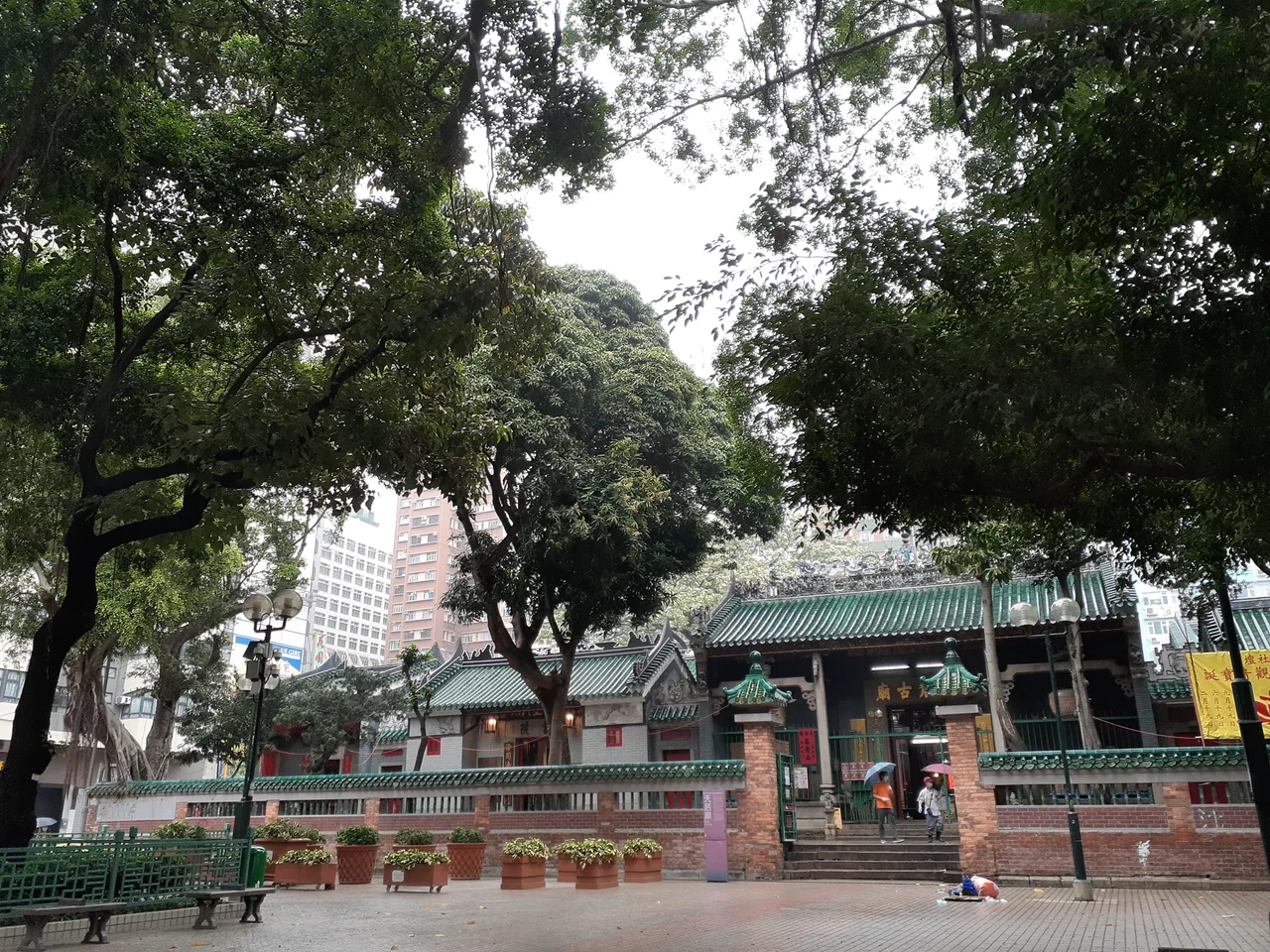

Tin Hau Temple Complex, Yau Ma Tei
Walk north from the neon-lit stalls of Temple Street at dusk, and the noise of vendors and fortune-tellers gives way to something quieter: five temple buildings standing in a row, their red pillars and curved eaves unchanged in feeling if not in exact form since the mid-19th century. The Tin Hau Temple Complex in Yau Ma Tei is not a single shrine but a miniature sacred district — a Kwun Yum temple, a Shing Wong temple, the Tin Hau temple itself, a communal hall rededicated over the decades, and a disused study hall that once taught the children of fisherfolk. Together they were declared monuments of Hong Kong in May 2020, formal recognition of what residents have known for generations.
A Temple Built by the Sea — Then the Sea Moved
The Tin Hau Temple traces its origins back to around 1864, when a small shrine stood in the Kwun Chung Market area. Boat people and villagers of Yau Ma Tei moved it to its present Temple Street location in 1876 — a practical act of devotion carried out, according to tradition, by water. What they placed it facing was the Yau Ma Tei waterfront. Today that shoreline is almost three kilometers away. Hong Kong's relentless programme of land reclamation has pushed the sea back so far that the temple, once a beacon for fishermen returning from the harbor, now sits deep in a dense urban grid. The goddess it honors — Tin Hau, protector of seafarers — is worshipped in a building that no longer sees the water. That irony has never diminished the faith.
Five Buildings, Many Deities
The complex is arranged left to right across a narrow plot, four lanes separating five distinct structures. The Kwun Yum temple on the left — formerly called Fuk Tak Tsz and dedicated to a different deity before its rededication — was built in 1894. Beside it stands the Shing Wong Temple, erected in 1878 and dedicated to the City God who watches over the district's moral order. The Tin Hau Temple itself is the oldest of the five. Then comes the Kwun Yam Lau She Tan, also built in 1894, originally a communal hall called the Kung Sor where the community met to govern itself; additional deities accumulated at its altar over time until Kwun Yum — the Goddess of Mercy — became the presiding presence. Finally, at the far right, the Hsu Yuen of 1897: a study hall, now silent, where the children of boat families and land families once learned to read.
School, Hall, Temple — and a Nine-Dragon Wall
The Kung Sor and the Hsu Yuen served the community in ways that went beyond the spiritual. Until 1955, they functioned as a free school, educating the children of both boat people and those who lived on land — populations that lived in close proximity in Yau Ma Tei but did not always share institutions. The school operated for roughly sixty years, a quiet form of public service embedded in a religious compound. Behind the complex, in the Public Square Street Children's Playground and Rest Garden along Nathan Road, a Nine-Dragon Wall stands — a motif borrowed from imperial Chinese architecture, here transplanted into the everyday streetscape of Kowloon. The garden and the playground exist in the temple's shadow, a buffer between old devotion and the traffic of one of Hong Kong's busiest thoroughfares.
Temple Street's Anchor
The complex gives Temple Street its name, and Temple Street gives the complex its context. Every evening the night market fills the square in front — Yung Shue Tau — with the smell of grilled seafood, the calls of fortune-tellers, and the flicker of mahjong parlors. The temple complex watches all of it from behind its public garden, a zone of incense and quiet that persists despite the commercial energy surrounding it. Visitors who duck under the entrance and let their eyes adjust find dim interiors, gilded altars, and the two guardian brothers Chin Lei Ngan and Shun Fung Yi standing sentinel on either side of the main altar — standard in Tin Hau temples across Hong Kong, but no less arresting for that. The Nathan Road traffic hums just beyond the back wall. Inside, time moves differently.
Declared and Defended
For most of its existence, the Tin Hau Temple Complex was protected by use rather than law: people came, the buildings were maintained, the traditions continued. Formal legal protection came only in May 2020, when the Antiquities and Monuments Office declared the temple and its adjoining buildings official monuments of Hong Kong. The declaration acknowledged what the physical evidence already showed — that these five structures represent a continuous thread of community religious life stretching back to the 1860s, through colonial rule, through the density and demolition that reshaped the rest of Kowloon, through land reclamation that erased the very waterfront the temple once faced. The sea is gone. The temple remains.
From the Air
The Tin Hau Temple Complex sits at approximately 22.3098°N, 114.1708°E in Yau Ma Tei, central Kowloon, roughly 500 meters west of Nathan Road. From the air at 2,000–3,000 feet, the Temple Street area is identifiable by the dense urban grid just north of the Jordan MTR station footprint. The complex itself is a low-profile cluster surrounded by the open space of Yung Shue Tau square and the playground garden to the east. Hong Kong International Airport (VHHH) on Lantau Island lies approximately 28 km to the west-southwest; Kai Tak (now a development zone) is about 3 km to the east. Visibility over Kowloon can be hazy in summer; morning light from the east catches the red pillars of the temple row. Approach from the south over Victoria Harbour offers the clearest sightline into the Yau Ma Tei street grid.
Nearby Stories
- Lok Ma Chau Loop 2.3 km away
- Portas do Cerco 2.3 km away
- Kweilin Incident 17 km away
- Wanshan Archipelago Campaign 34 km away
- Nanxiong Formation 115 km away
- Battle of Nanpeng Island 148 km away
- Heyuan 169 km away
- Cape Maobitou 632 km away