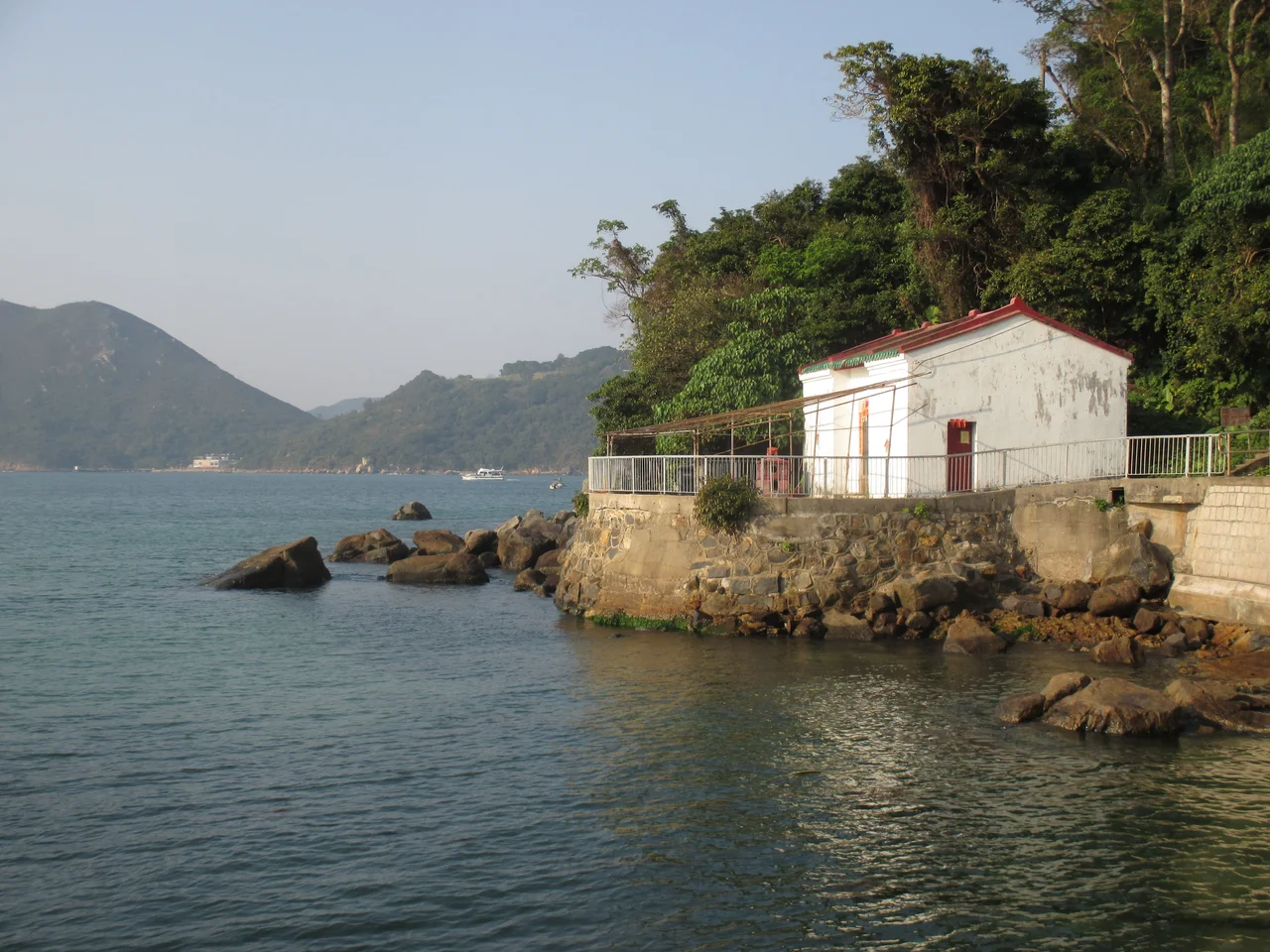

Tin Hau Temple, Joss House Bay
Once a year, hundreds of fishing boats crowd into Joss House Bay until the water is barely visible between hulls, their flags snapping in the sea breeze, incense smoke rising over the whole assembly. The occasion is the birthday of Tin Hau — Mazu, the Goddess of the Sea — and the temple that draws them has stood at the head of this bay since 1266. The bay itself takes its name from the temple: Tai Miu Wan in Cantonese, the Bay of the Large Temple, rendered in old English-language charts as Joss House Bay, joss being the colonial term for incense. The temple came first. The bay's identity followed.
Built in 1266
The temple is said to have been built by Lam Tao-yi in 1266, during the final decades of the Southern Song dynasty. If that date holds, this structure predates the British establishment of Hong Kong as a colony by nearly six centuries. The site sits near the south end of the Clear Water Bay Peninsula, in what is now Sai Kung District — remote enough that reaching it still requires a hike or a boat. That remoteness may be why the temple survived so long without being absorbed into the urban fabric that eventually swallowed so much of Hong Kong's older heritage. In 2023, the Hong Kong government formally declared the temple a monument, giving it the legal protection its longevity had already earned. The declaration came on October 20, 2023.
The Birthday of the Sea Goddess
Tin Hau's birthday falls on the 23rd day of the third month of the Chinese lunar calendar. In a city that has historically depended on the sea for its livelihood, the celebration at Joss House Bay is one of the largest traditional religious gatherings in Hong Kong. Upwards of 40,000 to 50,000 people attend in a single day. Some come by land, hiking via the High Junk Peak Trail through the surrounding hills. Many more arrive by water — fishing boats, pleasure craft, and ferries converging on the bay from across the territory, a spectacle of colour and noise and devotion that has no close equivalent elsewhere in Hong Kong. A ferry service runs annually from North Point Ferry Pier on that day alone, and the Joss House Bay Public Pier, positioned directly in front of the temple, receives the steady traffic of arriving worshippers. The Hong Kong Police Force holds the launching ceremony of their new patrol vessels here — a tradition that acknowledges Tin Hau's jurisdiction over the waters all police craft must eventually cross.
The Rock Inscription
Between the minibus stop at the head of the access road and the temple at the water's edge lies a flight of stairs and, partway down, a carved inscription on a rock face. The inscription is itself a declared monument — a separate piece of protected heritage on the path to the larger one. Its precise content and date are matters of scholarly record rather than visitor signage, but its presence on the route underscores how deeply this coastline has been marked by human inscription over the centuries. Visitors arriving by minibus — Route 16 runs from MTR Po Lam station to Po Toi O on a regular schedule — walk past the inscription without necessarily pausing. The temple ahead tends to command attention.
An Isolated Bay
Outside the festival period, Joss House Bay is quiet in the way that genuinely remote places are quiet: not silent, but emptied of the noise that has no business being there. The hills of the Clear Water Bay Peninsula press close on three sides. The mouth of the bay opens south toward the South China Sea. The temple stands at the water's edge, its red roof and gold detailing vivid against the green hillside. For most of the year, access requires commitment — the High Junk Peak Trail from the hills above, the short walk from the Clear Water Bay Country Club, or the minibus and ten-minute descent. The isolation is part of what the place is. A goddess of the sea might reasonably be expected to live somewhere not easily reached by land.
From the Air
The Tin Hau Temple at Joss House Bay lies at approximately 22.271°N, 114.290°E, at the head of a small bay on the southern coast of the Clear Water Bay Peninsula. From the air at 1,500–3,000 feet, Joss House Bay is identifiable as a distinct, sheltered cove with a small pier visible at its head. The surrounding hills of the Clear Water Bay Peninsula provide strong visual orientation, and High Junk Peak (344 m) is the prominent summit to the northwest. Hong Kong International Airport (VHHH) is approximately 28 km to the west. The bay faces south-southeast toward the open South China Sea. On Tin Hau's birthday, the concentration of vessels in the bay makes it uniquely recognizable from altitude — hundreds of fishing boats and pleasure craft pack the anchorage in a density visible from several thousand feet.
Nearby Stories
- Shek Pik 1.7 km away
- Tung Ping Chau 4.8 km away
- Hong Kong 12 14 km away
- Wanshan Archipelago Campaign 16 km away
- Pearl River Delta 18 km away
- Battle of Penghu 478 km away
- Penghu Air Raids 487 km away
- Cape Maobitou 596 km away