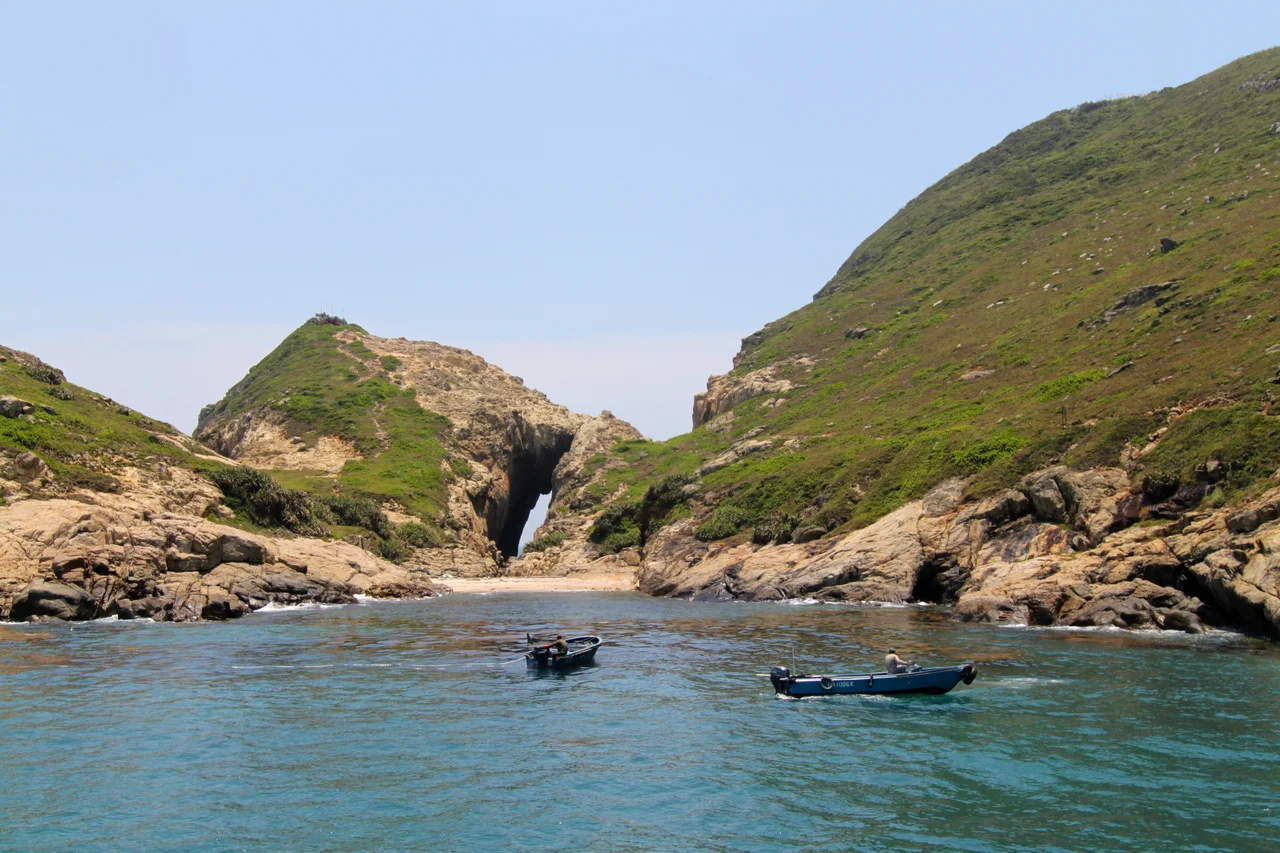

Tin Hau Temples in Hong Kong
Hong Kong has more than 100 temples dedicated to Tin Hau, the goddess of the sea. That number alone says something about this city's history. Before the skyscrapers and container terminals, before the handover and the MTR, Hong Kong was a fishing society — and fishing societies prayed to the woman who controlled the waters. Tin Hau, known elsewhere in China as Mazu, is said to have been a real woman from Fujian Province who died young and was deified for the miracles she performed for sailors. Her temples followed the fisherfolk wherever they settled, and fisherfolk settled everywhere in Hong Kong. The result is a sacred geography that overlays the physical one: wherever there is a bay, a harbor, a stretch of shoreline worth remembering, there is almost certainly a Tin Hau temple nearby.
A Goddess Born on the Mainland, Rooted in Hong Kong
Tin Hau is the Cantonese name for the deity better known in Mandarin as Mazu — the Empress of Heaven, patron of seafarers. Her cult spread along China's southeastern coast with the fishing and trading communities that relied on her protection, and when those communities came to Hong Kong, they brought her with them. The temples they built were not grand statements of imperial faith but practical sanctuaries: places to pray before heading out to sea, to give thanks on returning, to settle disputes and bind the community together. Over generations, the temples became civic anchors as much as religious ones. In Yau Ma Tei, the temple complex gave its name to Temple Street. In Causeway Bay, the Tin Hau temple gave its name to an entire MTR station and the neighborhood that grew around it. The goddess's footprint on the city's map is indelible.
The Oldest and the Most Sacred
Among all the Tin Hau temples in Hong Kong, the one at Joss House Bay holds a special place. Built in 1266, it is both the oldest and the largest. Its Grade I historic building status reflects that distinction, and its annual Tin Hau Festival draws upwards of 40,000 to 50,000 worshippers — pilgrims who arrive mostly by boat, as their ancestors did, in a harbor that fills with decorated vessels for the occasion. The scale of that gathering, in a city of seven million people, says something about the depth of continued devotion. Two other temples — on Leung Shuen Wan (High Island) and on Tap Mun — hold marine parades to mark the festival, though Tap Mun's parade comes only once every ten years, making it a genuinely rare event when it occurs.
Guardians at the Door
Step inside any of the larger Tin Hau temples and you will find, flanking the main altar, two figures: the daemon brothers Chin Lei Ngan and Shun Fung Yi. They are Tin Hau's guardians, present in every major temple as a standard of the tradition. Chin Lei Ngan — his name translates roughly as Thousand-Mile Eyes — can see threats approaching from far away. Shun Fung Yi — Fair Wind Ear — can hear distant sounds, including the distress calls of sailors at sea. Together they give the goddess perfect information about the world she protects. Their statues, painted in vivid traditional colors, are among the most immediately striking features of any Tin Hau temple interior, and their presence marks a space as authentically part of the Tin Hau tradition rather than a generic Chinese religious building.
A Sacred Network Across Eighteen Districts
Tin Hau temples in Hong Kong are not concentrated in any single district but distributed across all eighteen — from the Eastern District on Hong Kong Island to the New Territories villages to the outlying islands. That spread follows the logic of Hong Kong's original settlement patterns, which were coastal and scattered rather than centralized. Every community that depended on the sea built its own shrine. The Causeway Bay temple, at 10 Tin Hau Temple Road, is a declared monument sitting east of Victoria Park, a relic of a time when that part of Hong Kong Island was still a fishing village. The temples of the outlying islands — on Lantau, Cheung Chau, Tap Mun — anchor communities that remain more maritime in character than the dense urban core. Together they form a living map of where Hong Kong came from.
Devotion That Outlasted the Boats
The fishing fleets that once crowded Hong Kong's bays have largely given way to container ships and pleasure craft. The boat people communities of Yau Ma Tei and Aberdeen, once so numerous they formed floating villages, have mostly moved ashore. But the temples remain — maintained, visited, and alive with incense on the Tin Hau Festival and on the ordinary days between. The goddess who once guided junks through typhoons now watches over a city that has moved far inland from its maritime origins. She watches over it from more than 100 places at once. For a deity of fishermen, she has adapted well to a city of bankers.
From the Air
Tin Hau temples are distributed across Hong Kong at approximately 22.28°N, 114.23°E as a general center of gravity, though individual temples range from Joss House Bay in the east (22.30°N, 114.32°E) to the outlying islands in the west. From the air, the dense urban center of Hong Kong Island and Kowloon is visible at altitudes of 3,000 feet and above, with Victoria Harbour the clear visual dividing line. Hong Kong International Airport (VHHH) is on Lantau Island to the west; Joss House Bay, site of the oldest and largest Tin Hau temple, lies roughly 15 km east of VHHH across the New Territories. Best aerial perspective on the distribution of Hong Kong's sacred geography comes from a north-south pass over the harbor at 4,000–5,000 feet on a clear day.
Nearby Stories
- Lok Ma Chau Loop 2.3 km away
- Portas do Cerco 2.3 km away
- Kweilin Incident 17 km away
- Wanshan Archipelago Campaign 34 km away
- Nanxiong Formation 115 km away
- Battle of Nanpeng Island 148 km away
- Heyuan 169 km away
- Cape Maobitou 632 km away