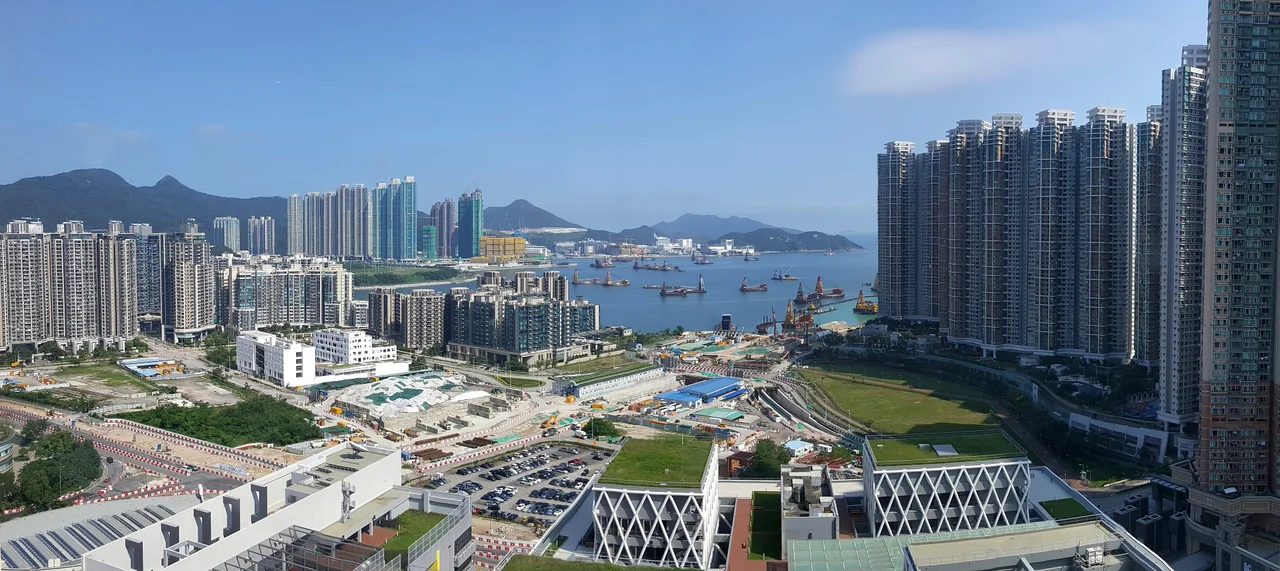

Tiu Keng Leng
The name has been changed twice, and each change tells its own story. The Tanka people who first named this place on the shore of Junk Bay called it Chiu Keng Leng — Mirror Ridge — for the calm, reflective surface of the adjacent water. Then a Canadian businessman drowned himself here in 1908, and the bay took on a grimmer character. The Chinese name shifted to 吊頸嶺, Neck Hanging Ridge, a dark pun on the original. Because a name like that invited bad luck, the characters were swapped again for similar-sounding ones that meant something neutral. By then, the place had larger problems than its name.
The Mill That Failed, the Man Who Drowned
Alfred Herbert Rennie was a 19th-century Canadian businessman who came to Junk Bay with ambitions and partners — Paul Chater and Hormusjee Naorojee Mody, names well known in Hong Kong commercial history. Together they established the Hong Kong Milling Company at Rennie's Mill, as the place came to be called in English. The enterprise failed. Rennie drowned himself in the bay in 1908; contemporary reports got the manner of his death wrong, saying he had hanged himself, which is why the Chinese name memorialized a hanging rather than a drowning. A double mistranslation of a suicide, locked into the landscape. The English name Rennie's Mill survived him by nearly a century, appearing on road signs long after anyone connected to the mill was gone. The bay remembered what the city tried to forget.
Little Taiwan in the British Colony
On 26 June 1950, the Hong Kong Government's Social Welfare Office settled approximately 6,800 refugees at Rennie's Mill. They were former Nationalist soldiers and Kuomintang supporters, people who had fled mainland China after the Communist victory in the Chinese Civil War. The colonial government's plan was temporary resettlement pending repatriation — to Taiwan or back to the mainland — but the repatriation never came. What grew instead was something without precedent in Hong Kong: an enclave flying the flag of the Republic of China, with its own schools, its own internal governance, and practically off-limits to the Royal Hong Kong Police Force until 1962. By the late 1950s, 'Little Taiwan' was the nickname; 'Bastion Against Communism' was the slogan painted on the hillside. The 1967 riots that shook the rest of Hong Kong never touched Rennie's Mill. It was insulated by its own politics.
Typhoons, Promises, and Eviction
Typhoon Wanda struck in 1962, badly damaging Rennie's Mill and rendering many of its residents homeless. The community rebuilt. The Hong Kong Government, seeking to reduce tension over the growing Kuomintang presence, turned the enclave into a formal resettlement estate that same year, bringing it back under some degree of administrative control. In 1961, residents had been promised they could stay indefinitely. By 1996, the government was serving notices to quit. Residents petitioned the High Court, and judge Raymond Sears found plainly that serving those notices, in breach of the 1961 promises, amounted to an abuse of power. The finding changed nothing. In 1996, the last of the original residents were evicted — a move widely understood as a gesture to the incoming Beijing government ahead of the 1997 handover of sovereignty.
Redevelopment and the New Tiu Keng Leng
After the handover, the English name Rennie's Mill was officially retired. The area became Tiu Keng Leng in all government usage, following the Cantonese. What followed was a complete physical transformation. High-rise residential towers replaced the low-slung refugee settlement. Metro Town, nine towers built above a shopping mall podium and a carpark, is now the tallest structure in the area. Ocean Shores, built on the site of the former Shiu Wing Steel mill, added more towers to the south. Three public housing estates — Kin Ming Estate, Choi Ming Court, and Shin Ming Estate — house tens of thousands of people where a few thousand exiles once lived under a foreign flag. The 2002 opening of Tiu Keng Leng MTR station connected the area to Kowloon's urban core; the Tseung Kwan O–Lam Tin Tunnel, completed in 2022, added a direct road link. The enclave that was once almost unreachable by public transport now has two tube lines.
Education on the Edge of History
Something unexpected happened in the new Tiu Keng Leng: it became an education hub. The Hong Kong Design Institute, opened in November 2010 at a construction cost of HK$1.2 billion, occupies a building of conspicuous architectural ambition — a glazed box raised seven storeys above the ground on four lattice-steel towers, designed by French firm Coldefy & Associés, meant to resemble a sheet of paper suspended in mid-air. Next door, the Hong Kong Institute of Vocational Education's Lee Wai Lee campus trains tradespeople. Saint Francis University, the first Catholic university in Hong Kong, occupies a campus in the same district. The settlement that kept itself apart from Hong Kong for four decades is now, in a particular irony, a place where young people from across the territory come to learn.
From the Air
Tiu Keng Leng sits at approximately 22.30°N, 114.25°E on the western shore of Junk Bay (Tseung Kwan O), in the Sai Kung District of Hong Kong. From the air at 3,000–4,000 feet, Junk Bay is a distinctive inlet opening southward, with the dense residential towers of the Tseung Kwan O New Town visible along its western and northern shores. Tiu Keng Leng station is identifiable at the southern end of the development cluster. Hong Kong International Airport (VHHH) lies roughly 30 km to the west-southwest on Lantau Island. The Tseung Kwan O–Lam Tin Tunnel portal is visible near the western edge of the development. On a clear day, the ridgeline above the old enclave — where Cold War-era banners once proclaimed loyalty to Chiang Kai-shek — is still visible as a green hillside to the south.
Nearby Stories
- Lok Ma Chau Loop 2.3 km away
- Portas do Cerco 2.3 km away
- Kweilin Incident 17 km away
- Wanshan Archipelago Campaign 34 km away
- Nanxiong Formation 115 km away
- Battle of Nanpeng Island 148 km away
- Heyuan 169 km away
- Cape Maobitou 632 km away