.jpg)
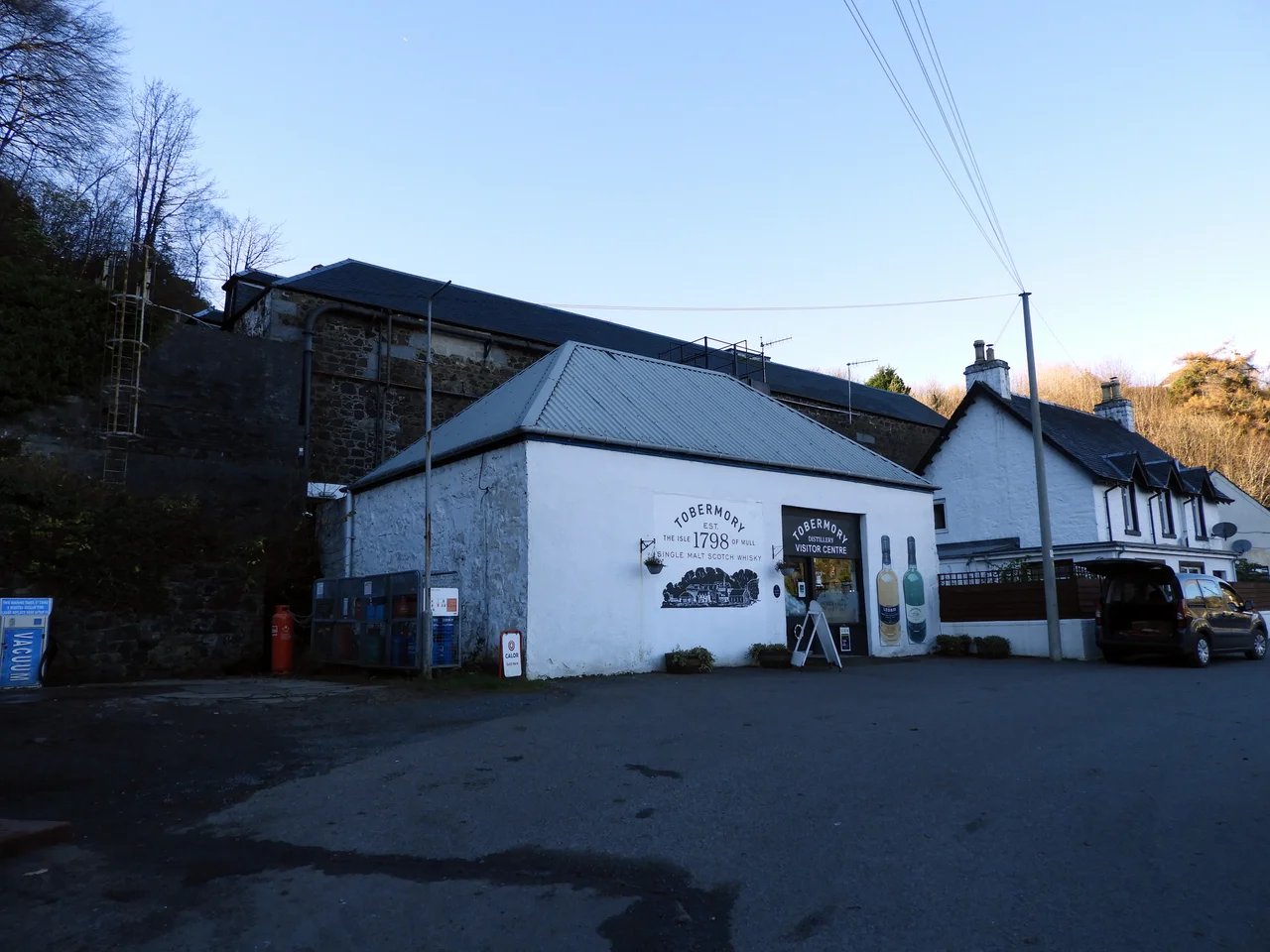
Tobermory Distillery
When John Sinclair of Lochaline applied for 57 acres at the head of Tobermory Bay in April 1797, he was breaking rules nobody else dared touch. Distilling had been banned across the UK for two years to save grain for the war with France. Sinclair was a kelp merchant turned schemer, and he wanted to build houses and a distillery on the south side of the harbour. By the time the ban lifted, he was ready. The distillery he founded in 1798, ten years after Tobermory itself was laid out by the British Fisheries Society, would outlive him by more than two centuries. It would also outlive most of its owners.
Ledaig and the Long Silence
The distillery was first called Ledaig, pronounced Letch-ick, and it ran fitfully through the early 19th century. By 1837 production had stopped. Sinclair put the place up for sale in 1844, again in 1849, and was still trying in 1851. Nobody wanted it. The buildings sat silent above the bay for nearly forty years. Then in 1876, Dr. Neil M'Nab Campbell bought it, refitted it with new equipment from a Townsend foundry, and brought distilling back to Mull. The Mackill brothers of Glasgow took over by 1883 for £9,300, went bankrupt four years later, and the cycle began again. In 1888, the Glasgow merchant John Hopkins & Co picked up the keys. The brand they pushed, Old Tobermory, would be advertised in newspapers from Berkshire to Oxford. The whisky was finally finding an audience beyond the island.
Prohibition and Departure
In 1916 the distillery was bought by Distillers Company, the dominant force in Scotch whisky. Then came American Prohibition, and demand collapsed. Malting at Tobermory ceased in 1930. Only token shipments left the bay. The company's two main labels at this point were Old Mull and Old Tobermory, both fading. In 1936 the distillery was sold to John McLean of Edinburgh, who promptly stripped it out: the entire contents were transferred to bonded warehouses in Campbeltown, on the Kintyre peninsula. Tobermory went quiet again. The colourful houses on Main Street looked down at an empty distillery for the better part of four decades. It would not produce another drop until 1972, when it reopened under the Ledaig name and immediately began another cycle of receivership and rescue.
When the Loch Ran Dry
In 2012, Mull endured its driest summer in thirty years. The small private loch that feeds the distillery dropped so low that production had to be halted to protect the consistency of the spirit. The following spring brought more dry weather and a second shutdown. Whisky on a small Hebridean island is at the mercy of weather that nobody else cares about. The same year as the first drought, Burn Stewart Distillers, which had owned the distillery since 1993, was bought by South Africa's Distell Group for £160 million. Heineken later absorbed Distell. So a single malt distilled at the head of a Mull sea loch is now produced by a company ultimately owned in Amsterdam. The whisky itself remains stubbornly local, matured ten years in oak, with the heavily peated Ledaig still made in small batches under the original name.
Heather and Rowan
In October 2020 the distillery launched Tobermory Hebridean Mountain Gin, built around three things the island grows itself: wild heather, rowan berry, and rosehip. The following April, it was named best gin in the world at an international competition. The distillery sits where it has always sat, at the foot of the steep hill that rises behind Tobermory, beside the painted houses, at the inner end of the bay. Visitors walk down Main Street past the lilac bakery and the red Chinese restaurant, past the clock tower that Isabella Bird funded as a memorial to her sister, and arrive at a working distillery that has been making spirit, with long interruptions, since George Washington was president.
From the Air
Tobermory Distillery sits at the head of Tobermory Bay on the north coast of the Isle of Mull, at 56.6206 degrees north, 6.0706 degrees west. From the air, look for the cluster of brightly painted buildings curving around the sheltered crescent harbour at the northern tip of Mull, with the distillery at the inland end of the bay. Recommended viewing altitude 2,000-3,000 feet for harbour detail. Nearest airport is Oban (EGEO) about 30 nautical miles southeast. Glasgow (EGPF) is roughly 80 nautical miles south. The Sound of Mull runs southeast from Tobermory toward Oban and is itself a useful navigation channel.
Nearby Stories
- Strontian 3.6 km away
- Gylen Castle 6.7 km away
- Kinloch Castle 10 km away
- Carsaig Arches 16 km away
- Tiree 24 km away
- German submarine U-722 26 km away
- Dun Telve 27 km away
- Skerryvore 29 km away