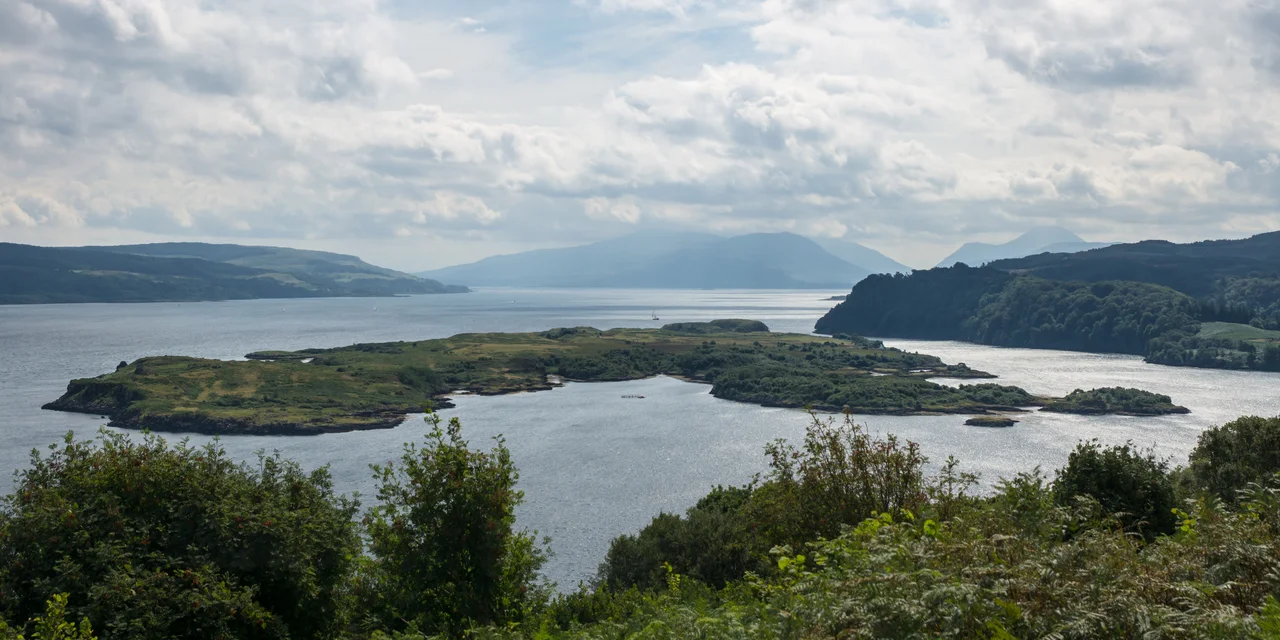

Tobermory, Mull
There is supposedly a Spanish galleon buried in the mud at the bottom of Tobermory Bay, somewhere beneath the keels of the yachts and Calmac ferries that come and go from the harbour. The story has been told in Mull since the 17th century: a ship of the defeated Spanish Armada, fleeing the English fleet in 1588, anchored here for provisions, argued over the bill or, depending who you ask, was cursed by the witch Doideag, caught fire, blew up when the magazine exploded, and sank with £300,000 in gold in her hold. Divers have hunted the wreck for four centuries. They have pulled up a few cannon. They have never found the gold. The hunt itself, however, helped invent modern marine archaeology.
Mary's Well and Telford's Lines
The name Tobermory comes from the Gaelic Tobar Mhoire, meaning Mary's well, a reference to a spring nearby that was dedicated in ancient times to the Virgin Mary. The town below the spring was a much later invention. In 1788 the British Fisheries Society, hoping to bring industry to the Highlands after the Clearances, founded a planned fishing port at the head of the bay. Its layout was drawn up by the great Dumfriesshire engineer Thomas Telford, who would later design canals, roads, and bridges across half of Britain. The grid of Main Street, the rising terraces above, the careful relationship between harbour and houses, all come from Telford's pen. Until 1973 it was the only burgh on the island. As of 2022 the population was 1,045, roughly a third of everyone living on Mull.
The Painted Houses
The seafront's bright colours, lilac and red and blue and ochre, are not original. They were a 20th-century decision that turned out to be a stroke of marketing genius. Between 2002 and 2005 the BBC filmed Balamory, a children's show, using the seafront as its main backdrop. Two decades later, anyone who grew up watching CBeebies arrives in Tobermory with a strange sense of recognition. The Mishnish pub, the bakery, the harbour wall, all look like a stage set. The colours shift over time as owners repaint, so the Balamory map that visiting parents bring is never quite up to date. The same painted street featured in the 1971 Alistair MacLean thriller When Eight Bells Toll, where Tobermory played the fictional port of Torbay. Even Saki, the Edwardian short-story master, gave the name to a cat who learns to speak English.
Isabella's Tower
Halfway along the harbour wall stands a small Gothic clock tower. It is a memorial. Isabella Bird, the Victorian travel writer who rode horseback through the Rocky Mountains and the Yangtze valley and pretty much anywhere else she could reach, spent stretches of her life in Tobermory, where her sister Henrietta kept a house. Isabella often helped the local doctor on his rounds, and on one occasion served as anaesthetist while he removed a tumour from a Tobermory woman. When Henrietta died young, Isabella funded the clock tower as a memorial to her sister. It went up on the harbour wall, where it still tells time to ferries arriving from Kilchoan. The town that gave its name to a children's TV show also gave us one of the most travelled women of the 19th century.
Terror, Mendelssohn, and Tobermorite
During the Second World War, HMS Western Isles operated out of the bay as the Royal Navy's Anti-Submarine Training School. Its commander, Vice-Admiral Sir Gilbert Stephenson, became famous as the Terror of Tobermory for the merciless drills he put green Atlantic crews through. The composer Felix Mendelssohn passed through in 1829 on his way to Staffa, an excursion that inspired his Hebrides Overture and is now commemorated by the annual Mendelssohn on Mull Festival. And the town gave its name, improbably, to a mineral: tobermorite, a calcium silicate hydrate found in rocks near Tobermory in 1880, is the same compound that gives ancient Roman concrete its remarkable durability. Roman engineers used it accidentally. The mineral is named for a town that didn't exist when Vesuvius buried Pompeii.
From the Air
Tobermory sits on the east coast of Mishnish at the northern end of the Isle of Mull, at 56.6200 degrees north, 6.0700 degrees west. From the air the town is unmistakable: a tight crescent of brightly painted houses curving around a sheltered bay, with Calve Island shielding the entrance. Recommended viewing altitude 2,000-4,000 feet for the painted harbour and surrounding landscape. The Sound of Mull runs southeast toward Oban. Rubha nan Gall lighthouse, built by the Stevensons in 1857, marks the headland two miles north. Nearest airport is Oban (EGEO) about 30 nautical miles southeast. Glasgow (EGPF) is 80 nautical miles south. Tobermory Distillery sits at the inland end of the bay.
Nearby Stories
- Strontian 3.6 km away
- Gylen Castle 6.7 km away
- Kinloch Castle 10 km away
- Carsaig Arches 16 km away
- Tiree 24 km away
- German submarine U-722 26 km away
- Dun Telve 27 km away
- Skerryvore 29 km away