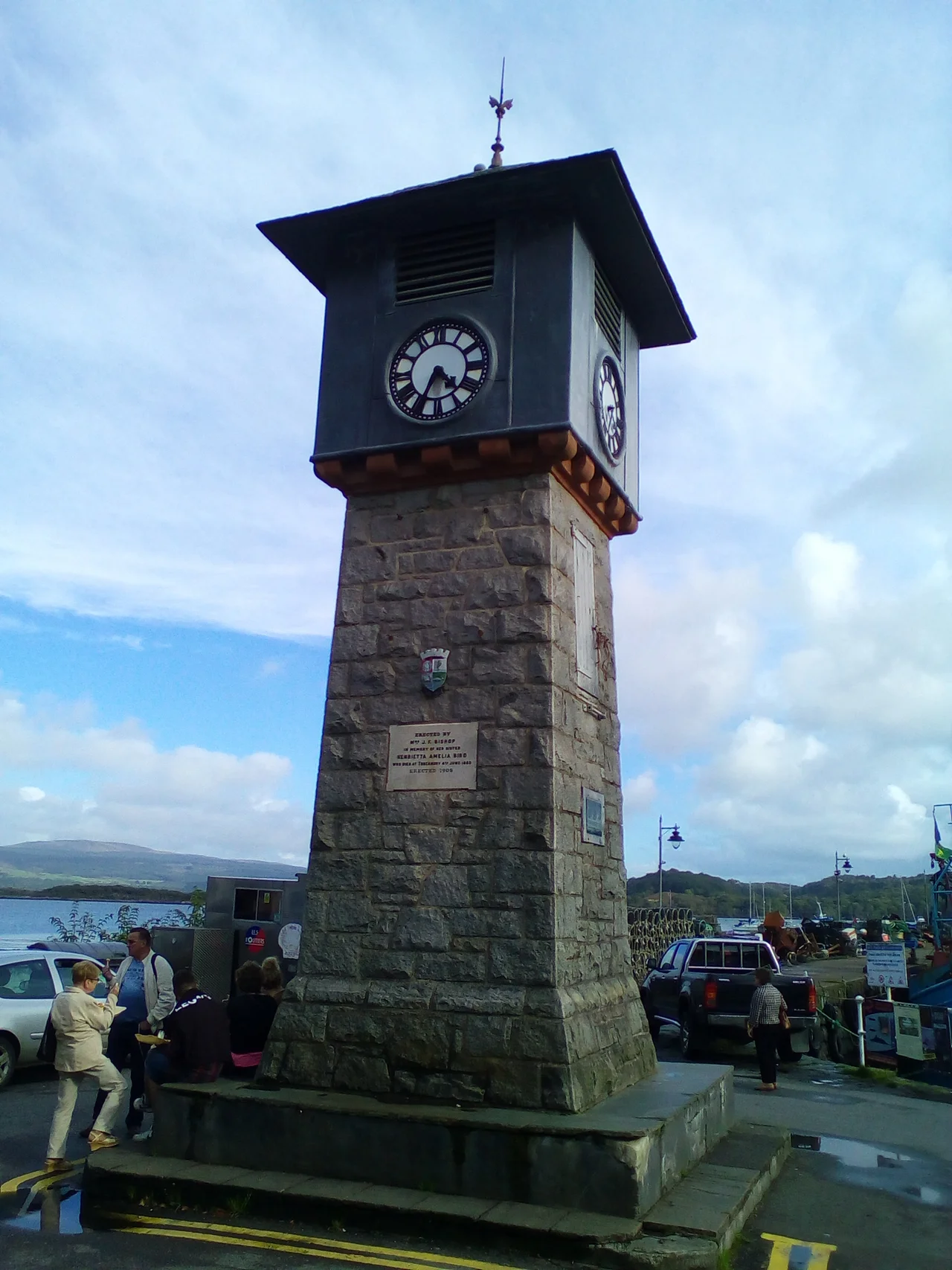

Tobermory
On Mull, a place with a thousand permanent residents counts as a town. Anywhere else in Britain, Tobermory would be called a village. Hebridean scale is different. Cross from Oban on the Calmac ferry, drive 21 miles up the A848 across a landscape that goes single-track for six miles in the middle, and you reach a place where most of the island's amenities are concentrated along one curving harbour. Population about 1,000 in 2020. A third of everyone living on Mull. By mainland standards a small village; by Hebridean reckoning, a bustling town with a bakery, a pub or two, a whisky distillery, and a ferry terminal to the mainland. Britain's Generation Z arrives knowing the place already, because they grew up watching Balamory.
Calmac Country
There are three ways onto Mull, and two of them involve Tobermory in some way. The big one is the Calmac ferry from Oban to Craignure, sailing hourly in summer and every two or three hours in winter, 50 minutes across the Firth of Lorn. From Craignure it is 21 miles up the A848 to Tobermory, mostly two-lane but pinching to single-track for a stretch near Salen. The second route comes in from the north: a ferry from Kilchoan on the Ardnamurchan peninsula, 40 minutes across, four sailings a day in winter, more in summer. It is only useful if you are touring the magnificently remote Ardnamurchan first. The third is the short crossing from Lochaline to Fishnish further south on Mull. West Coast Motors Bus 95 or 495 meets the Craignure ferries five or six times daily, threading through Salen to reach Tobermory in another 50 minutes.
Calve Island and the Stevensons
The low island sheltering the bay is called Calve. It is grazing land with a single summer cottage and no permanent residents. The channel between Calve and Tobermory is just about tidal at extreme low water but you would not want to risk wading it. Divers know Calve for the submerged wall and surrounding wrecks, including a Calmac ferry called Pelican. Two miles north along a muddy clifftop path stands Rubha nan Gall, the headland lighthouse built in 1857 by the Stevenson engineers, the same family that designed dozens of Scotland's lighthouses and produced one author called Robert Louis. The Rubha nan Gall light was automated in 1960, and the keepers' cottages are now available as totally off-grid self-catering accommodation, reached only by foot.
Glengorm and the Volcano
Northwest of town stand the Glengorm Standing Stones, a group of three on the moor near Glengorm Castle, with a path that continues half a mile to the scrappy remains of Dun Ara Castle. The view is the point, looking out across the Sea of the Hebrides toward the Outer Isles. Closer to town, on the road toward Dervaig and Calgary, rises a plug of rock locals call the Volcano. Eagles hunt the upland here. The trail is steep and rough. The Tobermory Golf Club lays its nine holes across the cliff tops north of town, par 64 if you go round twice off the white tees, visitors welcome unless there is a competition. South of town, off the main road, Aros Park offers waterfalls and woodland walks for the days when the wind off the Sound makes the cliff tops less welcoming.
Bright Doors and Patchy Signal
The painted shopfronts that make Tobermory famous, the lilac Tobermory Bakery, the blue Galleon restaurant, the red Crystal Palace serving Chinese on Main Street, are not just photogenic backdrops. The colours function as addresses. Tobermory locals give directions by hue. The Macdonald Arms keeps long hours on Main Street. The Tobermory and Ledaig whiskies come from the distillery at the head of the bay. Whitetail Distillery makes gin further south on Loch Scridain. The mobile signal is famously patchy from every UK carrier as of 2022, and 5G has not reached Mull at all. That is part of the deal: a Hebridean island town that quietly skips a generation of telecoms. Beyond Tobermory, ferries lead to Iona for a day trip that deserves an overnight, or to Ardnamurchan, which is technically on the mainland but feels more remote than the island.
From the Air
Tobermory lies at the northern tip of the Isle of Mull, at 56.6200 degrees north, 6.0700 degrees west. From the air the painted seafront curves around a sheltered bay shielded by Calve Island. Recommended viewing altitude 2,000-3,500 feet to see the harbour, the surrounding hills, and the Sound of Mull. Visual landmarks include the harbour clock tower, the distillery at the head of the bay, and Rubha nan Gall lighthouse on the headland two miles north. Nearest airport is Oban (EGEO) about 30 nautical miles southeast. Glasgow (EGPF) is 80 nautical miles south. The single-track A848 winds south from town through Salen to Craignure, where the Oban ferry docks.
Nearby Stories
- Strontian 3.6 km away
- Gylen Castle 6.7 km away
- Kinloch Castle 10 km away
- Carsaig Arches 16 km away
- Tiree 24 km away
- German submarine U-722 26 km away
- Dun Telve 27 km away
- Skerryvore 29 km away