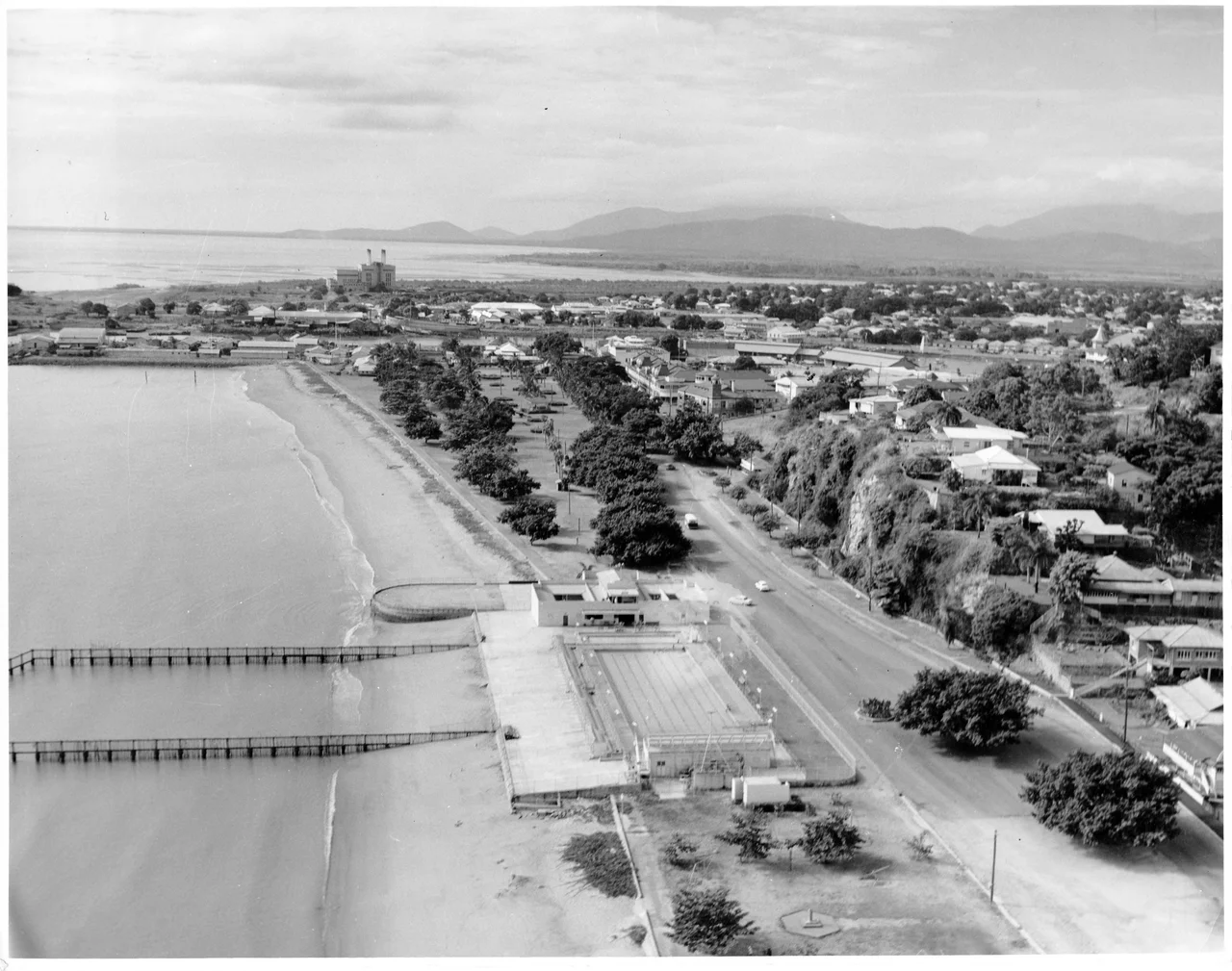

Tobruk Memorial Baths
The doors are etched with fish and seahorses, the facade is a confident wash of blue and white art deco, and behind it lies a 50-metre pool open to the tropical sky. The Tobruk Memorial Baths have stood on Townsville's Strand for three-quarters of a century, and on most days they are exactly what they look like: a much-loved place to swim. But the name carries weight. These baths are a war memorial - one of the most substantial in Australia dedicated to the men who held a besieged desert town against the odds.
Named for the Rats
Construction began in 1941 as a simple civic project to replace Townsville's ageing city baths. That same year, on the far side of the world, Australia's 9th Division and their allies were dug into the Libyan port of Tobruk, holding it under siege against Rommel's advancing forces from April to December 1941. German propaganda sneered that the defenders were trapped like rats; the men embraced the insult and called themselves the Rats of Tobruk with fierce pride. In December 1941, the Townsville council decided their new pool would honour those soldiers. When it was complete, it became the only public memorial in the country dedicated specifically to the Tobruk campaign. Inside the entrance, the local branch of the Rats of Tobruk Association set a marble plaque - a quiet anchor of memory in a place built for joy.
The Pool That Opened Twice
The baths welcomed their first swimmers on 14 October 1950, the water finally filling a pool nine years in the making. The formal dedication as a memorial came later, on 26 November 1951, performed by Major-General W. J. Windeyer, who had himself been a senior officer at Tobruk. The complex was built to last and to please the eye: a rendered masonry pavilion with a two-storey central entrance, the Olympic pool behind, a toddlers' pool between, and a setting of clipped lawns, royal palms, and frangipani. It was civic design at its most generous - a town spending care and money on something its families would use every summer for generations.
Six World Records in One Night
Then there is the swimming. Townsville's warm winter climate made these baths the ideal training ground for Australian teams preparing for the Melbourne 1956 and Rome 1960 Olympics - the most dominant era this swimming nation has ever known. The legends trained here: Dawn Fraser, Murray Rose, Lorraine Crapp, and the Konrads siblings, John and Ilsa. On one extraordinary night in 1956, swimmers at the Tobruk baths broke six world records and 13 Australian records, and the footage of it was broadcast on the very first night of television in Melbourne. The pool's manager in those years, Allan "Stumpy" Lawrence, raised a son, Laurie Lawrence, who became one of Australia's most famous swimming coaches. The teams that trained here went on to make the 1956 and 1960 squads the most successful Australian swimming teams the world had yet seen. Gold-medal history was rehearsed in this tropical water before the world ever saw it.
Still Open, Still Loved
The baths earned their place on the Queensland Heritage Register in 1995, recognised for their history, their architecture, and their deep association with Australia's golden age of swimming. Since the late 1980s the complex has been run by private operators rather than directly by the council, but its purpose has never changed. Children still take their first lessons in the heated pool. Swimmers still do laps under an open sky where world records once fell. A war memorial usually asks you to stop and stand still; this one asks you to dive in. In honouring the Rats of Tobruk through a place of everyday life, Townsville found a way to keep their memory not solemn and distant, but warm and alive.
From the Air
The Tobruk Memorial Baths sit on The Strand in North Ward, Townsville, at approximately 19.253 degrees S, 146.820 degrees E, facing Cleveland Bay. From the air the blue-and-white pavilion and rectangular open-air pool are set just back from the beachfront promenade, with Anzac Memorial Park adjacent and Magnetic Island 8 km offshore to the north. Townsville Airport (ICAO YBTL) is about 5 km west, sharing the field with RAAF Base Townsville. Cairns (YBCS) lies roughly 250 km north. Dry-season skies from May to October give the clearest views; the summer wet season brings monsoonal cloud and cyclone risk.
Nearby Stories
- Ayr 13 km away
- SS Yongala 34 km away
- Great Palm Island 35 km away
- Bindal People 50 km away
- Cardwell UFO Festival 83 km away
- Hinchinbrook Island 113 km away
- Porcupine Gorge 215 km away
- Samarai 998 km away