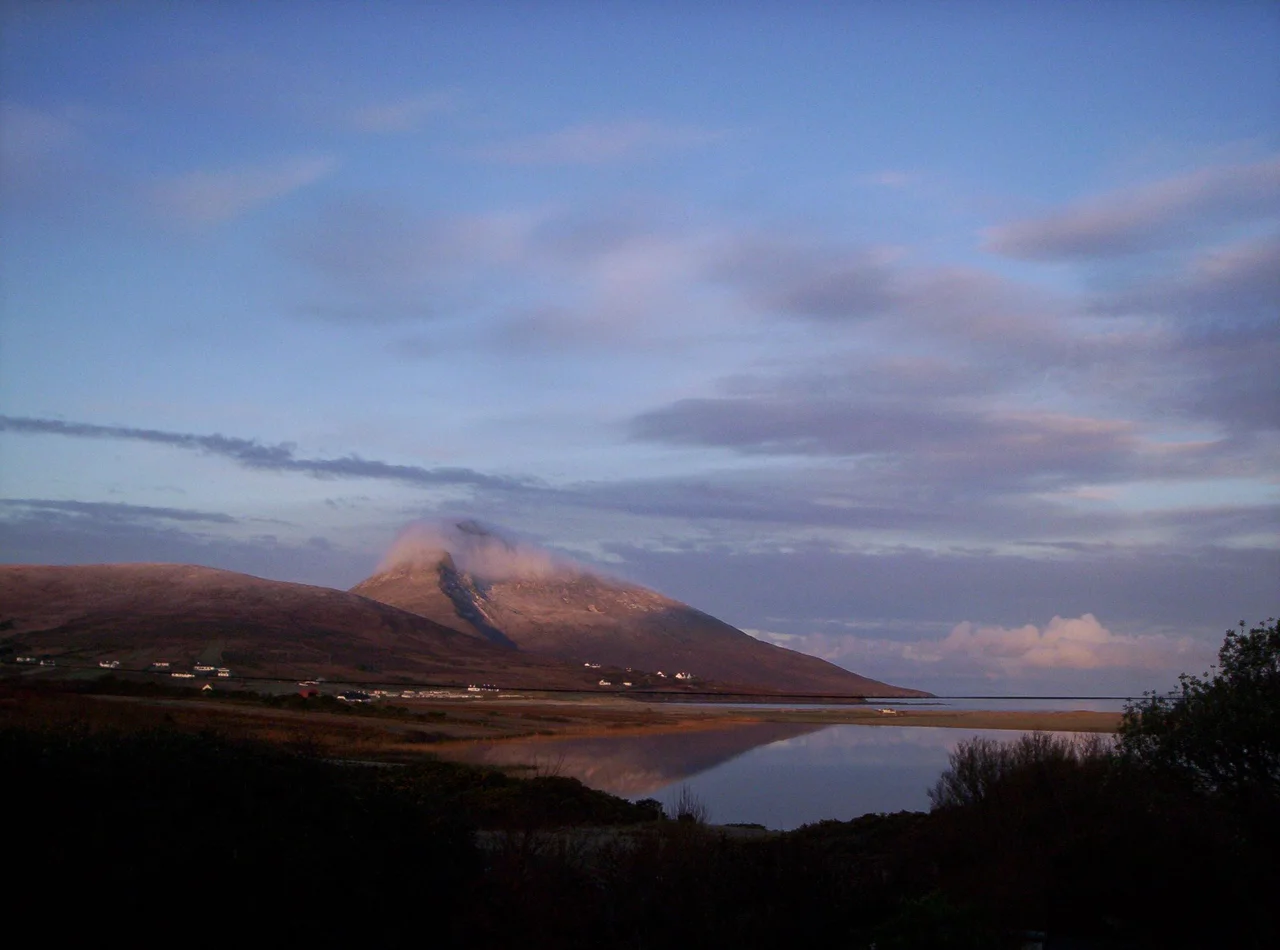

Tóin an tSeanbhaile
The name means 'the end of the old village,' and the name is the clue. Tóin an tSeanbhaile is one of the oldest settlements on Achill Island, a flat plain in the northeast corner where the bedrock surfaces in glints of schist and gneiss and the lakes carry names older than English. Loch Geall, the bright lake. Loch Dubh, the black lake. Sruhill Lough, the tidal lake. Around them lies bog, and around the bog lies the sea. The 1911 census counted 253 people. Today there are roughly 113. The old village keeps ending.
Layers Older Than Memory
Walk the southern townland and you walk through millennia. A cairn stands south of the modern village near Bun an Churraigh. On Caraun Point, where the first settlement is thought to have stood, there are the remains of a midden, a ringfort, and an enclosure. A crannóg, the small artificial island that Irish builders favored for both defense and dignity, sits near the centre of the present village. Caraun Point also holds a cillín, a burial ground for unbaptised children, and from this the place takes its Irish name Rinn na Leanbh, the children's point. The land here has been used and reused so long that no surface is innocent of what came before.
The Attack at Valley House
In the early 1870s, Frederick Lambart, 8th Earl of Cavan, bought 1,900 acres around the village. He built a hunting lodge. In 1888 his widow sold the estate to Agnes MacDonnell. Six years later, in October 1894, Mrs MacDonnell's employee James Lynchehaun set fire to Valley House and savagely attacked her, leaving her for dead. She survived, disfigured. She lived another twenty-nine years and wore a veil in public until her death in 1923. Lynchehaun was arrested, escaped, was rearrested, escaped again, and the story raced through newspapers from Dublin to New York. J.M. Synge built it into The Playboy of the Western World. James Joyce slipped it into Ulysses. In 1998, a film called Love and Rage starred Daniel Craig as Lynchehaun and Greta Scacchi as MacDonnell. The house itself, rebuilt by MacDonnell and completed in 1902, still stands. It is now a bar and hostel.
Where the Liverworts Live
Tóin an tSeanbhaile is the only place in Ireland where the liverwort Leiocolea gillmannii has ever been recorded. The machair near Loch Dubh, a rare Atlantic grassland that forms only where wind, sand, and grazing strike a particular balance, is protected as a Special Area of Conservation under the European Habitats Directive. It also harbors the scarce mosses Catoscopium nigritum and Fossombronia incurva. Most visitors will never knowingly see any of them. They are small, easy to step over, easy to call grass. But botanists know what is here, and so does the Irish state, which in 2007 designated much of the southern townland a Natural Heritage Area for its hyperoceanic blanket bog, the kind of soggy, acid landscape that only exists where the Atlantic insists on it.
Birds, Mammals, and the Open Sea
Off Ridge Point, basking sharks pass through. Whales and porpoises are commonly sighted. The shoreline below is a directory of seabirds: cormorants and shags drying their wings on the rocks, oystercatchers stabbing at the wrack, common, Arctic, and Sandwich terns wheeling in summer. Whooper swans winter on the inland lakes. The rare corncrake, whose grating call once defined Irish summer evenings, still nests inland from time to time. There is one bus stop and one postbox in the village. The Bus Éireann 440 calls once a day. The football pitch is named for Fr O'Brien, the longtime parish priest. There is a Catholic church, a pier, and a blue flag beach. There is the bar and hostel where the Valley House once burned. There is, in short, enough.
From the Air
Tóin an tSeanbhaile sits at 54.01°N, 9.97°W on the northeast point of Achill Island, the largest island off Ireland's coast. The Valley House is the most identifiable landmark from the air, with Slievemore (672 m) rising prominently to the west and the Atlantic open to the north. Belmullet Aerodrome (EIBT) lies about 30 km north across Blacksod Bay; Ireland West Airport (EIKN) is roughly 75 km east. Coastal conditions can shift quickly off the Atlantic; haze often softens the long views toward the Mullet Peninsula.
Nearby Stories
- Aughagower 3.4 km away
- Caher Island 8 km away
- Enaghbeg 10 km away
- Action of 7 May 1794 21 km away
- Lissadell House 59 km away
- RMS Carinthia (1925) 64 km away
- Glencolmcille 95 km away
- Inishtooskert 214 km away