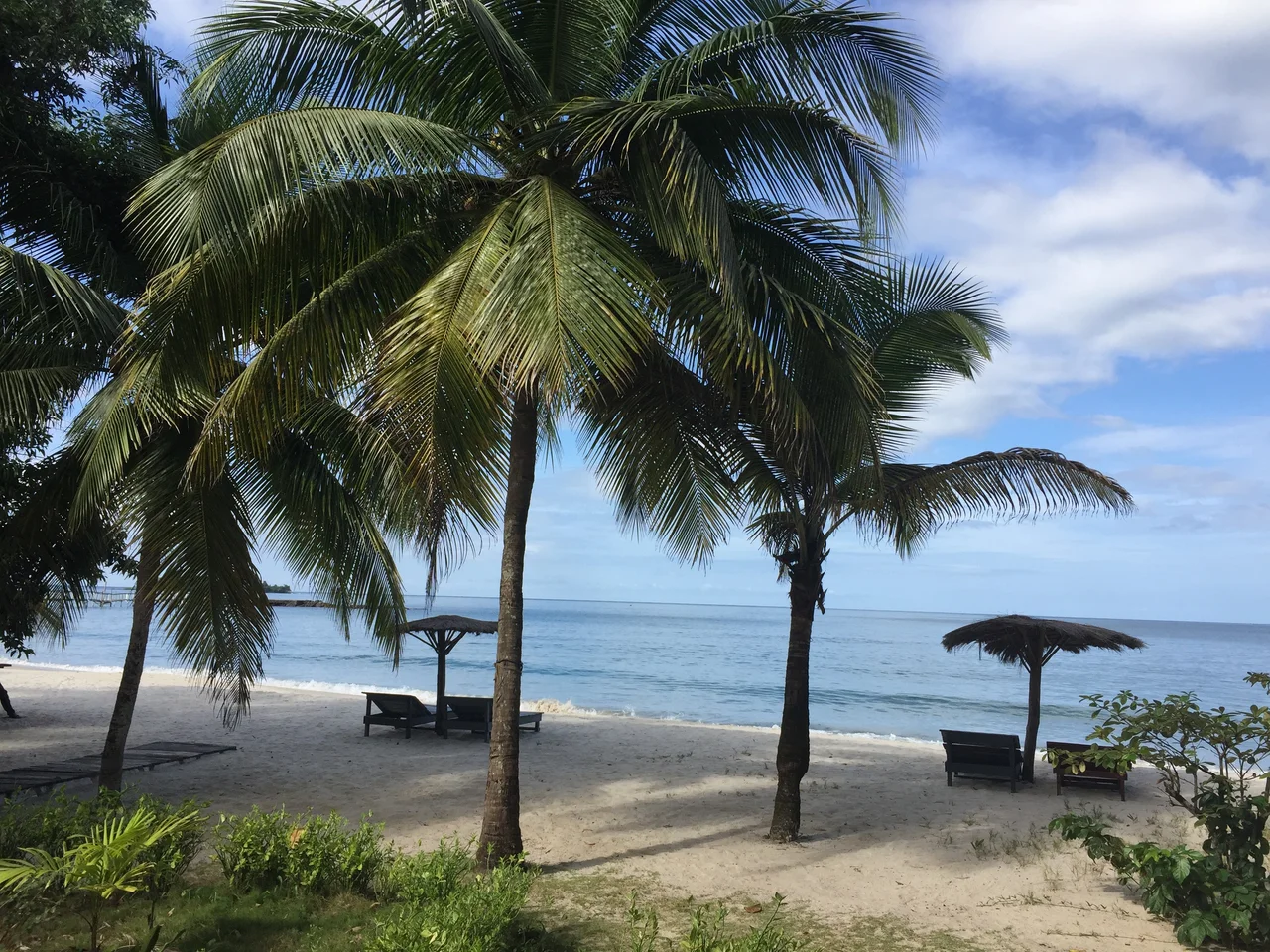

Tokeh, Sierra Leone
The sand at Tokeh is the kind of white that hurts to look at in the noon sun, curving for miles along the Atlantic where the Lion Mountains tumble down to the sea. It began as a fishing village - founded, the story goes, by a Sherbro fisherman named Pa Baw who settled along the river in the colonial era. For most of its life it was a place of nets and canoes and maybe eighty people. Then the wider world discovered the beach, and Tokeh's fortunes started rising and falling like the tide it sits beside.
One of West Africa's Great Beaches
Tokeh Beach is regularly counted among the largest and most beautiful in West Africa, and standing on it, the claim feels modest. Forested mountains rise directly behind the sand; a short boat ride offshore lies uninhabited Tokeh Island, green and empty in the swell. The water is warm, the shoreline broad, and the light has the clarity that draws photographers and filmmakers to this stretch of the Freetown Peninsula. About twenty miles east of the capital and near the town of York, Tokeh still lives partly by fishing - canoes drawn up on the same sand the resorts advertise - but tourism now drives much of its economy and its growth.
The Resort That Rose and Fell
Tokeh's modern story is bound up with one family. In 1968, a prominent Sierra Leonean barrister named Shakib Basma acquired beach land here and, partnering with a French company, built the Africana Tokey Village. It grew to 400 rooms and employed up to 600 people; through the 1980s it was the glamorous heart of the country's coast. Then came collapse. As the Sierra Leone Civil War tore through the 1990s, the resort was shut, tourists were turned away, and the abandoned hotel was slowly looted and stripped - not destroyed by rebels, the accounts note, but hollowed out by years of war and neglect. A place that had welcomed the world went dark.
Built Back Again
In 2003, with the war ending, Issa Shakib Basma - the founder's son - returned to revive what his father had begun. The rebuilding came in stages: Tokeh Sands opened in 2011 with 18 rooms, a restaurant, and a bar; the 16-suite Tokeh Palms followed in 2013. The Basma family's investment reached far beyond the resort gates. The village's church, mosque, community center, and primary school all stand on land the family donated, and Tokeh has swelled from roughly 80 inhabitants in the 1960s to several thousand today. Tourism and philanthropy here have grown together, knitting the resort into the community rather than fencing it off from it.
Five Stars on the Sand
Tokeh drew international attention again in 2013, when the Australian businessman Chris Brown opened a five-star resort called The Place, inaugurated by Sierra Leone's then-president Ernest Bai Koroma and often described as the country's first true luxury beach hotel. Its impact, again, reached past the guests: the development built a dam supplying water to both the resort and the village, funded a community school, and channeled jobs and training to local youth and women. It is a familiar pattern on this coast, where a single beautiful beach can lift or sink a whole town. Tokeh has been the abandoned ruin and the gleaming resort, the fishing village and the postcard - and through all of it, the white sand and the green mountains have stayed exactly where they were.
From the Air
Tokeh lies on the western shore of the Freetown Peninsula at roughly 8.333°N, 13.067°W, about twenty miles (32 km) east-southeast of Freetown near the town of York. From the air, look for a long crescent of bright white sand backed by forested mountains, with small, uninhabited Tokeh Island just offshore. Lungi International Airport (GFLL) lies across the estuary to the north. Coastal visibility is generally good in the November-April dry season; expect haze, rain showers, and lower ceilings during the May-November wet season.
Nearby Stories
- Mabilafu 48 km away
- Turtle Islands 55 km away
- Sierra Leone 63 km away
- Bonthe 64 km away
- Îles de Los 95 km away
- Sandervalia National Museum 115 km away
- Loos Islands 126 km away
- Rocas Atoll 2595 km away