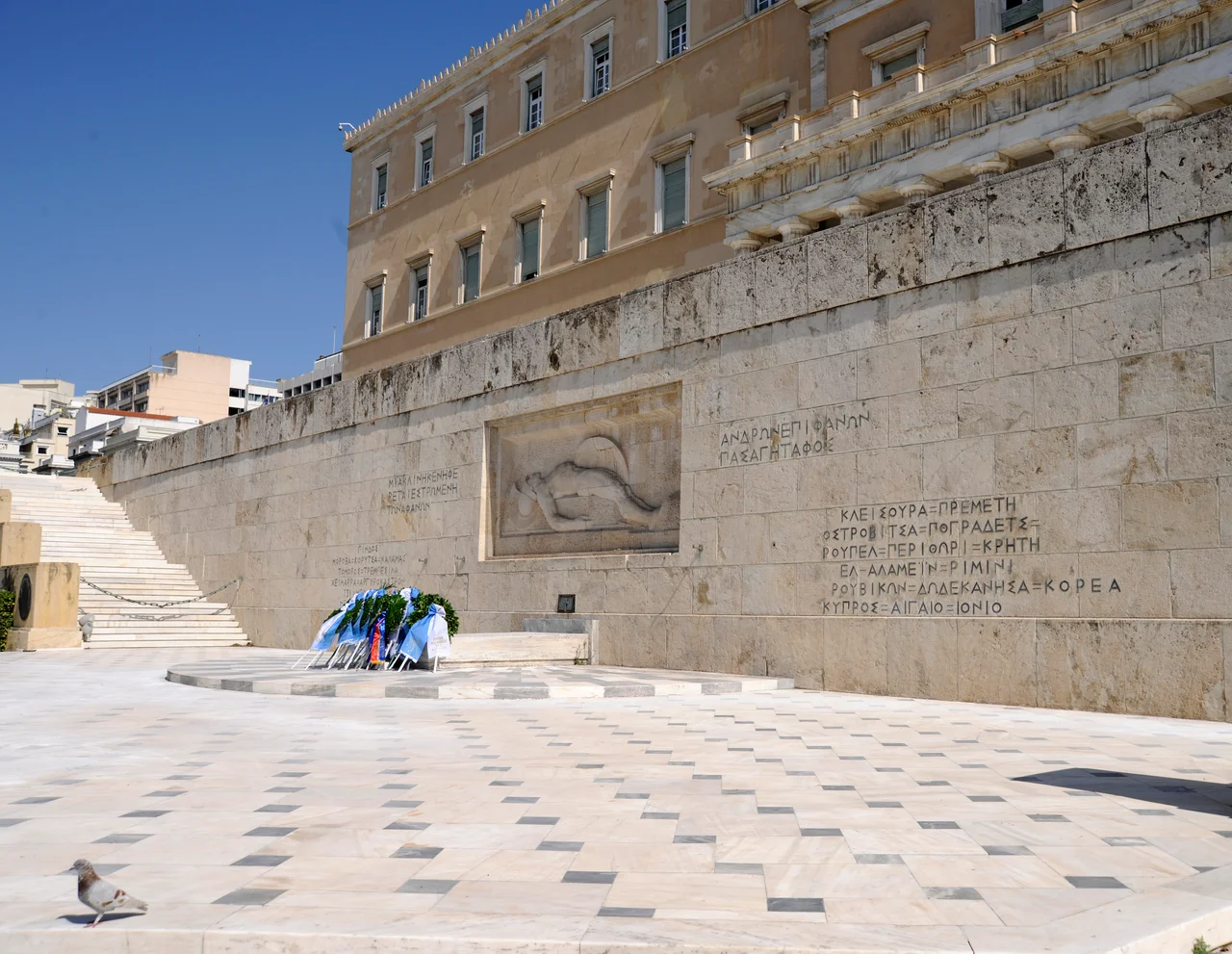

Tomb of the Unknown Soldier (Athens)
A stone warrior lies on his back below the old royal palace, helmet on his head, shield resting in his left hand. He is naked, unguarded, and entirely still, yet the sculptor carved him so that he seems poised to rise. This is the Tomb of the Unknown Soldier, the place where Greece grieves the men it could not name. Before it, in pleated kilts and shoes tipped with heavy pom-poms, the Evzones of the Presidential Guard keep their silent, deliberate watch.
A Grave Without a Name
A cenotaph is an empty tomb, a grave for the body that was never recovered or never identified. This one stands in Syntagma Square, in front of the Old Royal Palace that now houses the Hellenic Parliament. It honours the Greek soldiers killed in war whose names no record preserves. The idea came in the aftermath of the First World War and the Balkan Wars, when nations across Europe reckoned with the sheer anonymity of mass death. Greece chose to lay its unknown son not in a remote field but at the very centre of the capital, in the busiest square of Athens, where the living could not pass without remembering.
From Idea to Monument
The path to the tomb was not smooth. The decision to build it was taken by General Theodoros Pangalos, who wanted the monument set against the Old Palace so the building could house his Army Ministry. The architect Emmanuel Lazaridis won the design study in 1926. But in 1929 the statesman Eleftherios Venizelos intervened, insisting the memorial belong to the city centre itself, much as the Arc de Triomphe anchors Paris. An early proposal showed an angel cradling the fallen man; it was abandoned for lack of funds. In 1930 the sculptor Fokion Rok was given the work, and the committee settled on something quieter: a single soldier at rest, chosen for its calm and its simplicity.
The Unveiling
On 25 March 1932, Greek Independence Day, Prime Minister Andreas Michalakopoulos unveiled the monument before delegations gathered from many nations. A torch carried from the monastery of Agia Lavra, where the 1821 revolution had been blessed, lit the eternal flame at the heart of the cenotaph. The monument is built in the French classical tradition, touched with Art Deco lines and references to ancient Greece. Flanking the carved soldier are words from Thucydides: to one side, "There is one empty bier, made up, for the missing"; to the other, "The whole earth is the sepulchre of famous men." Twenty-four centuries separate the historian from the monument, yet the grief is the same.
The Weight of the Names
Carved into the limestone walls are the names of the places where Greeks fell, and to read them is to walk through a century of loss. Down the left steps run the battlefields of the Balkan Wars and the First World War: Sarantaporo, Bizani, Skra, Doiran. Down the right, the campaigns in Asia Minor and the Russian Civil War: Sangarios, Afyonkarahisar, Proussa. Beside the figure of the dead soldier are the names from the Second World War and after: Pindus, Hill 731, Crete, El Alamein, and later still Korea and Cyprus. Each name stands for soldiers who did not return, many of whom were never identified. Day and night the Evzones march their slow ceremonial steps before them, a living guard for the unknown dead.
From the Air
The Tomb of the Unknown Soldier stands at 37.9753 N, 23.7364 E in Syntagma Square, central Athens, directly before the Hellenic Parliament (the former Old Royal Palace). The square sits east of the Acropolis and west of the National Garden, a useful green reference point from the air. Athens International Airport (LGAV) lies about 18 nm east-southeast. Dense urban surroundings; the monument itself is best appreciated on the ground during the changing of the guard.
Nearby Stories
- Great Sand Beach 5 km away
- Battle of Delium 7.7 km away
- Tower of Aliartos 9 km away
- HMHS Britannic 10 km away
- Saronic Gulf 15 km away
- Sousaki Volcano 17 km away
- Sanctuary of Apollo Maleatas 24 km away
- Skyros 66 km away