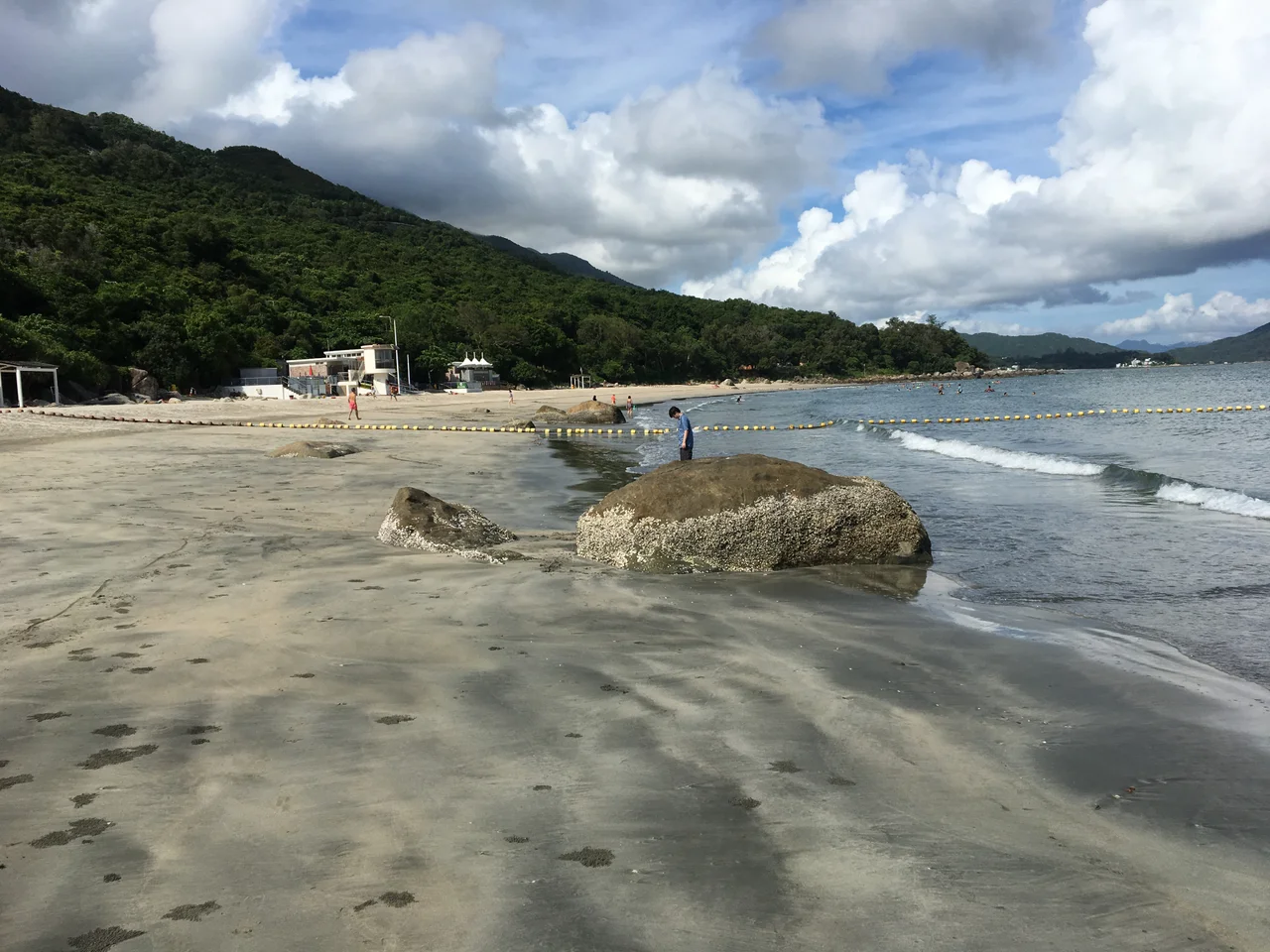

Tong Fuk Beach
CNN put Tong Fuk Beach on a list of eight hidden beaches in Hong Kong in 2018, describing it as offering 'the best of both worlds' — near enough to popular beach bars to be sociable, remote enough to find seclusion. The description holds. Tong Fuk sits on South Lantau Road, on the island's southern shore, where the coastline looks out toward Cha Kwo Chau and Shek Kwu Chau and the open water beyond. At 150 metres long, it is not large. What it has is firm gray sand, water the Environmental Protection Department has rated consistently as good to fair in water quality over the past twenty years, and sunsets that the same CNN feature called spectacular. On a crowded island that contains both Hong Kong International Airport and some of the territory's most popular hiking trails, Tong Fuk Beach quietly exists as neither.
South Lantau's Different Character
Most visitors to Lantau Island arrive at the north — at the airport, at Tung Chung, at the Ngong Ping cable car terminus — and leave the same way. The south shore of Lantau is a different place. The road that runs along it, South Lantau Road, is narrow and winding, and the communities it connects — Mui Wo, Cheung Sha, Tong Fuk, Pui O — are quieter, more village-like, less visited than the north. Tong Fuk village gives the beach its name. The Leisure and Cultural Services Department of the Hong Kong Government manages the beach as one of the territory's gazetted beaches — meaning it has official status, lifeguards in season, and basic facilities including changing rooms, showers, and toilets. Gazetted status brings oversight; it also brings the water quality testing that makes Tong Fuk's consistently acceptable ratings a documented fact rather than a hope.
Views Across the Water
Stand at the water's edge at Tong Fuk and look south. Cha Kwo Chau, an island that lies between Lantau and Lamma, sits on the eastern horizon. To the west, Shek Kwu Chau — a larger island, home for many years to a drug rehabilitation center — is visible across the channel. The Pearl River estuary lies beyond, though on hazy days the distinction between sea and sky dissolves before the mainland shore comes into view. In clear weather, the framing is generous: green hills behind, open water ahead, and the kind of uninterrupted horizon that is genuinely rare in a territory as dense as Hong Kong. Sunset here comes from the west over Lantau's own ridgeline, which produces the 'spectacular' effect the CNN article described — the last light striking the water and the islands in the channel.
The Porpoises of Tong Fuk
The beach made the news twice in quick succession for reasons that had nothing to do with sunbathing. On 21 December 2018, Ocean Park personnel found the carcass of a subadult female finless porpoise stranded at Tong Fuk, temporarily closing the beach while the Ocean Park Conservation Foundation transported the animal back for autopsy. Then, on 15 January 2019, a second finless porpoise was found — an adult female, in third-degree moderate decay, with visible wounds on her tail. The beach was temporarily closed again. The incidents were reminders that Tong Fuk Beach exists at the edge of waters that finless porpoises — a species under conservation pressure in Hong Kong — use as habitat. The Pearl River estuary and the waters around Lantau are among the most important zones for Hong Kong's population of Indo-Pacific finless porpoises. Their presence, in death as in life, on a beach used by swimmers is not incidental.
Hidden in Plain Sight
What makes a beach 'hidden' in Hong Kong is largely a matter of effort. Repulse Bay, Clear Water Bay, and the beaches of Sai Kung draw crowds because they are easy to reach from the urban core. Tong Fuk requires a deliberate choice — taking the ferry to Mui Wo or Peng Chau, then navigating South Lantau Road by bus or bicycle. That friction is the filter. The people who arrive at Tong Fuk have, by definition, wanted to come to Tong Fuk. The beach does not intercept passing traffic. It does not benefit from being adjacent to a shopping mall or a hotel. It simply sits there, 150 metres of gray sand between the South Lantau hills and the Pearl River estuary, doing what beaches do. The gazetted facilities make it comfortable; the distance makes it quiet. Both are, in their different ways, forms of value.
From the Air
Tong Fuk Beach sits at approximately 22.2281°N, 113.9354°E on the southern shore of Lantau Island, facing south toward the Pearl River estuary. From the air, South Lantau's coastline is a distinctive curve of green hills meeting water, with the beach visible as a small pale strip at the base of the hillside along South Lantau Road. Hong Kong International Airport (VHHH) is approximately 18 km to the north-northeast on the island's northern shore. At altitudes of 2,000–3,000 feet, the contrast between Lantau's forested ridgeline and the open water to the south is clear; Shek Kwu Chau and Cha Kwo Chau are visible as islands in the channel below. Approach from the south over the estuary provides the clearest view of the beach and its setting relative to the surrounding hills and water. Visibility can be reduced by Pearl River haze in summer and autumn.
Nearby Stories
- Lok Ma Chau Loop 2.3 km away
- Portas do Cerco 2.3 km away
- Kweilin Incident 17 km away
- Wanshan Archipelago Campaign 34 km away
- Nanxiong Formation 115 km away
- Battle of Nanpeng Island 148 km away
- Heyuan 169 km away
- Cape Maobitou 632 km away