_(32891627184).jpg)
Tower of the Winds
Long before the smartphone weather app, before the barometer, before anyone thought to measure the sky with instruments, a Greek astronomer raised an octagonal tower of white marble in the heart of Athens and asked it to do something audacious: tell you the time, predict the weather, and point out which wind was blowing - all at once. The Tower of the Winds still stands in the Roman Agora, virtually intact after more than two thousand years. Almost nothing else from classical antiquity has survived so whole. Each of its eight faces is carved with a winged god, each god a wind, each wind a warning or a blessing for the city below.
The First Weather Station
The man behind it was Andronicus of Cyrrhus, an astronomer about whom we know almost nothing - not even whether his home city was the small Cyrrhus in Macedonia or the larger one on the Euphrates. What he left behind speaks for him. Raised on three steps, the tower stands about 12 meters tall and 8 meters across, and it integrated three technologies that rarely met in one place. A bronze Triton on the roof turned with the wind, a rod in its hand acting as a weather vane. Eight sundials, one on each face, tracked the sun across the sky. And inside, a water clock - a clepsydra - measured the hours even when clouds hid the sun, fed by water flowing down from the Acropolis. "Citizens were thus able," one description records, "to orient themselves in space and time." Architecture, sculpture, and the new science fused into a single object.
Eight Gods of the Wind
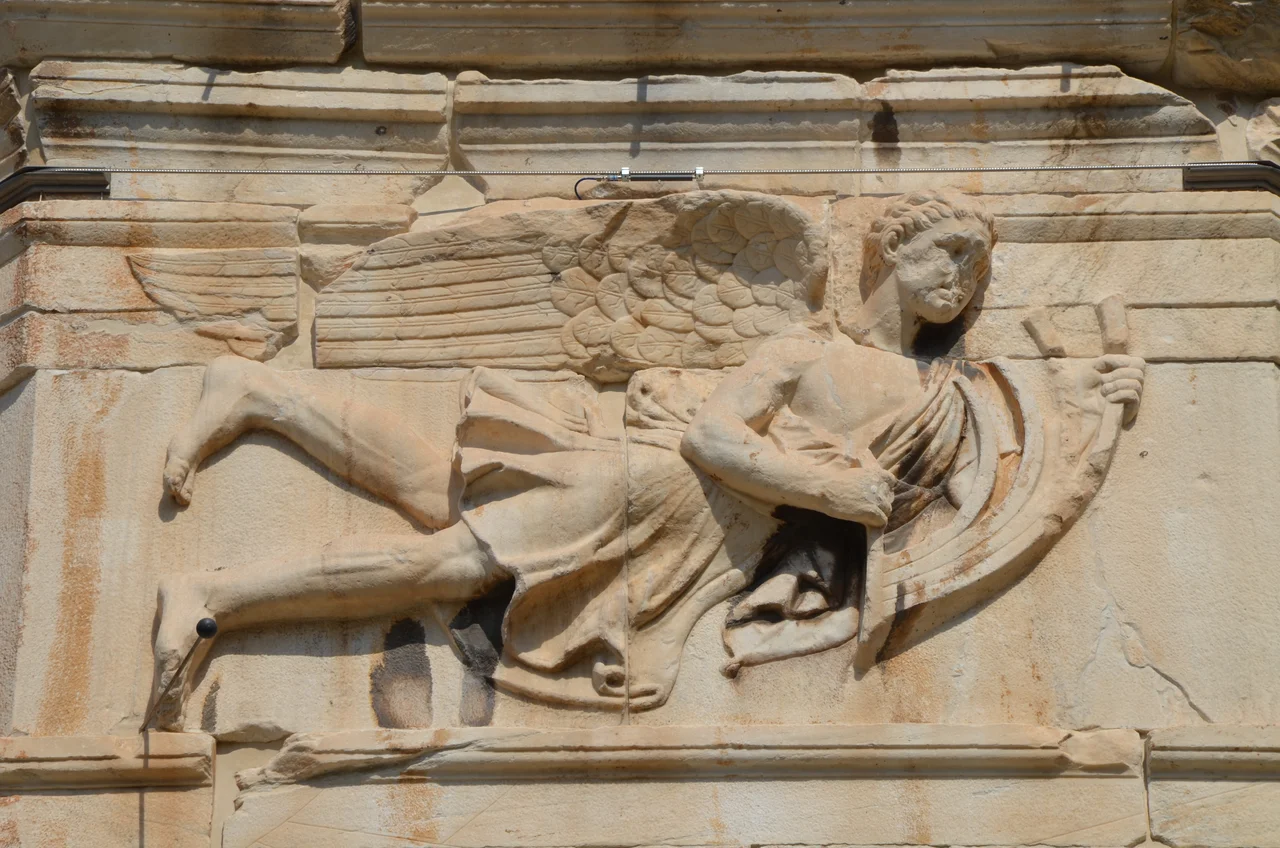
Walk around the tower and you meet the Anemoi, the wind deities, carved larger than life across the upper frieze. These are the largest representations of the winds to survive from antiquity. Boreas faces north, bundled against the cold, blowing through a twisted conch shell. Notus, the south wind that brought hot summer rain, wears light clothing and tips an upturned amphora. Zephyrus scatters flowers from the west. Each god is dressed and posed for the weather he carries, his name once carved clearly above - though today a modern restraining cable runs through the inscriptions, and centuries of Athenian weather have worn them faint. They were originally painted, with details added in bronze, a riot of color now bleached to bare stone.
Reading the Stone
The genius is in the details that still work. The bronze gnomons - the rods that cast the shadows on the sundials - vanished long ago, but the holes that held them remained, and modern replacements have been fitted. Each sundial is individually customized for how long its face sees the sun: the east and west faces carry only four hour-lines each, while the south-facing dial has eight. The Greeks divided daylight into twelve equal hours regardless of the season, so a winter hour was shorter than a summer one, and the engraved lines accommodate the difference. The roof above is essentially original - 24 trapezoidal slabs locked by a central keystone, a survival so rare in ancient buildings as to be almost miraculous. Traces of blue paint inside hint that the ceiling may once have depicted the sky itself.
Two Thousand Years of Tenants
The tower endured because it was always useful to someone. In late antiquity, a cross carved on an inner wall and faint painted traces suggest it served as a Christian baptistry or shrine. By Ottoman times it had filled with earth nearly to its waist; Turkish inscriptions still mark the walls inside. Between roughly 1749 and 1751 it became a tekke - a lodge for Mevlevi dervishes, who cut a prayer niche into the wall and danced their rituals here for some seventy years, until the Greek revolt of 1821. When the British surveyors James Stuart and Nicholas Revett measured the tower in the 1750s, the dervishes let them temporarily lift the wooden floor to glimpse the ancient stone beneath. Their precise engravings, published in London in 1762, made the tower famous across Europe and inspired imitations from Oxford to Glasgow. The Athens Ephorate of Antiquities cleaned and conserved the structure between 2014 and 2016.
From the Air
The Tower of the Winds sits in the Roman Agora at 37.9742 N, 23.7270 E, in the heart of old Athens just north of the Acropolis. From the air the octagonal marble tower is best picked out at low altitude alongside the Acropolis hill, which rises immediately to the southwest. Athens International Airport (LGAV) lies about 30 km east. Clear Aegean light and minimal cloud make spring and autumn the sharpest viewing seasons; midday sun flattens the relief, while low morning or evening light throws the carved wind gods into the deepest shadow.
Nearby Stories
- Great Sand Beach 5 km away
- Battle of Delium 7.7 km away
- Tower of Aliartos 9 km away
- HMHS Britannic 10 km away
- Saronic Gulf 15 km away
- Sousaki Volcano 17 km away
- Sanctuary of Apollo Maleatas 24 km away
- Skyros 66 km away