
Tree of Knowledge
Someone killed it with weedkiller. In 2006 a heritage-listed ghost gum that had stood for some two centuries outside the Barcaldine railway station was poisoned with glyphosate, the active ingredient in common herbicide, and slowly died. No one was ever charged. The motive was never established. It remains one of the strangest acts of vandalism in Australian history, because this was not just any tree. Under its canopy the striking shearers of 1891 had gathered, and the tree had become a living symbol of the birth of the Australian labour movement, an icon of the Labor Party known across the country simply as the Tree of Knowledge.
The Tree They Met Beneath
It was a Corymbia aparrerinja, a ghost gum, with the pale smooth bark that gives the species its name, growing in the main street where the railway line ended. During the Great Shearers' Strike of 1891 the bush workers who had made Barcaldine their headquarters met in its shade, and in 1892 the manifesto of the Queensland Labour Party was read out here, a document now counted among the foundation texts of the Australian Labor Party. So central was that text to the nation's story that the State Library of Queensland holds the original, and UNESCO later entered it on the Memory of the World register. For more than a century the people of Barcaldine cared for the tree as the emblem of their town's outsized place in history.
A Slow Decline
Even before the poisoning, the old gum was struggling. In 1990 it was found to be riddled with termites and other insects and in serious decline. A tree surgeon was called in, pest control applied, and the root system flushed with thousands of litres of water; by late 1993 the treatment seemed to have bought the tree a new lease of life. The town took cuttings, hedging against the day the original might fail. That foresight mattered. When the glyphosate did its work in 2006, living clones already existed, and in 2008 government scientists succeeded in propagating the tree again, so that its genetic line survives in Barcaldine and in a clone planted at Brisbane's Ecosciences Precinct.
What They Built Around the Stump
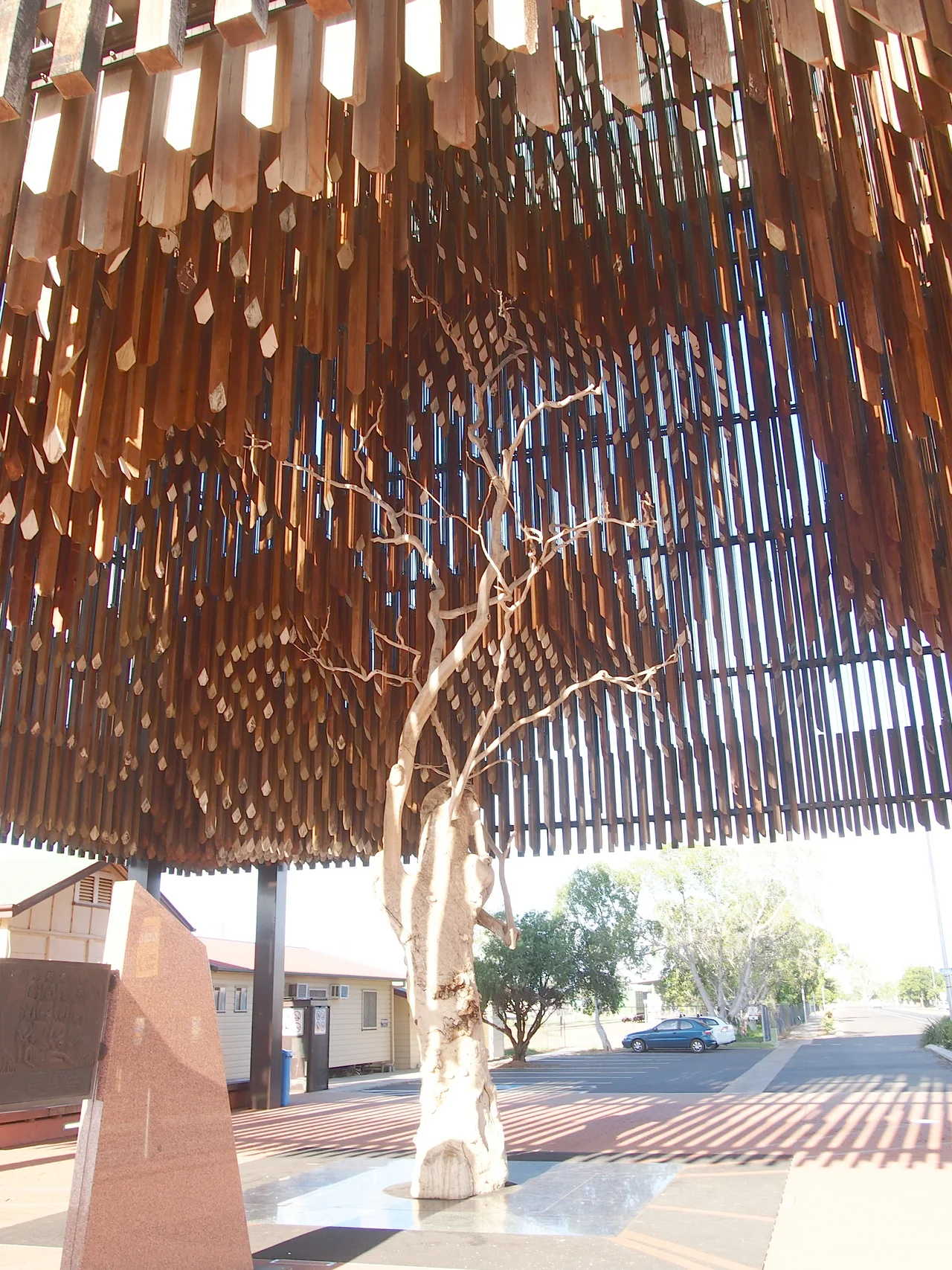
Rather than clear the dead tree away, Barcaldine chose to enshrine it. The remaining trunk and root ball were preserved in place, and in 2009 a striking memorial rose over them at a cost of around five million dollars. Designed by Brian Hooper Architect with m3architecture, it is an eighteen-metre tower built from some 3,600 individual timber slats, charcoaled black, hung at varying heights to trace in mid-air the shape of the canopy the ghost gum once spread. From a distance it reads as a dark suspended box. Step underneath, and the slats resolve overhead into the ghost of a tree, with the original root ball visible through a glass floor panel below. Lit at night, it has become a gathering place once more. The design won the Australian Institute of Architects' Lachlan Macquarie Award for Heritage Architecture in 2010.
A Symbol That Outlived the Symbol
A plaque at the foot of the memorial reads that it commemorates "the loyalty, courage, and sacrifice in 1891 of the stalwart men and women of the west from whom, beneath this tree, emerged Australia's labour and political movement." The wording is deliberate, the women named alongside the men. In 2009 the state declared the Tree of Knowledge one of the 150 icons of Queensland. In 2011 Prime Minister Julia Gillard planted a sapling grown from one of its cuttings at the National Arboretum in Canberra. A tree was poisoned and died, but the thing it stood for proved harder to kill. Cuttings took root, a memorial was raised, a nation kept telling the story. The Tree of Knowledge outlived the tree.
From the Air
The Tree of Knowledge memorial stands on Oak Street in central Barcaldine, beside the railway station, at roughly 23.55 degrees south, 145.29 degrees east. From the air, look for the green grid of Barcaldine's wide tree-lined streets against the surrounding flat brigalow plains, with the Central Western Railway running straight through town; the memorial's dark eighteen-metre form sits right beside that line and is floodlit after dark. Nearest field is Barcaldine Airport (ICAO YBAR), a short hop west of town; Longreach Airport (YLRE) lies about 100 km west-northwest. Best at low altitude in the long visibility of the dry season.
Nearby Stories
- Aramac Tramway Museum 28 km away
- Beaconsfield Station Sheep Wash 34 km away
- Wellshot Station 44 km away
- Bexley Station 53 km away
- Yalleroi 54 km away
- Augustus Charles Gregory 97 km away
- Cullin-la-ringo Massacre 230 km away
- Brigalow Belt 265 km away