
Trefriw Woollen Mills
Thomas Williams bought the mill in 1859. His descendants still run it. That single sentence tells you most of what makes Trefriw Woollen Mills unusual in the modern world: a working textile factory on the banks of the Afon Crafnant where the same family has been turning raw fleece into double-weave blankets for over a century and a half, in a country whose woollen industry has almost entirely disappeared. The original mill went up in 1820 a little higher up the river, called then the Vale of Conwy Woollen Mill. The current main building, low-slung with three shallow-pitched roofs, dates from around 1970. Behind it, the older mill buildings still cluster around a working yard.
Powered by the Crafnant
Walk to the back of the site and you can read the history of British industrial power in stone and pipe. The original mill ran on water. A thirty-six-foot overshot wheel turned the spinning mules and the spinning jennies. A smaller seven-foot wheel powered the fulling mill, where wooden hammers pounded the cloth to thicken and strengthen it after washing. Around 1900 the wheels came down and the first hydroelectric turbine went in. Today two Pelton wheel turbines, made by Boving and installed in 1942 and 1951 in a former flour mill, deliver about sixty kilowatts. They are fed through a twenty-inch pipe from a dam built in 1952, half a mile upstream and a hundred and twenty-five feet higher. The river that turned the spinning jenny still spins the looms.
Cards, spins, dyes, weaves
Most modern textile makers buy yarn. Trefriw buys fleece. The wool arrives raw, and every stage of the process happens on site: carding to comb the fibres straight, spinning to draw them into yarn, dyeing in vats fed partly by plants from the mill's own garden, and weaving on the looms that produce the mill's signature work. The double-weave blankets are what the place is best known for, two interlocked layers in geometric Welsh patterns, heavy and reversible. Tweeds, travelling rugs, and tapestry bedspreads round out the range. In summer the mill runs demonstrations - a spinner at a hand wheel, someone hooking a rag rug - and the shop downstairs sells finished cloth straight from the looms upstairs.
The 1918 Eisteddfod
Welsh wool was once a serious industry. The mill workers competed at the National Eisteddfod of Wales in 1918 and came home with prizes for a sample of fine cream serge, a sample of white baby flannel, and two double-size blankets. The country had hundreds of similar mills in the nineteenth and early twentieth centuries, each tied to a fast Welsh river and a local market for tweed and blanket cloth. Most are gone. Some survive as ruins; a few as museum demonstrations. Trefriw is one of the few still running as a working business, taking in fleece at one end and shipping finished cloth out at the other.
Family and continuity
The Williams family has owned the mill since 1859 - through hydro-electrification, two world wars, the collapse of the British textile industry, the rise of synthetic fibres, and the steady erosion of regional manufacturing across rural Britain. Most of the machinery on the floor today was acquired in the 1950s and 1960s, kept in working order by people who learned the trade from people who learned it from people who learned it from Thomas Williams. The garden out back grows the plants the mill uses for natural soaps, dyes, and fibres - madder, woad, weld - a small botanical inventory of the dyeing trade as it existed before aniline.
Flight Context
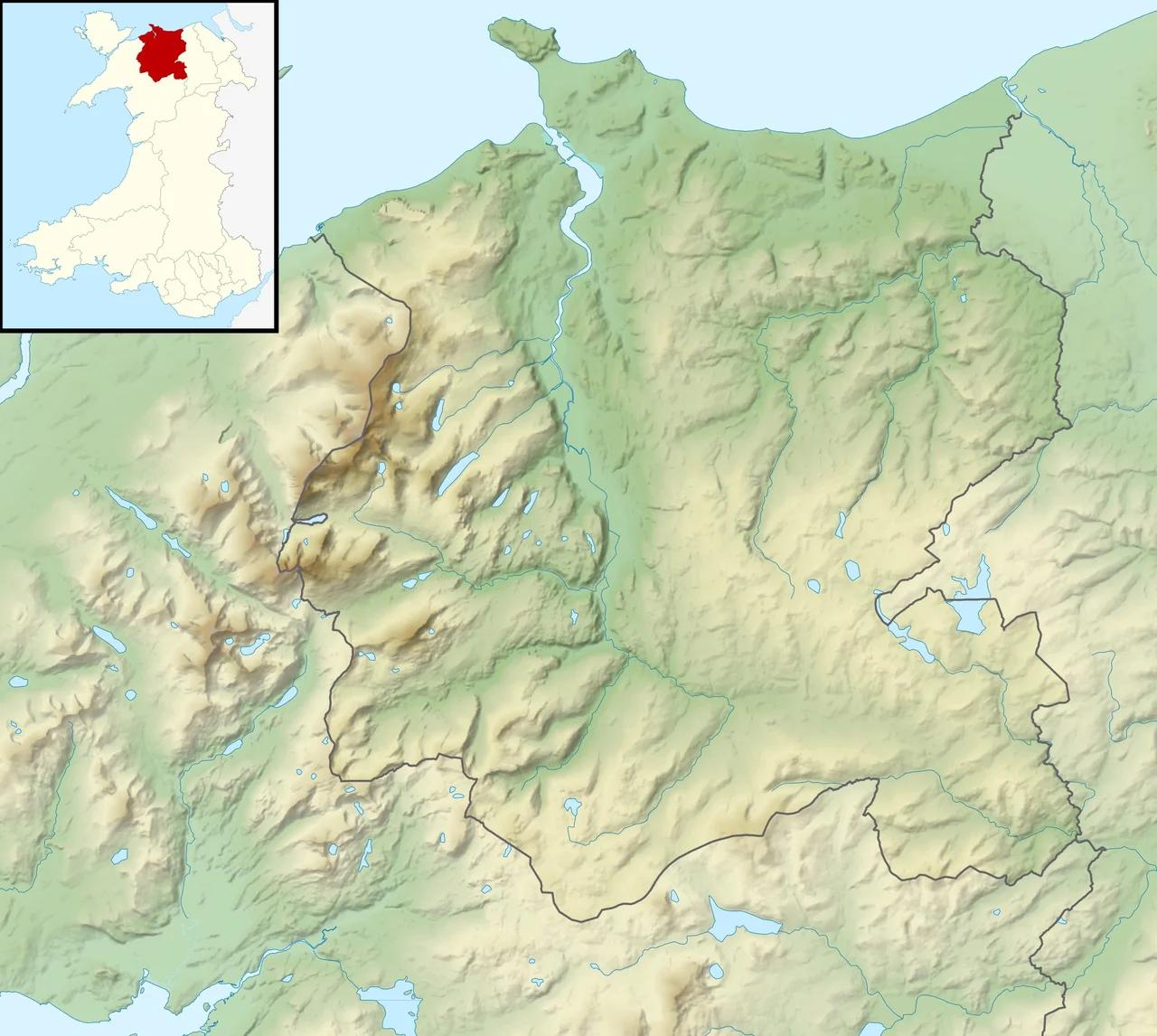
Trefriw Woollen Mills sits at 53.151 north, 3.825 west, on the western slope of the Conwy valley about four miles north of Betws-y-Coed and the same distance south of Conwy Castle. From the air, the valley is a deep glacial trench cutting south through the Carneddau, with the silver thread of the Afon Conwy at its floor and the mill clinging to the Crafnant tributary that joins from the west. Nearest airports are Caernarfon (EGCK) about fifteen miles west across the Snowdonia peaks, RAF Valley (EGOV) on Anglesey, and Hawarden (EGNR) east toward Chester.
From the Air
53.151°N, 3.825°W. Best viewed at 1,500-2,500 ft AGL down the Conwy valley from the south. Nearest airports: EGCK Caernarfon, EGOV Valley, EGNR Hawarden. Look for the village of Trefriw on the western valley wall; the mill is the long-roofed building on the Crafnant stream.
Nearby Stories
- Menai Strait 1.2 km away
- Battle of Ewloe 7 km away
- New Brighton Lifeboat Station 7.7 km away
- Butlin's Pwllheli 7.7 km away
- Battle of Oswestry 9.1 km away
- Cymer Abbey 22 km away
- Celtic Array 39 km away
- New Brighton Lighthouse 43 km away