
Trelissick
The flowers in this garden have a strange double life. From the 1930s onward, the camellias and hydrangeas that bloomed above the King Harry Ferry were carried back to Stoke-on-Trent and painted onto Spode china by the factory's flower artists. Ronald Copeland, the chairman of the Spode works, lived here. He and his wife Ida wanted living models for the pattern books, so the rhododendron beds at Trelissick effectively became a sample library for one of England's great pottery houses. The Cornish blossoms went out into the world as porcelain. Stand at the long terrace today, looking across the Carrick Roads to Falmouth, and you are standing in a garden that flowered twice: once on the bush, once in glaze.
Leidic's Farm
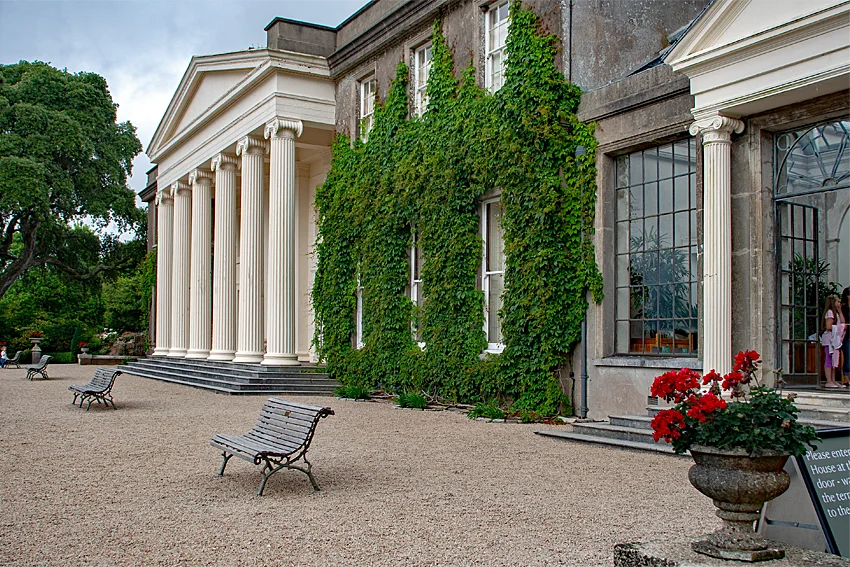
The name Trelissick was first recorded in 1275 and means "Leidic's farm," a Cornish settlement that long predates anything you see here now. The house was designed around 1750 for John Lawrence by the paternal grandfather of Humphry Davy, the chemist who would later invent the miner's safety lamp. In the 1820s the estate owner Thomas Daniell commissioned architect P.F. Robinson to remodel it. The Daniell family had built the original fortune in 18th-century Cornish copper mining, then poured the proceeds into the house above the Fal. It was extended again in the late 19th century and is now Grade II* listed. The estate sits on the B3289 just west of the King Harry Ferry, the chain-pulled ferry that has crossed the Fal since 1888, and the grounds slope toward the wide estuary of Carrick Roads. Almost a third of Cornwall is designated as Area of Outstanding Natural Beauty, and Trelissick is squarely inside it.
The Flowers That Became China
Ida Copeland gave Trelissick to the National Trust in 1955, after the death of her son Geoffrey, on the understanding the family could continue to live in the house. She left a stained glass window bearing the Copeland coat of arms in Feock parish church. The flowers she and her husband Ronald had planted are the garden's signature now. Rhododendrons and azaleas thrive in the mild Cornish air, alongside hydrangeas, camellias, flowering cherries, ginkgo trees and palms. Mr Copeland was the chairman and later managing director of Spode, his family's china factory. Flowers grown in this garden became the painted patterns on Spode ware. The Copeland family crest, a horse's head, turns slowly on a weathervane atop the stable block. Trelissick is also home to the National Plant Collections of photinias and azaras, two genera most visitors have probably never heard of, growing here in numbers no other British garden can match.
Squirrels and Sea Captains
On a Victorian Gothic water tower, paired with that horse's head, stand carved squirrels. They are not decorative whim but a memorial. The Davies-Gilbert family lived here in the second half of the 19th century, and their ancestor was Sir Humphrey Gilbert, an Elizabethan explorer who is generally credited with claiming Newfoundland for England in 1583. On his return voyage that September his ship, the small frigate Squirrel, foundered in heavy seas off the Azores and went down with all hands. Gilbert was last seen on the stern reading a book, reportedly calling across to his companion ship: "We are as near to heaven by sea as by land." The Trelissick squirrels remember him. The Cornish wrestling tournaments held here in the 1900s offered prizes, and the bridge between the two halves of the garden lets you cross over the public road without breaking the green.
Above the Estuary
Pass beneath the high oaks at the far end of the garden and the view opens. The Fal estuary swings south toward Falmouth, the King Harry Ferry crawling on its chains across the water below, dwarfed by laid-up cargo ships that often shelter in the deep channel here. More than 200,000 people walk these paths every year. They come for the views, the woodland walks, the rare shrubs, and the persistent feeling that an English estate has somehow imported a slice of warmer geography. In July 2013 Bonhams auctioneers sold the contents of the house, including the Copeland China Collection. The fabric of the rooms now serves a National Trust visitor experience, but the bones of the place, the chimneys and gables Thomas Daniell drew up in the 1820s, still rise over the Cornish copper money that bought them.
From the Air
Trelissick sits at 50.217 N, 5.033 W on the west bank of the Fal estuary, immediately above the King Harry Ferry. The chain ferry crossing makes a clear linear marker from altitude. Truro lies about 4 nautical miles to the north, Falmouth roughly 5 nm south. Carrick Roads opens wide to the south. Nearest airport is Newquay (EGHQ), about 23 nm north-northeast. Best viewed below 2,500 feet AGL.
Nearby Stories
- Morvah 2.9 km away
- Carnewas and Bedruthan Steps 6.1 km away
- Liskeard 7.5 km away
- Battle off Lizard Point 14 km away
- Polperro 17 km away
- MV Cita 47 km away
- HMS Affray 86 km away
- 1979 Fastnet Race 96 km away