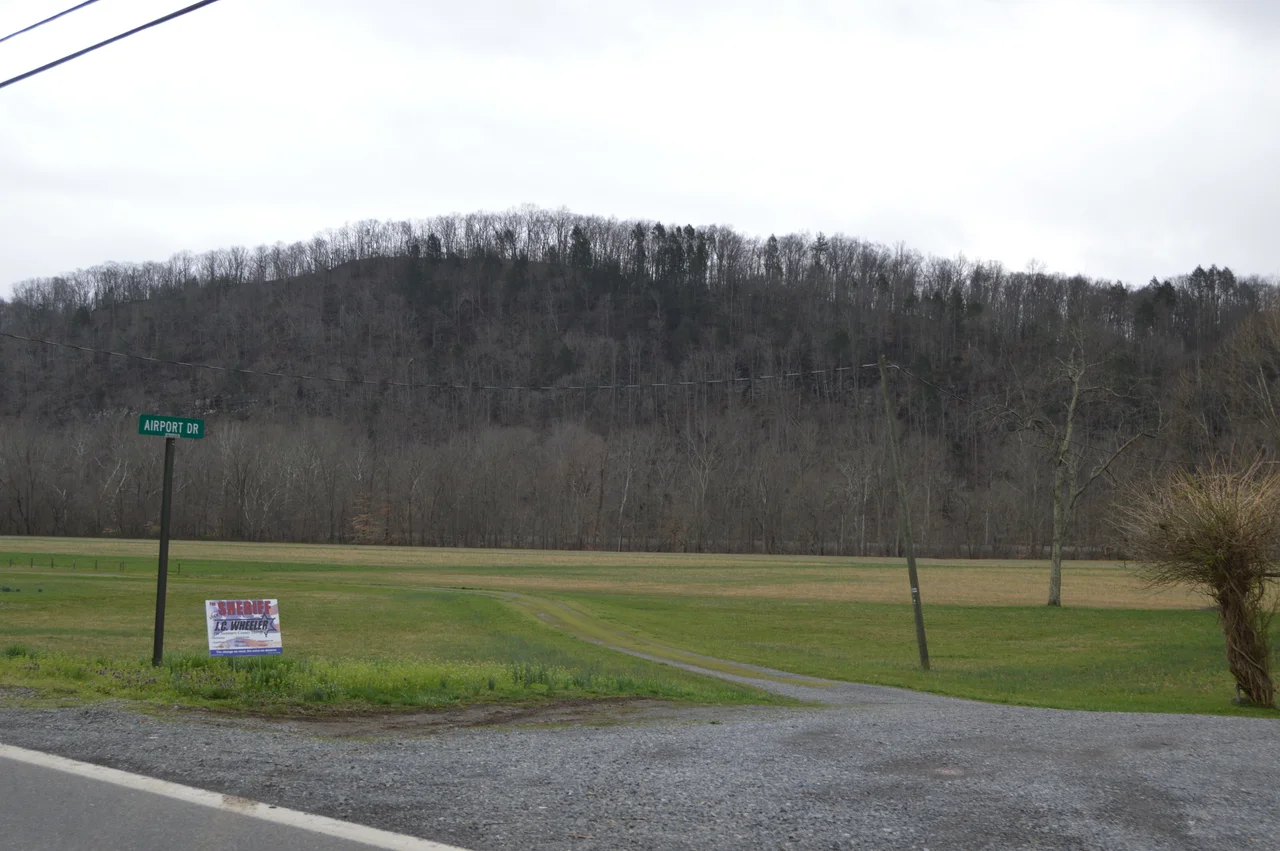

Tri-State Airport
On November 14, 1970, a chartered Southern Airways DC-9 carrying the Marshall University football team back to Huntington flew its final approach into a steady rain. The aircraft struck a hillside less than a mile short of the runway. All seventy-five people on board were killed - thirty-seven players, five coaches, two athletic trainers, the athletic director, twenty-five boosters, the flight crew. The Federal Aviation Administration would later record it as the worst sports-related air disaster in U.S. history. The hill is still there. So is the runway. And so is the airport, perched on a tabletop carved from a Wayne County ridge, where every approach and departure now carries that night in its institutional memory.
An Airfield on a Mountain
Tri-State Airport, officially Milton J. Ferguson Field, occupies 1,300 acres at 828 feet of elevation - a literal flat spot quarried out of the Appalachian foothills southwest of Huntington. The single asphalt runway, 12/30, runs 7,017 feet, the second-longest in West Virginia. There is something both impressive and a little uneasy about flying into a ridge-top airport in this country: the landscape gives no room for error. Pilots line up on final, watch the trees fall away to either side, and put the wheels down on what feels like a runway floating above the hollows. The airport serves three states (West Virginia, Ohio, Kentucky), which is where the name comes from, and it is the second-busiest commercial airport in West Virginia after Yeager Airport in Charleston.
The Slow Build of a Regional Hub
Commercial service began here in late 1952 with Piedmont DC-3s, those workhorse twin propliners that defined regional aviation in the postwar South. Eastern Airlines and Allegheny Airlines arrived the following year. For two decades, passengers from Huntington flew on Convair 440s and the occasional Lockheed Electra. The first jets came in 1969, when Piedmont introduced 737 service on a runway that was then just 5,280 feet long. Eastern's DC-9 service began in July 1968 with a Lexington-Huntington-Newark routing, and by 1970 the airline was flying 727s through the field. Eastern departed in late 1972, but Piedmont and Allegheny stayed all the way through the great airline merger of 1989. A long series of Airport Improvement Projects from 2006 to 2014 spent more than $39 million extending and reinforcing the facility, most of it federal money.
The Marshall Crash
In Huntington, the date November 14 still falls heavily on the calendar. Southern Airways Flight 932 had departed Kinston, North Carolina, after the Marshall Thundering Herd lost a road game to East Carolina. The flight crew descended through low ceilings and rain on approach to what was then designated runway 11 - the same strip of asphalt, but with a different number, before magnetic declination shifted in the half century that followed. The DC-9 struck a hillside short of the threshold and disintegrated. Among the dead were thirty-seven Marshall players, the head coach Rick Tolley, his four assistant coaches, two athletic trainers, the athletic director, and twenty-five team boosters, including doctors, businessmen, and city leaders. Seventy children were left without one or both parents. The story was told in the 2006 film We Are Marshall, but for the people of Huntington, the film could only ever be a footnote to the grief. A memorial fountain on Marshall's campus is shut off each year on the anniversary at the exact moment the team would have landed.
After the Crash
Two other crashes have marked Tri-State's history. On October 30, 1970 - just two weeks before the Marshall disaster - a U.S. Army U-8 Seminole went down three-quarters of a mile west of the airport during an emergency landing in rain and fog, killing three of the four aboard, including Major General Edwin H. Burba. On January 30, 2009, a Piper Seneca light twin attempting a fuel-emergency diversion to KHTS crashed in a snowstorm, killing all six on board. Airports remember their accidents in ways most other places do not. The runway gets repaved, the lights upgraded to LEDs in 2021, the terminal renovated. But the topography stays the same. The same hill that caught Southern 932 still rises off the approach end of runway 12. Pilots flying that approach are trained to know it is there.
From the Air
Tri-State Airport, ICAO KHTS, sits at 38.37 degrees north, 82.56 degrees west, at 828 feet field elevation in the ridges of Wayne County, West Virginia, about ten miles southwest of downtown Huntington. Runway 12/30 is 7,017 feet of asphalt. Best viewed at 3,000 to 5,000 feet AGL: the airport sits on a clearly visible flat-top above the surrounding hollows, with the Ohio River and Huntington proper to the northeast. Yeager Airport (KCRW) is fifty miles east in Charleston. Expect IFR conditions and reduced visibility on humid Appalachian mornings; the ridge-top siting means weather can sock in fast.
Nearby Stories
- Battle of Scary Creek 6 km away
- Portsmouth 7.2 km away
- Fred M. Vinson Museum and Welcome Center 14 km away
- Staats Mill Covered Bridge 24 km away
- Lake Tight 25 km away
- Battle of Blair Mountain 32 km away
- Lower Shawneetown 35 km away
- The Kentucky Meat Shower: When Flesh Fell From a Clear Sky 68 km away