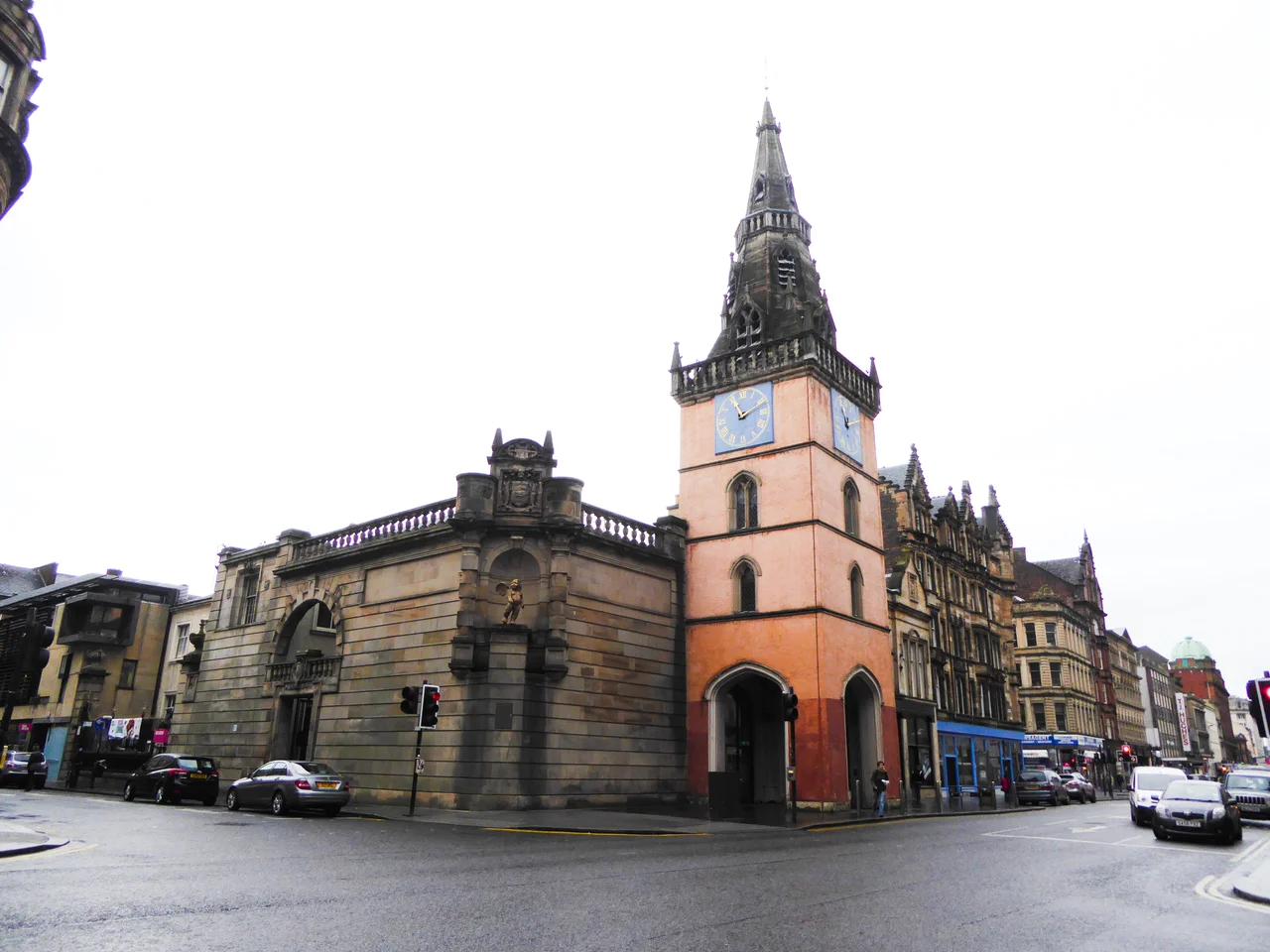

Tron Theatre
A skull and a golden cherub watch the Trongate from the front of the same building. They are sculptures by Kenny Hunter, added to the exterior of the Tron Theatre during its 1999 lottery-funded refurbishment. They are also a reasonable summary of the building's life. This was once the Collegiate Church of the Blessed Virgin Mary and St Anne, a medieval foundation. It became the Tron Kirk in 1795, rebuilt for the Church of Scotland by the architect James Adam - co-designer of the new Royal Infirmary and, soon afterward, of the city's Assembly Rooms on Ingram Street. By the 1970s it was derelict. In 1981 it reopened with a season of short plays in the Victorian Bar, and it has been a theatre ever since.
From Kirk to Theatre Club
The story of the modern Tron begins not with the building but with a group of artists. In 1978, Joe Gerber, Tom Laurie, Tom McGrath and Linda Haase founded the Glasgow Theatre Club, sometimes using the Close Theatre attached to the Citizens' Theatre in Gorbals. When fire damaged the Close, the Club needed a new venue and took on the almost-derelict Tron Kirk in the Trongate. The conversion preserved the bones of James Adam's church while turning the interior into rehearsal and performance space. The theatre opened its doors on 10 May 1981. Two days later, the first season of short plays began with Eine Kleine Nacht Musik, directed by Ida Schuster-Berkeley in the Victorian Bar. There had been an earlier theatre company on the same building - RF Pollock's Tron Theatre Club, active from 1929 to 1932, which had tried to develop a distinct Scottish acting style inspired by Stanislavski and produced Ibsen's Master Builder, launching the career of actor Duncan Macrae before splitting into smaller groups.
The Boyd Years
Faynia Williams became the Tron's first Artistic Director in 1984, writing the company's first original play, Burke and Hare, with her husband Richard Crane as dramaturg. But the run that put the Tron on the international map began with Michael Boyd, who led the company from 1986 to 1996. Under Boyd, a generation of actors emerged who would go on to define Scottish performance for the next thirty years: Alan Cumming, Forbes Masson, Peter Mullan, Craig Ferguson, and Siobhan Redmond all spent formative time at the Tron. The composer Craig Armstrong worked with the company in the same period. Boyd left for the Royal Shakespeare Company, where he eventually became Artistic Director. The Tron's reputation as a launching pad for Scottish talent was already settled.
World Premieres in Trongate
In 2000, the company presented two world premieres of plays by Scottish writers: Douglas Maxwell's Our Bad Magnet, and Zinnie Harris's Further than the Furthest Thing - a co-production with the Royal National Theatre, directed by Irina Brown, that premiered at the Edinburgh International Fringe Festival and won four major awards before a London run at the National Theatre, a transfer to the Tricycle, and a tour of South Africa. Neil Murray took over as Director in 2002, producing John Mighton's Possible Worlds and Chris Hannan's Shining Souls, which won Best Production at the 2003 Critics Awards for Theatre in Scotland. David Greig's San Diego (2004) and Anthony Neilson's The Wonderful World of Dissocia (2004) both premiered through Tron co-productions. Dissocia would win five of ten awards at the 2005 Critics' Awards. Murray then left to run the National Theatre of Scotland.
Adapting Ulysses
Andy Arnold became Director in April 2008, having previously founded the Arches Theatre Company. Under his fifteen-year tenure, the Tron produced David Harrower's A Slow Air (which transferred to London and New York), new plays by Abigail Docherty and Liz Lochhead, a John Byrne adaptation of Three Sisters, and - in 2012 - the UK and Irish stage premiere of James Joyce's Ulysses, adapted by Dermot Bolger. It toured to Belfast, Dublin, and Cork, and The List named it the best production of the year. When Arnold stepped down in 2023 after 16 years, Jemima Levick - then Artistic Director of A Play, A Pie, and A Pint - took the reins.
Skull and Cherub
Visit today and Kenny Hunter's sculptures are still there: the gold cherub above the entrance, the skull mounted on the wall like a memento mori. The building's clock tower is one of the older parts of the Trongate skyline. Inside, the Education and Outreach department runs drama workshops for children, creative writing classes for adults, and professional development for theatre students. The Tron continues to function as both a producing house, generating original work, and a receiving house, hosting visiting companies from across Scotland, the UK, and abroad. From a 13th-century collegiate church to a Georgian kirk to a derelict ruin to a contemporary new-writing powerhouse - the building has kept finding new audiences. Sometimes literally above old altars.
From the Air
Located at 55.8569°N, 4.24554°W, on the Trongate in the Merchant City quarter of central Glasgow. The clock tower is the most recognizable feature from low altitude. The site is approximately 400 m east of Glasgow Cross and 800 m south of Buchanan Street. Glasgow Airport (EGPF) lies 13 km west; Glasgow Prestwick (EGPK) is 50 km south-southwest. Best viewed at 1,000-2,000 feet AGL over the Merchant City.
Nearby Stories
- Mauchline 3.6 km away
- Shotts 4.2 km away
- HMS Ulysses (1917) 7.7 km away
- Rothesay Castle 8.8 km away
- Inchcailloch 10 km away
- Strachur 14 km away
- Battle of Dollar 16 km away
- Crawford Castle 16 km away