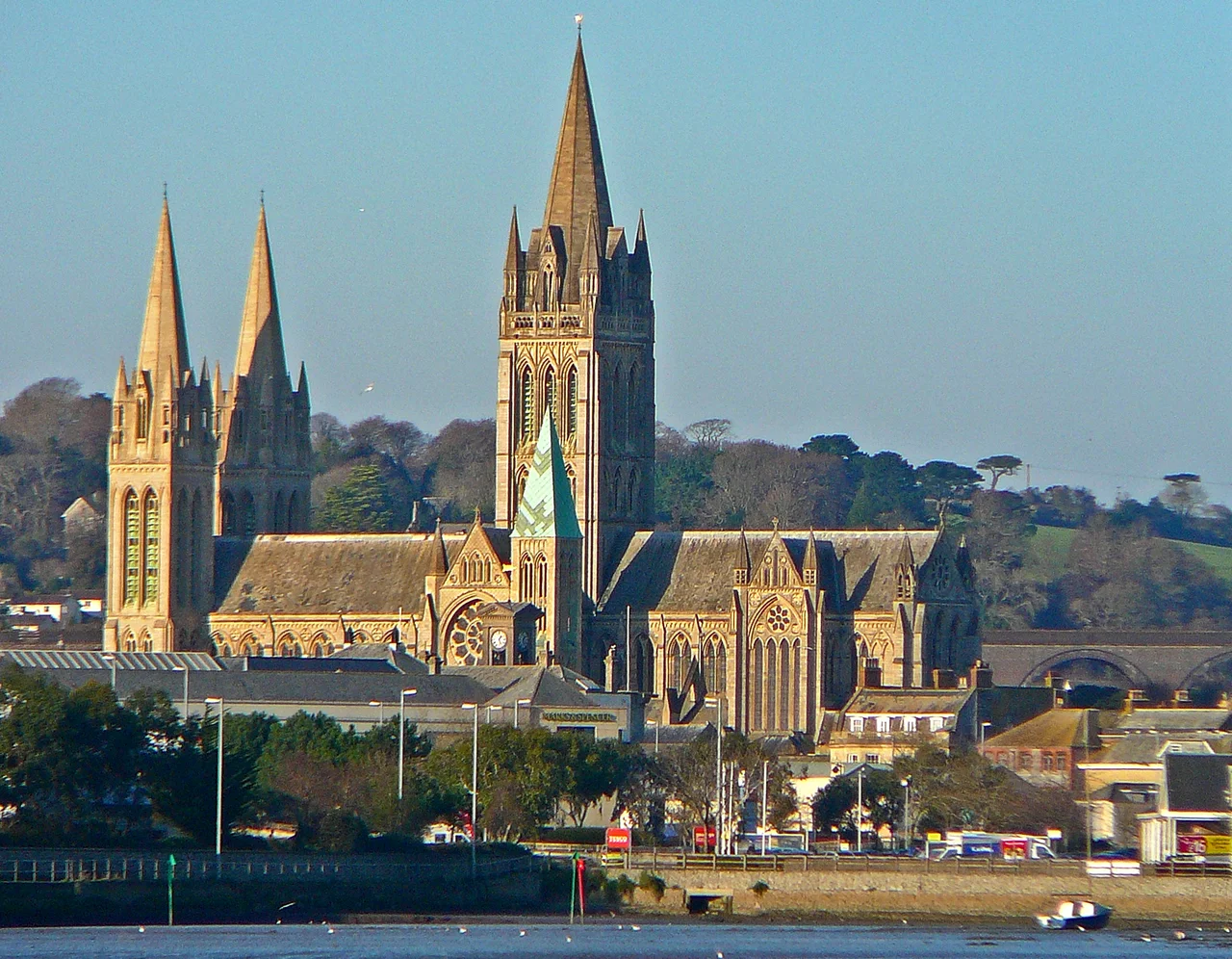

Truro Cathedral
On Christmas Eve 1880, in a wooden hut so cold in winter and stifling in summer that the parishioners complained from both directions, the new Bishop of Truro stood up to try something. Edward White Benson wanted his Cornish congregation kept out of the pubs on Christmas Eve, so he wove together nine scripture readings and nine carols and held what he called a Service of Nine Lessons and Carols. The hut held fewer than four hundred people. The service it inaugurated is now broadcast every Christmas Eve from King's College Chapel, Cambridge, to a global audience in the tens of millions. The cathedral that finally replaced that draughty wooden building was the first Anglican cathedral to be raised on a new English site in 660 years.
A New Cathedral, A Cornish See
The Diocese of Truro was established in December 1876, the first new Anglican see in Cornwall in roughly a thousand years. Edward White Benson, its first bishop, was consecrated at St Paul's the following April. Construction of his cathedral began in 1880 on the site of the parish church of St Mary the Virgin, a 16th-century building with a 128-foot spire in the Perpendicular Gothic style. The final services in St Mary's were held on Sunday 3 October 1880, and the church was demolished that month. Only the south aisle survived, kept on as the city centre's parish church. From 1880 to 1887 a temporary wooden cathedral served the diocese. The choir and transepts were finished in 1887, and Benson, by then Archbishop of Canterbury, returned to consecrate his cathedral on 3 November in front of twenty bishops and two thousand other people.
Pearson's Spires
The architect was John Loughborough Pearson, one of the leading Gothic Revivalists of the Victorian age. He gave Truro three spires, a central one rising to 250 feet, two western towers reaching 200 feet, and the design read as somewhere between Early English England and the cathedrals of northern France. The resemblance to Lincoln is not coincidental. Pearson held the post of architect at Lincoln Cathedral, and Bishop Benson had previously been Canon Chancellor there. Four kinds of stone went into the building. Mabe granite for the exterior, St Stephen's granite for the interior, and dressings of Bath and Polyphant stone for the decorative work. The cathedral is vaulted throughout. The central tower was finished in 1905. The two western towers opened in 1910, thirty years after the first stone was laid. Pearson himself died in 1897 and never saw it complete. His son Frank carried the design through to its full height.
Father Willis, Father Pearson
In the same year the choir was completed, Henry Willis built an organ. "Father" Willis, as the trade called him, was the most celebrated English organ-builder of the 19th century, and the 1887 Truro instrument is still widely considered one of his finest. The pipework arrived in Cornwall by boat. Almost identical in specification to the Coventry organ Willis built a year earlier, it carries his hallmarks: tierce mixtures on Great and Swell, characterful gedackts on the Choir, a small but telling pedal division. "It is not easy, even today, to think how the magnificence of the Willis organ in Truro Cathedral could be improved," wrote W. L. Sumner in 1952. Until 1963 the organist was perched high in the case, two or three minutes up a spiral staircase, unable to hear the choir forty feet below. That year a conservative restoration moved the console to a new south gallery.
Choir of Cornwall
Truro has kept an unbroken choral tradition since 1876. The current choir is twelve adult lay vicars and choral scholars, joined by either eighteen boy choristers or eighteen girl choristers. Truro Cathedral School closed in 1982, so the choristers attend Truro School on bursaries. Girls were first admitted to the choir in 2015, and on International Women's Day in 2017 they sang on BBC Radio 3's Choral Evensong with new commissioned canticles by Dobrinka Tabakova. They were among the choristers selected to sing at the coronation of Charles III in 2023. The Bath stone of the more decorative carvings has not weathered the Cornish maritime air well: salt and sand have left some surfaces honeycombed. The "Save Our Spire" appeal has raised funds to fix it, alongside grants from English Heritage and the Heritage Lottery Fund. Above the city, the three spires rise from the Tudor lanes like a Lincoln transplanted west, two-and-a-half centuries late but, in the end, exactly as planned.
From the Air
Truro Cathedral sits at 50.264 N, 5.051 W in the centre of Truro, Cornwall. The three spires are unmistakable from altitude, the central one reaching 250 feet and the western pair 200 feet, the tallest features in the city. The Truro River runs immediately south of the cathedral, joining Carrick Roads at the King Harry Ferry to the south. Nearest airport is Newquay (EGHQ), about 11 nautical miles north-northeast. Best viewed below 2,500 feet AGL.
Nearby Stories
- Morvah 2.9 km away
- Carnewas and Bedruthan Steps 6.1 km away
- Liskeard 7.5 km away
- Battle off Lizard Point 14 km away
- Polperro 17 km away
- MV Cita 47 km away
- HMS Affray 86 km away
- 1979 Fastnet Race 96 km away