
Tsan Yuk Hospital
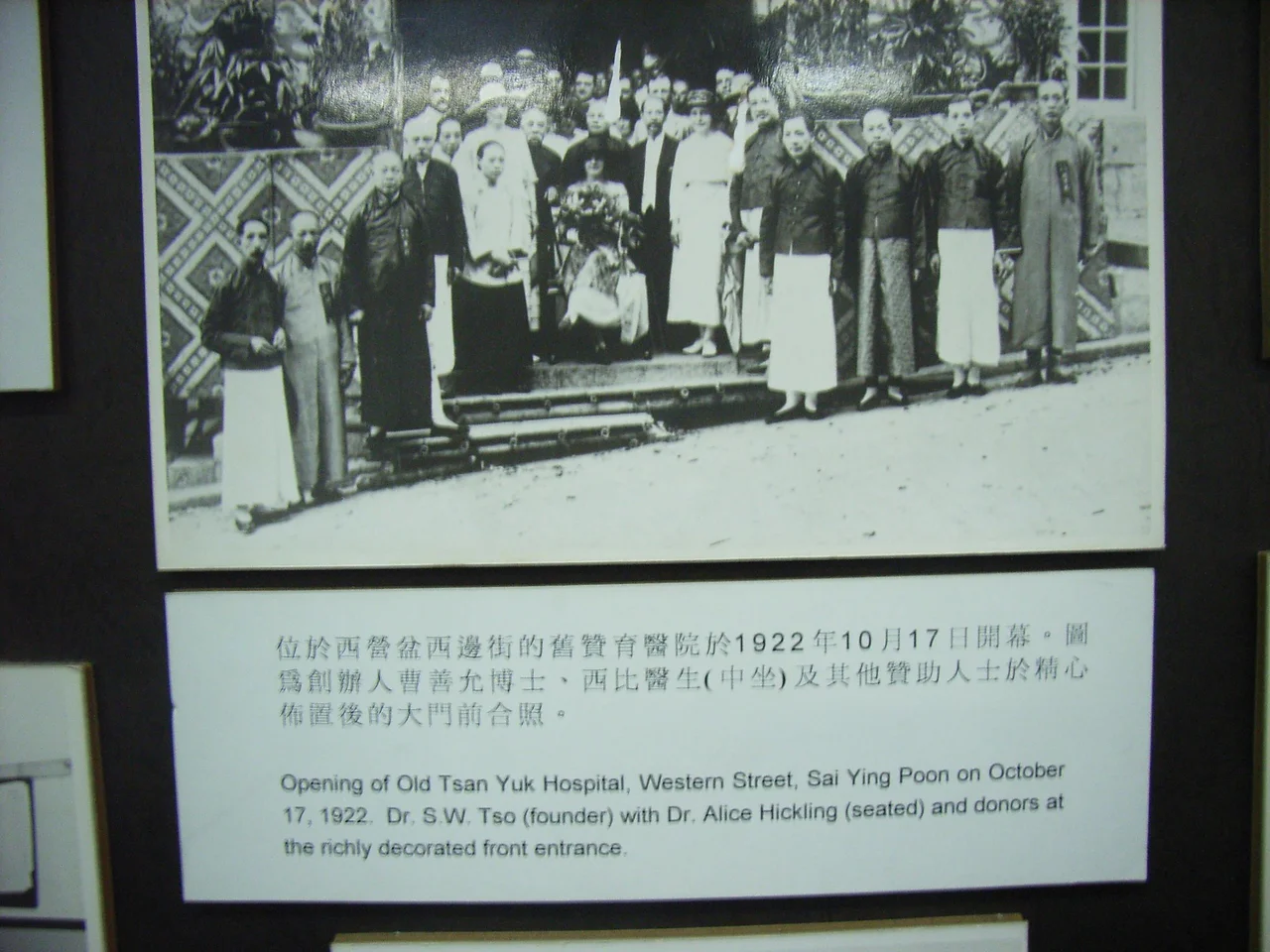
The hospital opened on 17 October 1922 with thirty donated beds, a foreign female doctor at its head, and $94,000 raised from fishmongers, fruit sellers, and a man named H. M. H. Nemazee. This was Tsan Yuk in its first form: a community institution built on the corner of Western Street and Third Street in Sai Ying Pun, financed by the people it intended to serve. Dr. Alice D. Hickling, the first foreign female doctor in Hong Kong, had been recruited by the London Missionary Society and sent here to run it. She looked around at the women of Hong Kong and saw something the colonial medical establishment had not thought to address: an abundance of women eager to become professional midwives, and nowhere to train them.
A Mission for Midwives
Dr. Hickling's insight was practical and consequential. She took her idea to Dr. S. W. Tso, Chairman of the Chinese Public Dispensary Committee, who supported it. From that conversation, Tsan Yuk became one of Hong Kong's first systematic training grounds for professional midwives and obstetricians — filling a gap that had left women across the territory dependent on informal birth attendants. In 1925, Professor Tottenham became the first obstetric professor at the University of Hong Kong and recognised Tsan Yuk as the natural base for his teaching work. By 1937, most obstetric and gynaecology teaching at the university had been transferred to the hospital. Its training was recognised by the Royal College of Obstetricians and Gynecologists. For a building on a side street in Sai Ying Pun, funded by market guild donations, it had reached an unexpected level of medical standing.
War and Relocation
In 1944, during the Japanese occupation of Hong Kong, Tsan Yuk Hospital was forced to close. Most of its furniture and equipment was moved to Nethersole Hospital. When peace came and the hospital reopened, the postwar demand for maternity services quickly overwhelmed the original Western Street premises. By the early 1950s, the hospital was facing serious bed shortages. The Hong Kong Jockey Club stepped in with a donation of $3,570,000 to fund a new building on nearby Hospital Road. On 28 October 1952, the Duchess of Kent — Princess Marina of Greece and Denmark — laid the foundation stone. On 13 June 1955, Sir Alexander Grantham, the Governor of Hong Kong, opened the new Tsan Yuk Hospital at 30 Hospital Road, Sai Ying Pun, where it stands today.
Decades of Expansion
The new hospital quickly established itself as a teaching institution aligned with the University of Hong Kong's Li Ka Shing Faculty of Medicine. In 1969, the Mrs Wu Chung Prenatal Diagnostic Laboratory was established, funded jointly by donations and the government, to screen pregnant women for congenital conditions and provide counselling. The Hong Kong Jockey Club contributed again in the 1970s, subsidising roof renovations that added 19 single rooms, 8 double rooms, and communal spaces. In 1975, the hospital centralised the preparation of infant milk products to address gastrointestinal conditions in newborns. In 1996, the Lady Helen Woo Women's Diagnostic and Treatment Centre opened, offering comprehensive women's health screening — mammography, ultrasound, cervical screening — services managed by the University of Hong Kong's Department of Obstetrics and Gynaecology.
The Transition to Outpatient Care
The late 1990s and early 2000s brought a gradual shift. In November 2001, the inpatient obstetric and newborn services moved to Queen Mary Hospital as part of a broader rationalisation of Hong Kong's hospital network. Tsan Yuk did not close — it reorganised. It became a day centre providing outpatient services, antenatal care for low-risk patients, and health education programmes on newborn care, pregnancy nutrition, and family planning. On 1 July 2007, the General Gynaecological Clinic also transferred to Queen Mary. The old teaching hospital had become something quieter and perhaps more accessible: a community resource for women navigating the earlier stages of pregnancy and reproductive health.
The Question of Mr. Li
Among Tsan Yuk's less celebrated chapters is a case that occupied Hong Kong's attention in the late 2000s. A man known as Mr. Li had reason to suspect he had been mixed up with another baby at the hospital in December 1976. DNA tests confirmed his DNA did not match the parents who raised him. The Hospital Authority, citing privacy concerns, would not search the records but offered DNA testing to others born at Tsan Yuk on the same day. Ensuing media coverage brought two men forward — neither matched. In March 2008, invitation letters went to 180 mothers who had given birth at Tsan Yuk between 28 November and 14 December 1976; thirty percent were never delivered. The Chuk Yuen Children's Reception Centre, a potential lead in the case, had closed in 2003 and destroyed its files. Mr. Li, as of the available record, has not confirmed his true identity. The case remains open in the way that only the loss of a self can remain open — with no clean resolution available, and a life lived in the shadow of an unanswered question.
From the Air
Tsan Yuk Hospital sits in the Sai Ying Pun neighbourhood of Hong Kong Island at 22.286°N, 114.145°E, on Hospital Road above the older Western District commercial streets. From the air, the building is located on the mid-levels slope below the University of Hong Kong's main campus. The urban density of this part of Hong Kong Island is immediately apparent — tightly packed residential and institutional buildings climbing toward the ridge. Nearest major airport: Hong Kong International Airport (VHHH) on Lantau, approximately 30 km to the west. Recommended viewing altitude 2,000-4,000 ft. The Victoria Harbour waterfront is visible to the north.
Nearby Stories
- Lok Ma Chau Loop 2.3 km away
- Portas do Cerco 2.3 km away
- Kweilin Incident 17 km away
- Wanshan Archipelago Campaign 34 km away
- Nanxiong Formation 115 km away
- Battle of Nanpeng Island 148 km away
- Heyuan 169 km away
- Cape Maobitou 632 km away