
Tun Sakaran Museum
The name on the building says Tun Sakaran, after the eighth Yang di-Pertua Negeri of Sabah, the statesman Sakaran Dandai. But step inside this museum in the coastal town of Semporna, and you will find it belongs to someone else entirely: the Bajau, a seafaring people whose relationship with these waters stretches back centuries. That tension between the name on the door and the stories within tells you something about Semporna itself, a town where political history and living culture occupy the same space, sometimes uneasily.
Built on Donated Ground
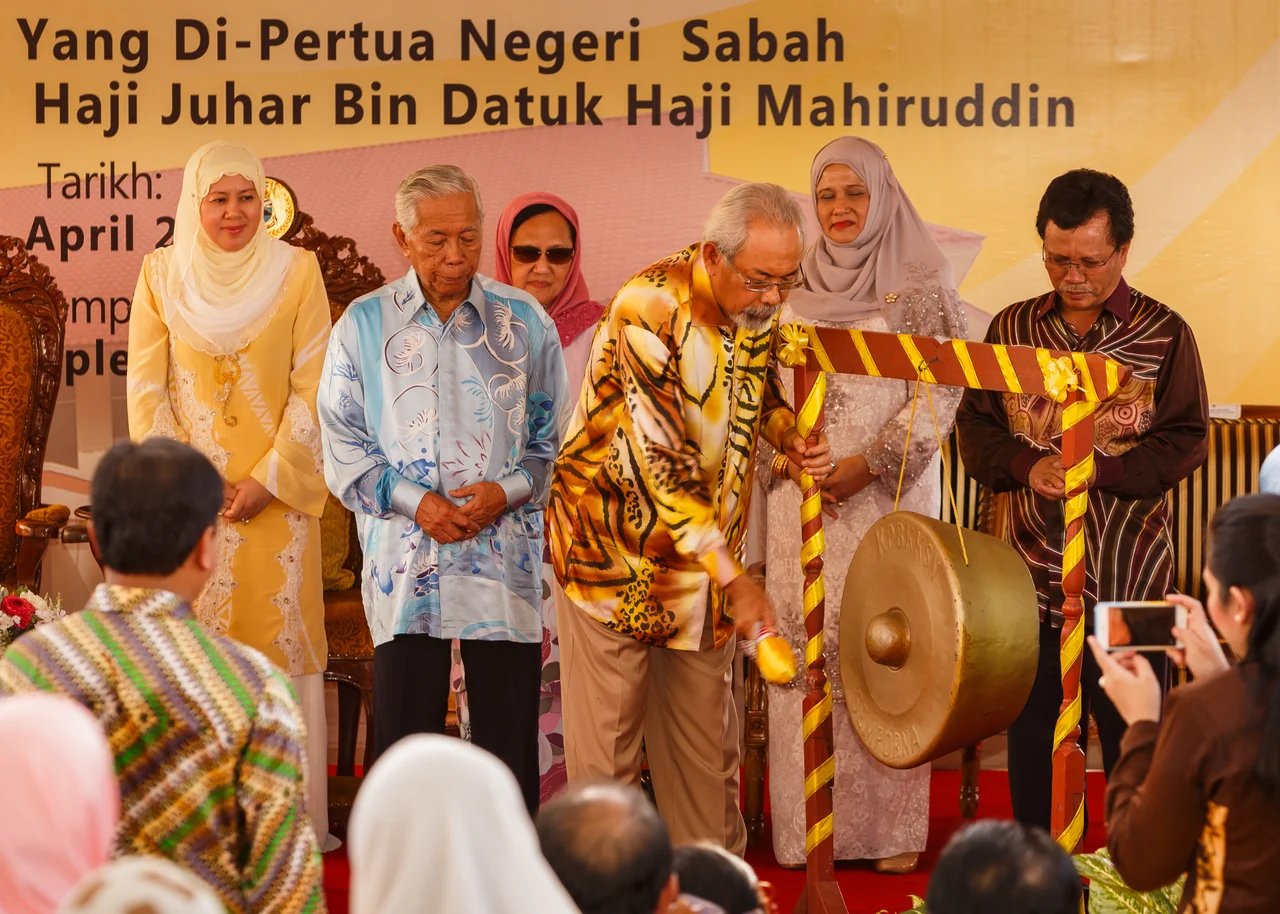
The museum's origins are modest and personal. On 31 December 2008, Sakaran Dandai donated the land himself, and workers broke ground on what would become a RM2.8 million project funded by the Government of Sabah. The exterior walls went up quickly, completed by 2010, but the interior took four more years to design and fill. From 2014 to April 2015, the museum ran soft openings, welcoming visitors to exhibits still being refined. The full opening came on 25 April 2015, officiated jointly by Dandai alongside Juhar Mahiruddin and Shafie Apdal. It was a quiet ceremony for a quiet building in a town better known as a jumping-off point for divers than a cultural destination.
The Bajau Story Inside
Although it bears Sakaran Dandai's name, the museum's galleries are devoted overwhelmingly to the history and culture of Semporna's Bajau community. The ground floor houses a main gallery, while the upper level rotates exhibitions of cultural and historical artifacts from the broader Semporna community. Among the most striking pieces is a model of a lepa, the traditional boat that has defined Bajau life for generations. These brightly painted vessels, celebrated annually during the Regatta Lepa festival, represent far more than transportation. For the Bajau Laut, the sea nomads who once lived their entire lives aboard such boats, the lepa was home, livelihood, and identity rolled into a single carved hull.
Semporna's Crossroads
Semporna sits on the southeastern coast of Sabah, facing the Celebes Sea and the scatter of islands that make up the Tun Sakaran Marine Park. The town has long been a crossroads, its population a mix of Bajau, Suluk, Chinese, and other communities whose presence reflects centuries of maritime trade across the Sulu and Celebes seas. Dive tourism has transformed the local economy since the 1990s, with visitors pouring through on their way to Sipadan, Mabul, and the marine park's islands. The museum offers something different: a reason to pause in Semporna itself, to look past the jetties and boat schedules and consider the human history that brought this particular mix of people to this particular stretch of coast.
A Small Building with Large Ambitions
The museum also features a cafeteria and a small multipurpose room open to the public, modest additions that signal an intent beyond mere display. This is meant to be a living space, a place where the community can gather, where schoolchildren can encounter their own heritage in glass cases and wall panels. For a building that cost less than three million ringgit, the ambitions are outsized. Semporna's cultural richness has always been easier to experience on the water than in an institution, and the museum's rotating exhibitions suggest an awareness that capturing that culture under a roof requires constant renewal. The challenge remains: how do you preserve the traditions of a people whose identity is defined by movement across open water?
From the Air
Located at approximately 4.48N, 118.60E in the town of Semporna on Sabah's southeast coast. Semporna is visible as a coastal settlement on the mainland, with the islands of Tun Sakaran Marine Park stretching to the east. The nearest major airport is Tawau Airport (WBKW), approximately 60 km to the southeast. Best viewed at altitudes of 3,000-5,000 feet to appreciate the town's position relative to the island chain and Darvel Bay.
Nearby Stories
- Kapalai 3.4 km away
- Malaysia Airlines Flight 2133 21 km away
- USS S-36 27 km away
- Menara (tree) 37 km away
- Sebatik Island 38 km away
- Sheikh Karimul Makhdum Mosque 76 km away
- Indonesia-Malaysia Border 120 km away
- Tawi-Tawi 128 km away