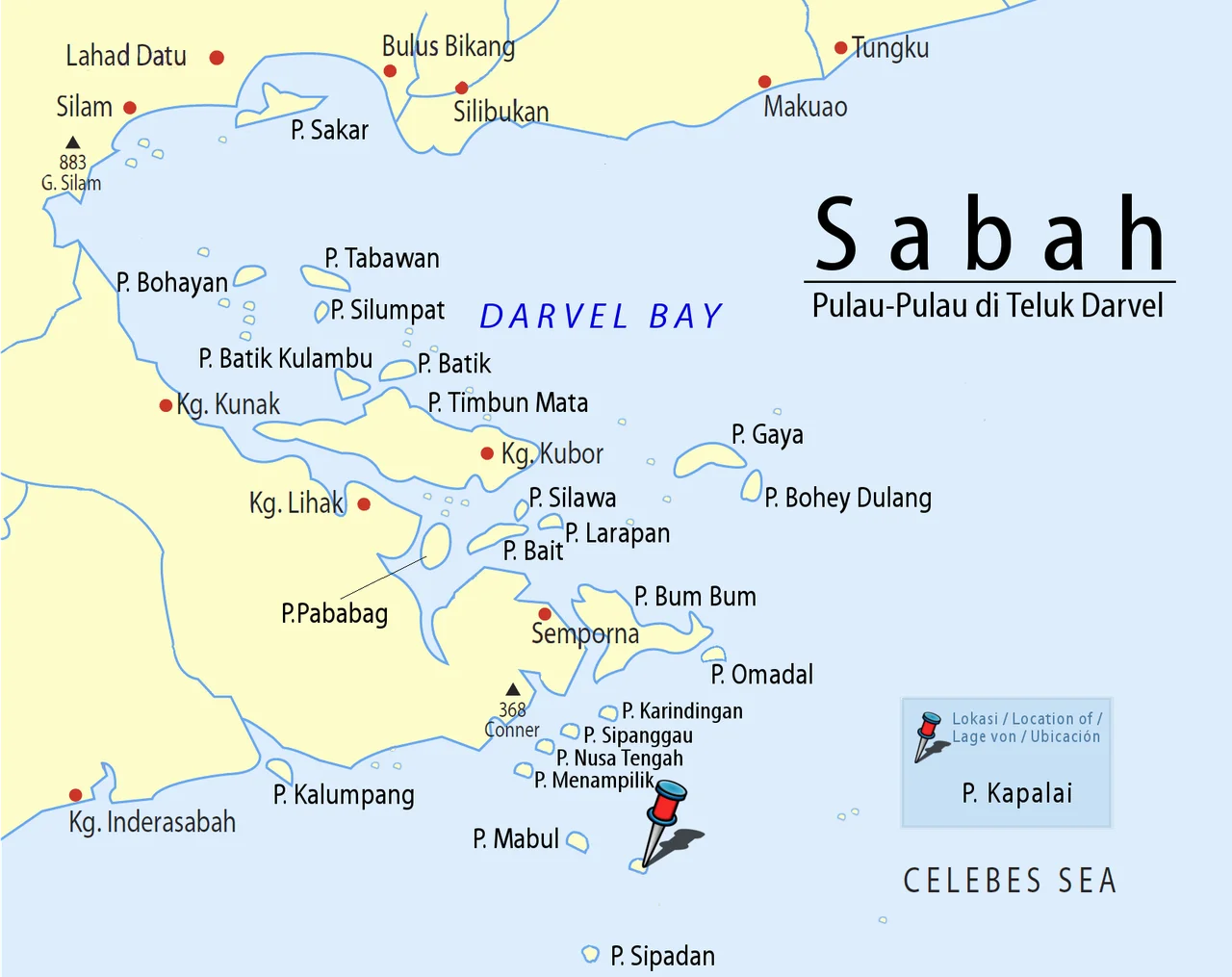

Kapalai
Two hundred years ago, Kapalai was a proper island. It had beaches, elevation, the usual geography of a tropical landmass in the Celebes Sea. Today, erosion has reduced it to a sandbar barely breaking the surface at high tide. What remains is not so much an island as a memory of one -- a flat expanse of reef sitting at sea level, 15 kilometers off Sipadan, where every structure stands on stilts driven into the underwater coral. The buildings do not sit on land. They sit on the idea of where land used to be.
Built on Water
Kapalai's single private resort occupies the edge of the extensive Ligitan Reefs, a shallow platform of coral that once supported a forested island and now supports wooden walkways, dive platforms, and guest chalets. Every building rests on stilts above the reef, creating the effect of a village floating on the open sea. The rest of the former island is uninhabited -- there is no "rest of the island" in any meaningful sense, just reef flat and sandbar stretching toward the horizon. At low tide, patches of sand emerge like the ghost of Kapalai's former self. At high tide, the reef disappears entirely beneath turquoise water, and the resort appears to hover over nothing at all. The visual effect is striking from any angle: a cluster of human habitation suspended between sky and sea with no solid ground in sight.
Getting to Nowhere
Reaching Kapalai requires a journey that emphasizes its remoteness. The closest airport is Tawau, on the east coast of Sabah, Borneo -- accessible by direct flights from Kota Kinabalu, Kuala Lumpur, and Singapore. From Tawau, a one-hour minivan ride reaches the coastal town of Semporna, whose jetty serves as the departure point for speedboats heading to Kapalai, neighboring Sipadan, and nearby Mabul Island. The boat ride from Semporna crosses open water, passing fishing platforms and sea gypsy settlements before arriving at a place that looks, from the approaching vessel, like a dock with nowhere to dock to. Kapalai sits northeast of Sipadan, positioned within the same marine ecosystem that made its neighbor one of the most celebrated dive sites on Earth.
The Reef Below
What Kapalai lost in land area it retained in marine richness. The Ligitan Reefs that form the island's foundation are part of the broader Coral Triangle, the epicenter of marine biodiversity where more species of coral and fish exist per square kilometer than anywhere else in the ocean. Divers descending from the resort's platforms find macro life in extraordinary density -- the reef flats and gentle slopes favor the small and camouflaged rather than the large pelagics of Sipadan's walls. Pygmy seahorses, ghost pipefish, blue-ringed octopuses, and flamboyant cuttlefish inhabit the coral rubble and sponge gardens. Mandarin fish emerge at dusk in their psychedelic orange-and-blue patterns. The diving here is less about spectacle and more about patience, about learning to see what hides in plain sight on a reef that looks unremarkable until you look closely.
A Vanishing Act in Progress
Kapalai is a case study in what the ocean does to small islands over time. Erosion, rising sea levels, and the slow grinding of wave action against coral substrate have reduced a once-solid landmass to a temporary feature -- a sandbar that exists at the discretion of the tides. The International Court of Justice weighed in on nearby Sipadan and Ligitan in 2002, and the legal question of what constitutes an "island" under the UN Convention on the Law of the Sea hovers over places like Kapalai, where the distinction between land and reef has become academic. For now, the resort continues to operate on its stilts, hosting divers who come for the reef life and find themselves sleeping above a place that is simultaneously island and not-island, land and sea, present and disappearing.
From the Air
Located at 4.22N, 118.68E in the Celebes Sea, approximately 15 km northeast of Sipadan island. From altitude, Kapalai appears as a shallow reef platform with a cluster of stilt structures -- the sandbar itself may not be visible at high tide. The resort structures on stilts are the primary visual identifier. Nearest airport is Tawau (WBKW). Sipadan and Mabul islands are nearby visual references. The Ligitan Reefs extend around the area as lighter-colored shallow water against the deep blue of the Celebes Sea.
Nearby Stories
- Skull Hill, Malaysia 6.1 km away
- Malaysia Airlines Flight 2133 19 km away
- Ambalat 24 km away
- Menara (tree) 69 km away
- 2006 Southeast Asian Haze 82 km away
- Indonesia-Malaysia Border 83 km away
- Sheikh Karimul Makhdum Mosque 93 km away
- Tawi-Tawi 155 km away