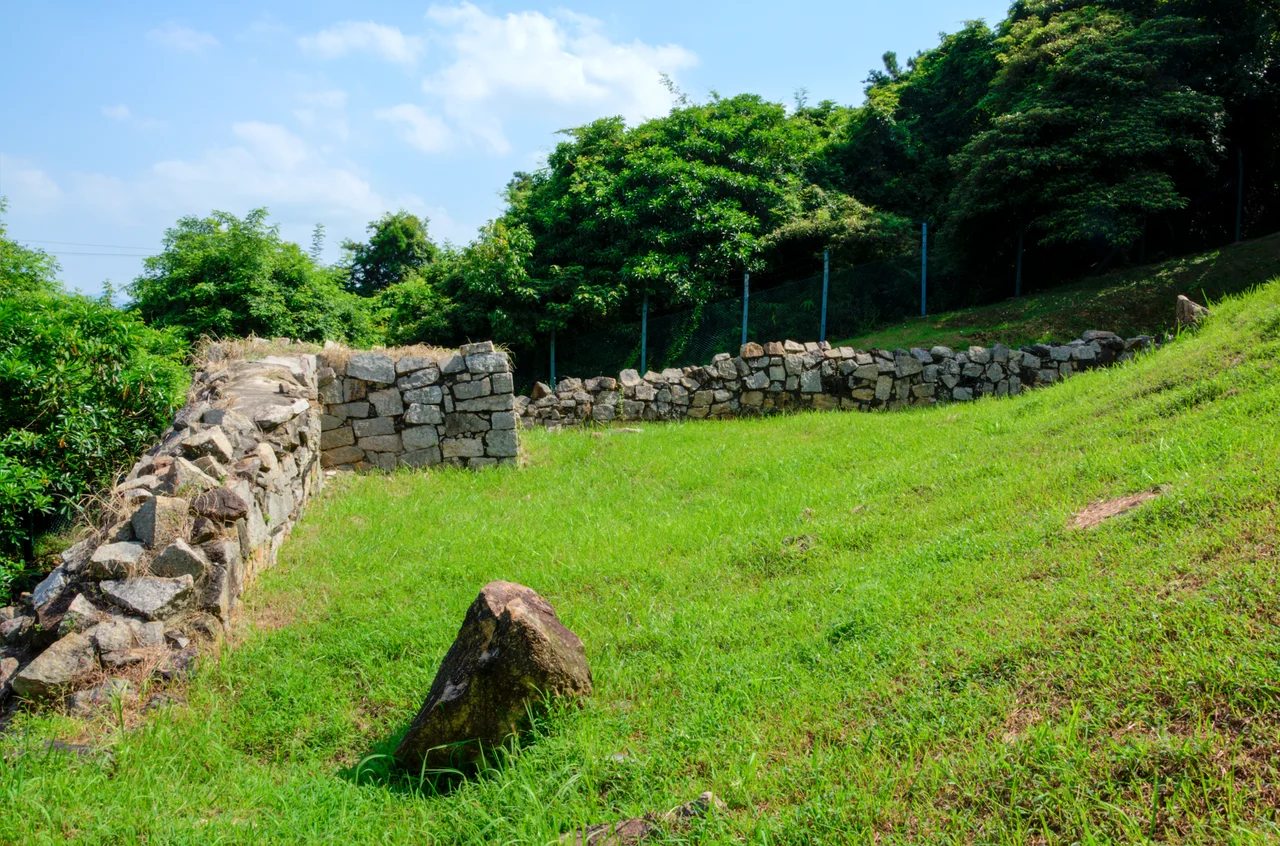

Tung Chung Battery
Twenty-four years before Britain claimed Hong Kong, the Qing government built a gun battery on a cliff above Tung Chung Bay. The year was 1817. Pirates were the problem — they moved freely through the channels and bays of the South China coast, raiding coastal settlements and threatening the shipping lanes that connected southern China to the world. The battery's two cannon emplacements were placed on the cliff precisely because the vantage point was excellent: clear sightlines to the water, a clear view of any vessel approaching the bay. No one who placed those guns could have imagined that, two centuries later, the water they watched would be buried under an airport runway.
Guarding a Bay the Qing Could Not Afford to Lose
In the early nineteenth century, the Qing dynasty faced a chronic problem along its southern coast: a navy too small to police the territory it was meant to protect. Pirates — some commanding fleets large enough to challenge imperial warships — operated almost freely in the waters around Lantau Island. The solution the government chose was architectural. Rather than building more ships, it built more fortifications. Tung Chung Battery, completed in 1817, was part of this strategy. Positioned a kilometre north of the companion Tung Chung Fort, the battery consisted of two coastal artillery cannon emplacements and seven guard houses. The cliff site was chosen for visibility: from that height, lookouts could spot approaching vessels with enough warning to prepare a response. The battery and fort together formed a defensive system for Tung Chung Bay, with the fort handling garrison troops and the battery handling the water.
Centuries of Silence, Then Discovery
How long the battery was in active use is not precisely recorded, but by the time Britain took possession of the broader Hong Kong territory in 1841 and the New Territories lease followed in 1898, the strategic landscape had shifted entirely. The Qing military presence on Lantau faded, and the battery fell out of use. It was not until 1980 that it was formally rediscovered and documented. Two years later, Hong Kong's Antiquities and Monuments Office declared it a monument, protecting it from the kind of demolition that had claimed so many other historical structures during the city's rapid postwar development. In November 1997, marking Hong Kong's return to Chinese sovereignty, the site was included in a heritage celebration tour of North Lantau organized by the AMO, culminating in a performance of traditional Cantonese opera at the nearby fort.
What the Cannons Face Now
Stand at the Tung Chung Battery today and something immediately feels wrong with the geometry. The cannon emplacements, positioned to look out over Tung Chung Bay, now face Hong Kong International Airport. The airport — built on land that includes the leveled island of Chek Lap Kok — was completed in 1998 as part of the Airport Core Programme, one of the largest civil engineering projects in Hong Kong's history. Where the Qing gunners once watched open water, there are now runways, taxiways, and the ceaseless movement of aircraft. The bay the battery was built to defend is gone. The irony is complete and permanent: a monument to coastal defense, surrounded by the infrastructure that buried the coast it was meant to protect.
From the Air
Located at 22.2873°N, 113.9355°E on the northern coast of Lantau Island, approximately 1.5 km east-northeast of Hong Kong International Airport's eastern runway threshold. On approach to VHHH runway 07R, the Tung Chung valley is visible to the south, with the residential towers of Tung Chung New Town rising above the bay. The battery sits on a low cliff north of the Tung Chung Fort, both hidden from the air by vegetation and the development that now surrounds them. Approaching from the west at 800–1,500 ft, the arc of Tung Chung Bay — substantially altered from its historical form — is visible below. VHHH (Hong Kong International Airport) is the region's dominant landmark.
Nearby Stories
- Lok Ma Chau Loop 2.3 km away
- Portas do Cerco 2.3 km away
- Kweilin Incident 17 km away
- Wanshan Archipelago Campaign 34 km away
- Nanxiong Formation 115 km away
- Battle of Nanpeng Island 148 km away
- Heyuan 169 km away
- Cape Maobitou 632 km away