.jpg)
Tung Chung Fort
The salt smugglers came first. In the Southern Song dynasty, between 1174 and 1189, smugglers on Lantau Island were moving salt illegally from the island to Canton, attacking local officials in the process. The government's response was to send a naval force led by an officer called King Leok Chin to pacify the island and establish control. Three hundred soldiers arrived at Tung Chung and built a fort. After three years of relative peace, most were recalled — 150 of them transferred northward to build what would eventually become Kowloon Walled City. The soldiers left. The fort stayed. And for the next eight hundred years, almost every kind of authority that touched Hong Kong passed through Tung Chung Fort.
The Pirate Who Used It Best
Of all the figures in Tung Chung Fort's long history, Cheung Po Tsai is perhaps the most vivid. During the Qing dynasty, he commanded one of the most powerful pirate fleets in South China — a confederation of ships that at its peak numbered in the hundreds. Tung Chung Bay, sheltered and strategically positioned, was the kind of anchorage a pirate fleet needed, and Cheung Po Tsai made full use of the fort. The Qing government eventually negotiated his surrender rather than continuing to fight a battle it was losing. After Cheung Po Tsai submitted to imperial authority, the government rebuilt and regarrisoned the fort. Scholars debate the precise year — either 1817 or 1832 — but the rebuilt fort was manned by the Right Battalion of Tai Peng to defend the coast until the New Territories were leased to Britain in 1898, at which point the garrison was withdrawn.
Six Cannons, Three Gates
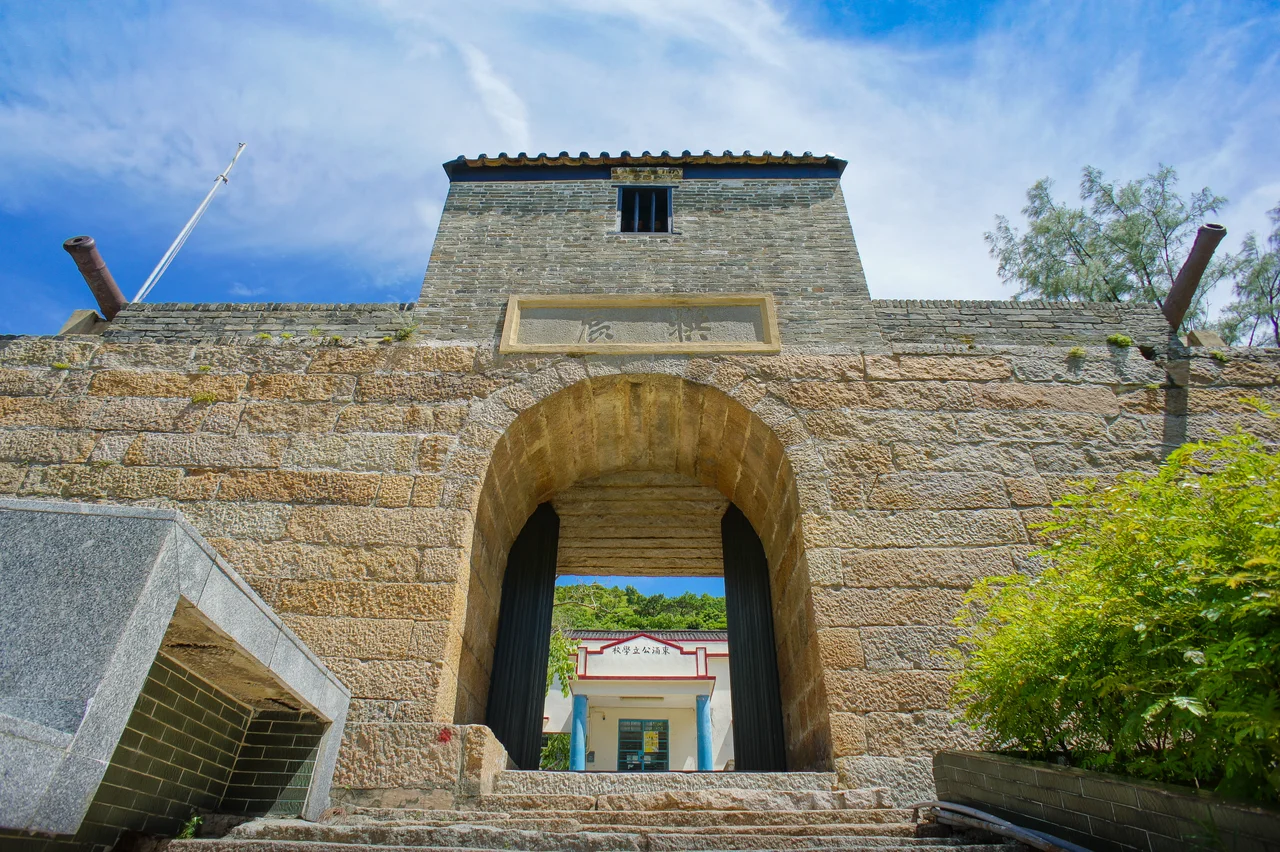
The fort that survives today is the Qing reconstruction, and it is more complete than most historical sites of comparable age in Hong Kong. Six muzzle-loading cannons still stand on their cement bases, each surrounded by granite block enclosures. Three arched gateways punctuate the walls, each one engraved with a Chinese inscription. The walls themselves are built from large granite blocks, with the characteristic mass and thickness of a serious military installation. The villages of Sheung Ling Pei and Ha Ling Pei still surround the site, giving it a context that feels continuous rather than museum-like. Walking through the arched gateways, there is an unusual quality of solidity: the granite is cool and heavy, and the proportions of the enclosures suggest a place designed to absorb violence, not merely to observe it.
School, Police Station, Committee Office
After the garrison departed in 1898, Tung Chung Fort accumulated a long series of new identities. The Imperial Japanese Army occupied it during World War II. After the war, it became a police station, then was converted to house Wa Ying College. For a time it served as the Tung Chung Public Primary School, which operated until 2003 when the school ceased operations. Today the fort compound serves as the base for the Rural Committee Office. Each transformation left the structure essentially intact — the walls are too solid for anything short of deliberate demolition. Hong Kong's Antiquities and Monuments Office declared it a monument in 1979, and it was refurbished in 1988, adding another layer of institutional attention to a site that has somehow accumulated more care than destruction over eight centuries.
Monument in a Changing Valley
Tung Chung Fort sits in a valley that has been transformed almost beyond recognition in the past three decades. When the fort was built in the Southern Song era, Tung Chung was a remote bay settlement on the northern coast of Lantau. When it was last garrisoned in the Qing era, it still faced open water and fishing villages. Now, it is surrounded by a new town of over a hundred thousand people, an international airport less than two kilometres away, and the beginning of an expressway network connecting Lantau to Zhuhai and Macau via the world's longest sea-crossing bridge. The granite walls absorb the noise of aircraft and traffic the way they once absorbed the concern of approaching ships. The fort endures. Everything around it keeps changing.
From the Air
Located at 22.2779°N, 113.9360°E in the Tung Chung valley on Lantau Island, approximately 2 km southeast of the eastern runway threshold of Hong Kong International Airport (VHHH). On final approach to VHHH runway 07R, the Tung Chung valley opens below to the south, with the residential towers of Tung Chung New Town visible on the valley floor. The fort itself is difficult to distinguish from altitude due to surrounding vegetation and development, but the companion Tung Chung Battery sits approximately 1 km to the north on higher ground. Best viewed during a low-level transit of the valley at 500–800 ft. VHHH handles all commercial traffic for Hong Kong.
Nearby Stories
- Lok Ma Chau Loop 2.3 km away
- Portas do Cerco 2.3 km away
- Kweilin Incident 17 km away
- Wanshan Archipelago Campaign 34 km away
- Nanxiong Formation 115 km away
- Battle of Nanpeng Island 148 km away
- Heyuan 169 km away
- Cape Maobitou 632 km away