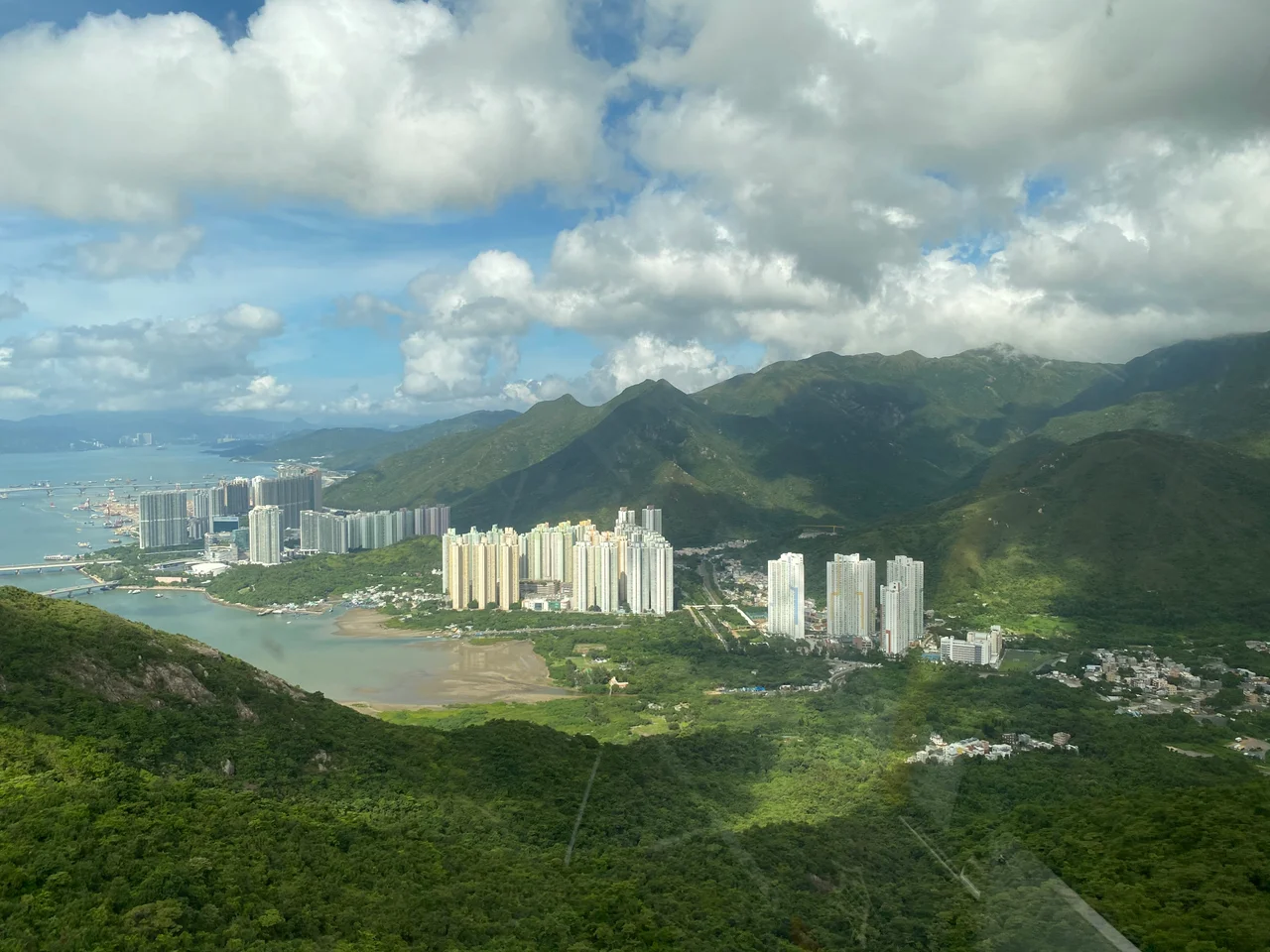

Tung Chung New Town
The town exists because of an airport that does not yet exist, and the airport exists because of a plan to tear down an island. That compressed chain of cause and effect is how Hong Kong works, and Tung Chung New Town is one of its most complete expressions. In the late 1970s, the government decided Kai Tak Airport — wedged into Kowloon Bay and surrounded by apartment buildings — had to be replaced. The replacement site chosen was Chek Lap Kok, a small island off the northern coast of Lantau. Building the airport meant leveling Chek Lap Kok and reclaiming the surrounding sea. Building a new town to house airport workers and new residents meant filling Tung Chung Bay. Both projects moved forward together in the 1990s, and what had been fishing villages and old fort walls became the youngest of Hong Kong's nine new towns.
Planned from the Beginning
The idea of developing North Lantau was formally proposed in a government study in 1983, calling for a new town of nearly 300,000 people along the northern Lantau coast. The Airport Core Programme of the early 1990s — one of the most ambitious public works undertakings in Hong Kong's history — accelerated the plan dramatically. The Lantau Fixed Crossing, the North Lantau Highway, the Tung Chung MTR line, and the new town itself were built simultaneously, each project depending on the others. By 1998, when Hong Kong International Airport opened, Tung Chung was ready to receive its first residents. It was the only new town in the Islands District — a designation that still sets it apart from the rest of Hong Kong's new towns, most of which are on the mainland peninsula rather than on islands.
Fast Growth, Slow Infrastructure
Speed has been the defining tension of Tung Chung's development. Population grew faster than the planners expected, and community facilities — libraries, swimming pools, sports centres, markets — lagged years behind demand. Former Chief Executive Donald Tsang pledged in his 2006–2007 policy address to fill these gaps, and the promised facilities were completed between 2009 and 2011. The North Lantau Hospital, approved in 2009, opened in September 2013, though some of its facilities took additional years to become operational. The market situation has been a particularly persistent frustration: the four markets in the district are managed by private operators, leading to prices that residents consistently describe as among the highest in Hong Kong. In 2016, residents organized their own informal market in protest, at one point clashing with security contractors. It is the kind of friction that emerges when a city is built faster than its civic life can catch up.
The Bridge That Changed the Weekend
In October 2018, the Hong Kong–Zhuhai–Macau Bridge opened. The world's longest sea-crossing bridge — stretching more than 55 kilometres across the Pearl River Delta — connected Hong Kong to Zhuhai and Macau, with its Hong Kong side terminating near the airport on Lantau. Almost immediately, Tung Chung became a popular stop for mainland Chinese tourists arriving via the bridge. On weekends, shopping malls filled beyond capacity. Queues formed at bus stops. Residents found everyday goods snapped up before they could buy them. By November 2018, a campaign called "Reclaim Tung Chung" had launched to demand limits on tourist traffic. The episode illustrated a tension written into the town's founding logic: Tung Chung was built partly as a tourism and consumption area, but the people living there are also just trying to buy groceries and get to work.
Still Expanding
Tung Chung New Town is not finished. A major expansion plan approved in 2018 involves reclaiming 130 hectares of land at Tung Chung East, with updated government projections now targeting an additional population of around 182,000 upon full development. The Siu Ho Wan depot site, a 30-hectare MTR facility, is also proposed for residential and commercial development. The Tung Chung East Railway Station, part of the expansion, is envisioned as a regional business center. What is remarkable, looking at the map, is how much of the ground under Tung Chung — the roads, the town center, the reclaimed bays — did not exist fifty years ago. The fort walls and the battery cliffs predate it all by centuries. The question the expansion raises is the same one it always has been: how much more can be added before the qualities that make the place worth living in are outweighed by what it takes to build?
From the Air
Located at 22.2927°N, 113.9566°E on the northern coast of Lantau Island, directly adjacent to Hong Kong International Airport (VHHH). On departure from VHHH runway 25L heading west, Tung Chung New Town is immediately visible to the south — a dense cluster of high-rise residential towers arranged in curved rows at the base of Lantau's mountains. The contrast between the green mountain slopes and the white residential towers is striking from altitude. The Tung Chung valley runs east-west, with the old fort and battery sites visible (with difficulty) amid the surrounding development. The Hong Kong–Zhuhai–Macau Bridge is visible as a long white arc extending northwest from the airport island.
Nearby Stories
- Lok Ma Chau Loop 2.3 km away
- Portas do Cerco 2.3 km away
- Kweilin Incident 17 km away
- Wanshan Archipelago Campaign 34 km away
- Nanxiong Formation 115 km away
- Battle of Nanpeng Island 148 km away
- Heyuan 169 km away
- Cape Maobitou 632 km away