
Tung Chung
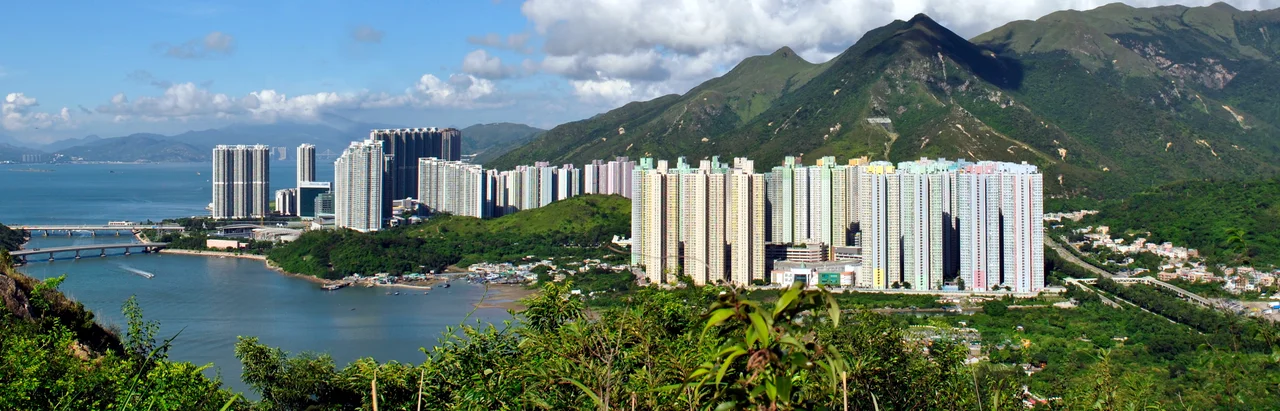
Trade winds once carried merchant ships through a gap in the hills of northwestern Lantau, east toward the village and west toward Macau. That orientation gave the place its earliest name: Tung Sai Chung — Eastern-Western Stream. Fishermen and farmers had worked the same bay since at least the Song dynasty, roughly a thousand years ago. Then, in a single decade in the 1990s, the village became a new town of tens of thousands, built largely on land that had been water just years before.
A Thousand Years on the Bay
People have lived at Tung Chung since the Song dynasty, between 960 and 1279 AD, subsisting on crabs, fish, and crops grown along the river delta. The coastal restriction known as the Great Clearance evacuated the entire shoreline in the 1660s, and Tung Sai Chung was one of only five Lantau villages allowed to resettle when that decree lifted in 1669. By 1815 the settlement appeared on Western navigational charts, sometimes spelled Toong-chung, a name already well-established in the trade routes between the Pearl River Delta and Macau. Through the Ming and Qing dynasties, the Tung Chung Battery — an artillery fortification built in 1817 at the foot of Rocky Lion Hill — guarded the bay against pirates and foreign warships. Those walls, rediscovered under dense undergrowth in 1980, still stand near the pier, a quiet reminder that this gentle-looking coast once demanded defending.
The Airport That Built a Town
In the early 1990s, the Hong Kong government made a decision that would transform Tung Chung entirely: move the international airport. The old Kai Tak airfield, wedged into dense Kowloon, would close. The new airport would rise on reclaimed land at Chek Lap Kok, right next to Tung Chung. What had been a quiet village on an outlying island suddenly sat at the center of Hong Kong's largest infrastructure project. Land was reclaimed from Tung Chung Bay in phases — north, east, northeast — to build housing for the airport's support community. Phase 1 was completed in 1994, infrastructure ready by January 1997 just as the airport opened. Hundreds of thousands of square meters of new ground were created from the bay itself. The first new town on any of Hong Kong's outlying islands was born from seawater.
Five Dragons in the Valley
Turn away from the glass towers and the cable cars, walk south into Lantau North Country Park, and Tung Chung reveals a different self entirely. The valley streams here bear names rooted in dragon mythology: Wong Lung (Yellow Dragon), Tung-Lung, Pak-Lung, Chong-Lung, Ngo-Lung — collectively known as the Five Dragons of Tung Chung. Their source is the saddle east of Sunset Peak, and the Tung Lung Stream alone drops more than 700 feet through continuous waterfalls before reaching the valley floor. Rare Hong Kong newts (Paramesotriton hongkongensis) hide in the primeval forest at the upper reaches, alongside several species of wild orchids. The Tung Chung River is the only known Hong Kong site for the rare fish Acrossocheilus wenchowensis beijiangensis, and one of only two places on Lantau where the crested kingfisher has ever been recorded. Eagle owls nest undisturbed in the upper valley, and the cliffs shelter the territory's largest known population of tokay geckos.
Gateway to the Big Buddha
Tung Chung serves as the starting point for the Ngong Ping 360, a 5.7-kilometer gondola lift that ascends through the hills to the plateau where Po Lin Monastery sits beneath the Tian Tan Buddha. The cable car links Tung Chung station and Ngong Ping via intermediate stations at Airport Island and Nei Lak Shan, offering views across the Pearl River estuary on clear days. It suspended service after an accident in June 2007 and reopened once safety was guaranteed. Hikers can reach the same plateau on foot, or follow the Tung O Ancient Trail — a strenuous four-hour walk hugging Lantau's northwestern coast to the fishing village of Tai O, with runway approach lights from Chek Lap Kok glinting below. The ferry from Tung Chung passes territory where Chinese white dolphins are sometimes spotted along the North Lantau shore.
Where Airlines Keep Their Offices
The proximity to Hong Kong International Airport has shaped Tung Chung's commercial character in ways few new towns share. Greater Bay Airlines, Hong Kong Airlines, and Metrojet Limited all maintain their head offices in One Citygate, the office building at the heart of the town. The Citygate Outlets mall — built in the same glass-and-steel aesthetic as the terminal across the highway — spans over 1.4 million square feet across nine floors, with the Ngong Ping 360 cable car station a short walk away. Hotels have multiplied: the Novotel Citygate opened in April 2006 as the first, joined since by the Hong Kong Skycity Marriott, the Sheraton, the Four Points by Sheraton, and the Silveri Hong Kong-MGallery. The Hong Kong–Zhuhai–Macau Bridge, the world's longest sea crossing, begins its arc near Tung Chung, connecting the bay to the mainland and to Macau, completing a circle that Tung Sai Chung's merchants would have recognized across a thousand years of trade.
From the Air
Tung Chung lies at 22.287°N, 113.944°E on the northwestern coast of Lantau Island, directly adjacent to Hong Kong International Airport (VHHH). Approaching from the south or west at 2,000–4,000 feet, you can see the reclaimed land of the new town spreading out from the original valley. The Ngong Ping 360 cable car line is visible ascending northeast toward the plateau. The Tsing Ma Bridge — the main road link to Kowloon — spans east across the Ma Wan Channel. Recommend 3,000 feet for an overview of the entire Tung Chung Bay, the airport island, and the Pearl River estuary beyond.
Nearby Stories
- Lok Ma Chau Loop 2.3 km away
- Portas do Cerco 2.3 km away
- Kweilin Incident 17 km away
- Wanshan Archipelago Campaign 34 km away
- Nanxiong Formation 115 km away
- Battle of Nanpeng Island 148 km away
- Heyuan 169 km away
- Cape Maobitou 632 km away