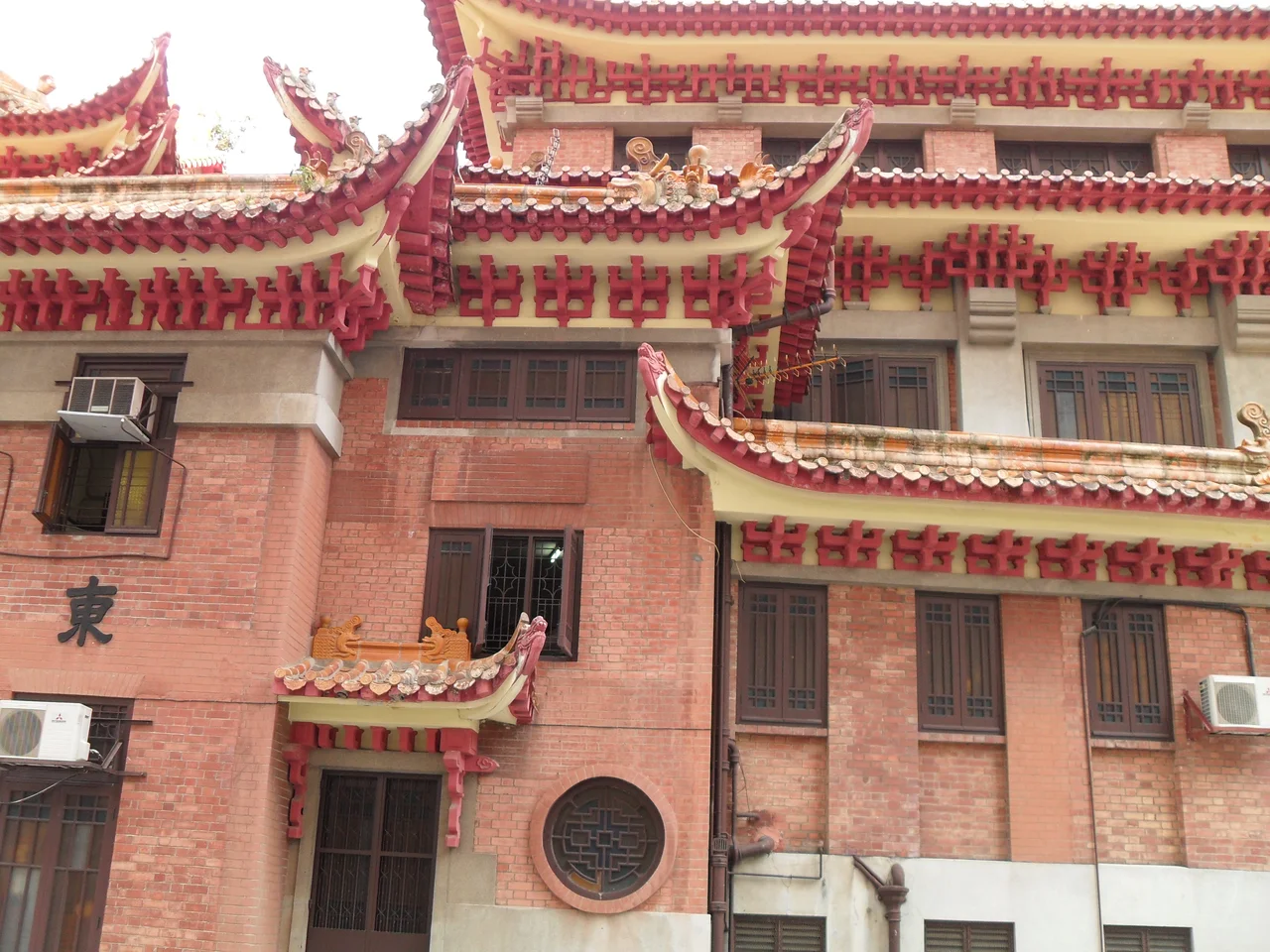

Tung Lin Kok Yuen
Lady Clara Lin-Kok buried her eldest son, nursed Sir Robert through serious pneumonia, lost her parents, and struggled with a chronic throat condition — and from that accumulation of grief she built a temple. Not as retreat, but as act. In 1935, on 12,000 square feet of Happy Valley land she purchased from the Hong Kong Government, she completed Tung Lin Kok Yuen: a Buddhist nunnery, a school for girls who could not otherwise afford one, and a place whose entire architectural silhouette was shaped like a boat — because, in Buddhist symbolism, Buddha guides the living through a sea of suffering toward the light.
A Woman Who Traveled Twenty-One Sacred Mountains
Lady Clara Lin-Kok (1875–1938) was the second wife of Sir Robert Ho Tung, one of Hong Kong's most prominent figures of the early twentieth century. She married him in 1895 and raised ten children. But the biography that matters most for understanding Tung Lin Kok Yuen is not the one of wealth and social standing — it is the one of accumulated loss. The early death of her eldest son, a household stricken by serious illness, her parents' deaths, her own failing voice: these drove her not away from Buddhism but deeper into it. She traveled to twenty-one sacred mountains and famous monasteries across China, including Mount Wutai and Mount Lao, pursuing what she called her journey to truth. She invited Ven. Aiting — retired abbot of the Bamboo Grove Monastery — to supervise the temple's construction and give dharma talks to the community. The result was named after both herself and her husband, in recognition of the support he gave her charitable work.
Hong Kong's First Free School for Girls
When Tung Lin Kok Yuen opened in 1935, it contained more than a temple. Lady Clara had founded the Po Kok First Free School in Hong Kong in 1931, and she built a second branch in Macau shortly after. The school moved into the new temple complex in Happy Valley, becoming the first free Buddhist school for girls in Hong Kong. By 1951, enrollment had outgrown the temple buildings, and a new school structure was built next door to hold the Po Kok Vocational Middle School. Today the Po Kok network operates as female-only institutions at multiple sites in Hong Kong and the New Territories, offering curricula that combine Buddhist sutras with mathematics, English, Chinese, and history. Total enrollment runs to 1,256 students. Tung Lin Kok Yuen remains the only seminary for Buddhist nuns in Hong Kong, offering an eight-year Mahayana programme taught in part by authorities from the wider Sangha.
A Temple Shaped Like a Boat
The architecture of Tung Lin Kok Yuen is inseparable from its philosophy. Shanghainese craftsmen who had also worked on Sir Robert Ho Tung's house on the Peak fitted the interior; their work survives in the dharma hall, lecture theatre, library, sutra hall, dining hall, ancestral hall, and dormitories. Curved ceramic tiled roofs draw on the conventions of imperial palace design. The overall silhouette — seen from a distance — resolves into the shape of a vessel on water, a deliberate reference to the bodhisattva's role as ferryman through suffering. One of Tung Lin Kok Yuen's most celebrated features is its collection of calligraphy and Chinese-style couplets by renowned historical figures, displayed throughout the building. In 2017, Hong Kong declared the compound a monument under the Antiquities and Monuments Ordinance — the highest category of protection, reserved for buildings of outstanding merit.
Buddhist Studies Without Borders
In 1994, Robert Hung-Ngai Ho — longtime board chairman of Tung Lin Kok Yuen who passed away in November 2025 at the age of 93 — established the Tung Lin Kok Yuen Canada Society in Vancouver, British Columbia, registering it with the Government of Canada in Ottawa as a non-profit charitable organisation. His goal was a global network of Buddhist studies centres at major universities, connected by modern communication technology. Centres have already been established in Hong Kong and Canada, with plans to expand to universities in the United States and Europe. The spirit Lady Clara pursued across twenty-one mountains — of bringing Buddhist learning into formal educational institutions, and making it available to people who might not otherwise have access — has crossed an ocean and taken root in university departments on two continents.
From the Air
Tung Lin Kok Yuen sits at 22.267°N, 114.186°E in Happy Valley on Hong Kong Island, a dense residential and commercial district distinguished from the air by the Happy Valley Racecourse — one of Hong Kong's most recognizable landmarks, an oval of green encircled by towers. The nunnery is a short distance northeast of the racecourse. Nearest airport is Hong Kong International (VHHH), roughly 25 kilometers to the northwest on Lantau Island. Approach at 2,000 feet from the harbor for a clear view of the hillside neighborhood and its distinctive tiled rooftops.
Nearby Stories
- Lok Ma Chau Loop 2.3 km away
- Portas do Cerco 2.3 km away
- Kweilin Incident 17 km away
- Wanshan Archipelago Campaign 34 km away
- Nanxiong Formation 115 km away
- Battle of Nanpeng Island 148 km away
- Heyuan 169 km away
- Cape Maobitou 632 km away