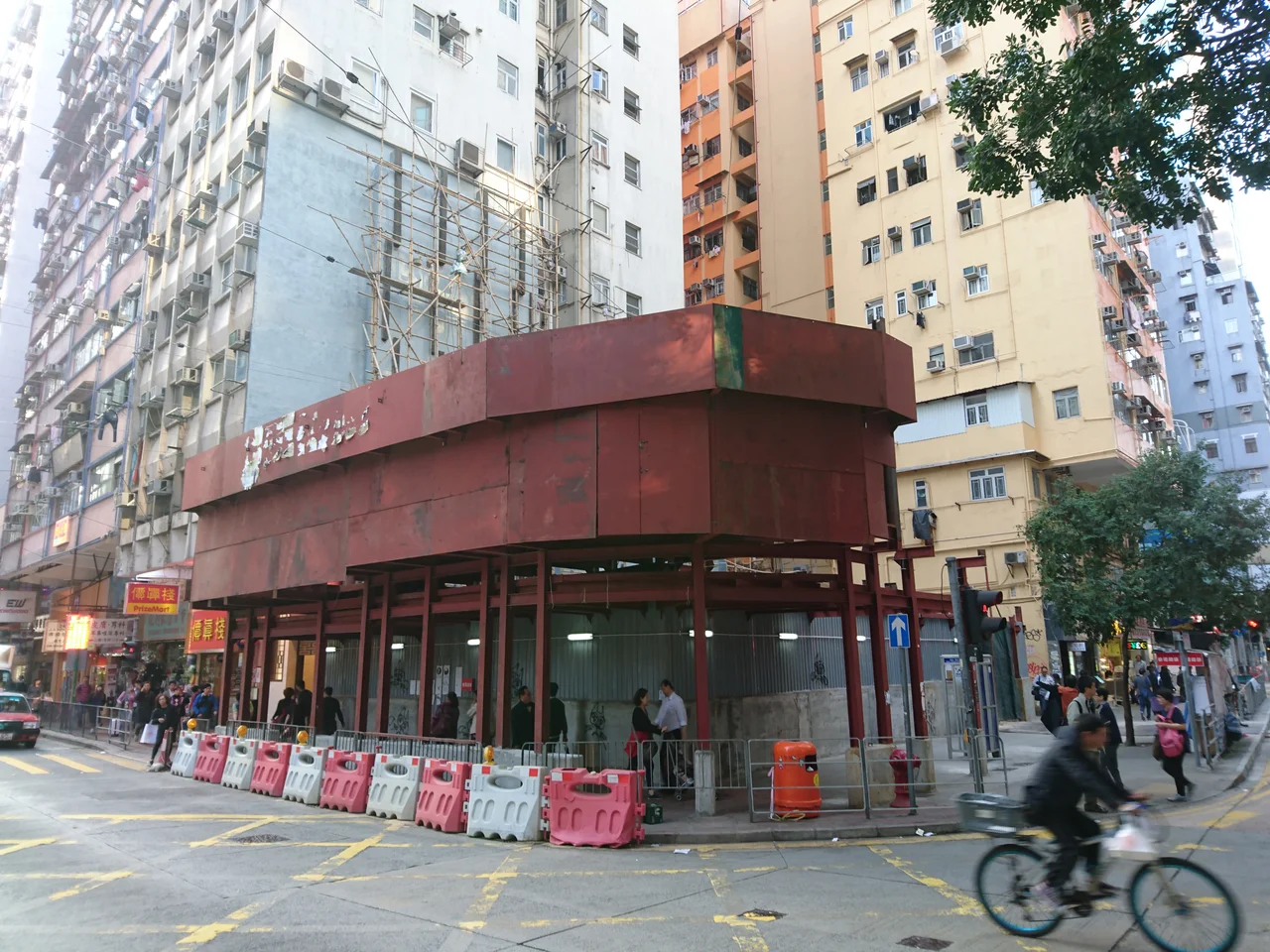

Tung Tak Pawn Shop
In August 2015, the wrecking equipment moved in on 369 and 371 Hennessy Road while heritage advocates were still fighting in the press to stop it. The Tung Tak Pawn Shop — a two-building ensemble on Wan Chai's busiest commercial strip, rated Grade III by Hong Kong's Antiquities Advisory Board — came down anyway. It had stood for roughly eight decades, from the reclaimed land of the early 1930s through the colonial era and into the Special Administrative Region. What the demolition left was a gap in the streetscape, and a photograph record of what Wan Chai once looked like when its shophouses still stood shoulder to shoulder.
Land Reclaimed, Then Built Upon
No. 371 Hennessy Road was probably built in the 1930s, in the years following the completion of the Praya East Reclamation Scheme — a major civil engineering project that extended Hong Kong Island's northern shoreline between 1921 and 1931. The land beneath Tung Tak Pawn Shop was not there a generation before the building went up. Initially the property served as a general commercial building before taking on its identity as a pawnbroker. Pawn shops occupied an important social and economic niche in Hong Kong's working-class districts: they provided short-term credit to families who had no access to banks, accepting household goods, jewelry, and clothing as collateral. The Wan Chai neighborhood around Hennessy Road was exactly the kind of dense, mixed-use district where a pawn shop would find steady business.
The Firm That Left Its Mark on Hong Kong
Tung Tak was designed by the architectural firm Raven and Basto, active in Hong Kong from 1922 to 1937. In a relatively short working life, the firm left a notable imprint on the city. Their most celebrated surviving commission is King Yin Lei on Stubbs Road — a Chinese Renaissance-style mansion built in the same era, now a Grade I declared monument. They also designed St. Louis School, a Grade II historic building, and Shing Kwong Church, a Grade III. Tung Tak was built in the International Modern style then fashionable in the 1930s, a clean-lined approach that sat in productive tension with the traditional Cantonese shophouse, or tong lau, form: a Verandah Type Shophouse with covered walkways at street level, upper floors set back behind colonnades to shade pedestrians from the subtropical sun.
A Last-Ditch Battle and the Wrecking Ball
Hong Kong's Grade III classification means a building has been evaluated and found to be of some historical or architectural merit — but unlike Grade I and Grade II status, it carries no legal protection against demolition. The owner of 369–371 Hennessy Road applied to redevelop, and the application proceeded. In August 2015, with the South China Morning Post reporting on what it called a last-ditch battle to save the building, conservation groups appealed and commentators protested. The appeal failed. By November 2015, photographs showed only a cleared site where the shophouses had been. Wan Chai has lost most of its pre-war tong lau streetscape to successive waves of redevelopment. Tung Tak Pawn Shop was one of the last. The firm Raven and Basto, which built it, had itself dissolved decades earlier, in 1937 — the same year the Japanese army was approaching Shanghai, and the world that made their buildings had already begun to change.
From the Air
The former Tung Tak Pawn Shop stood at 22.279°N, 114.180°E on Hennessy Road in Wan Chai, on the northern shore of Hong Kong Island. From the air at 3,000 feet, the district is identifiable by the dense commercial corridors running parallel to Victoria Harbour, with the Wan Chai MTR station and the Hong Kong Convention and Exhibition Centre's distinctive curved roofline visible to the north. Hong Kong International Airport (VHHH) lies approximately 30 kilometers to the west on Lantau Island. The site itself is now redeveloped and no longer visually distinguishable.
Nearby Stories
- Lok Ma Chau Loop 2.3 km away
- Portas do Cerco 2.3 km away
- Kweilin Incident 17 km away
- Wanshan Archipelago Campaign 34 km away
- Nanxiong Formation 115 km away
- Battle of Nanpeng Island 148 km away
- Heyuan 169 km away
- Cape Maobitou 632 km away