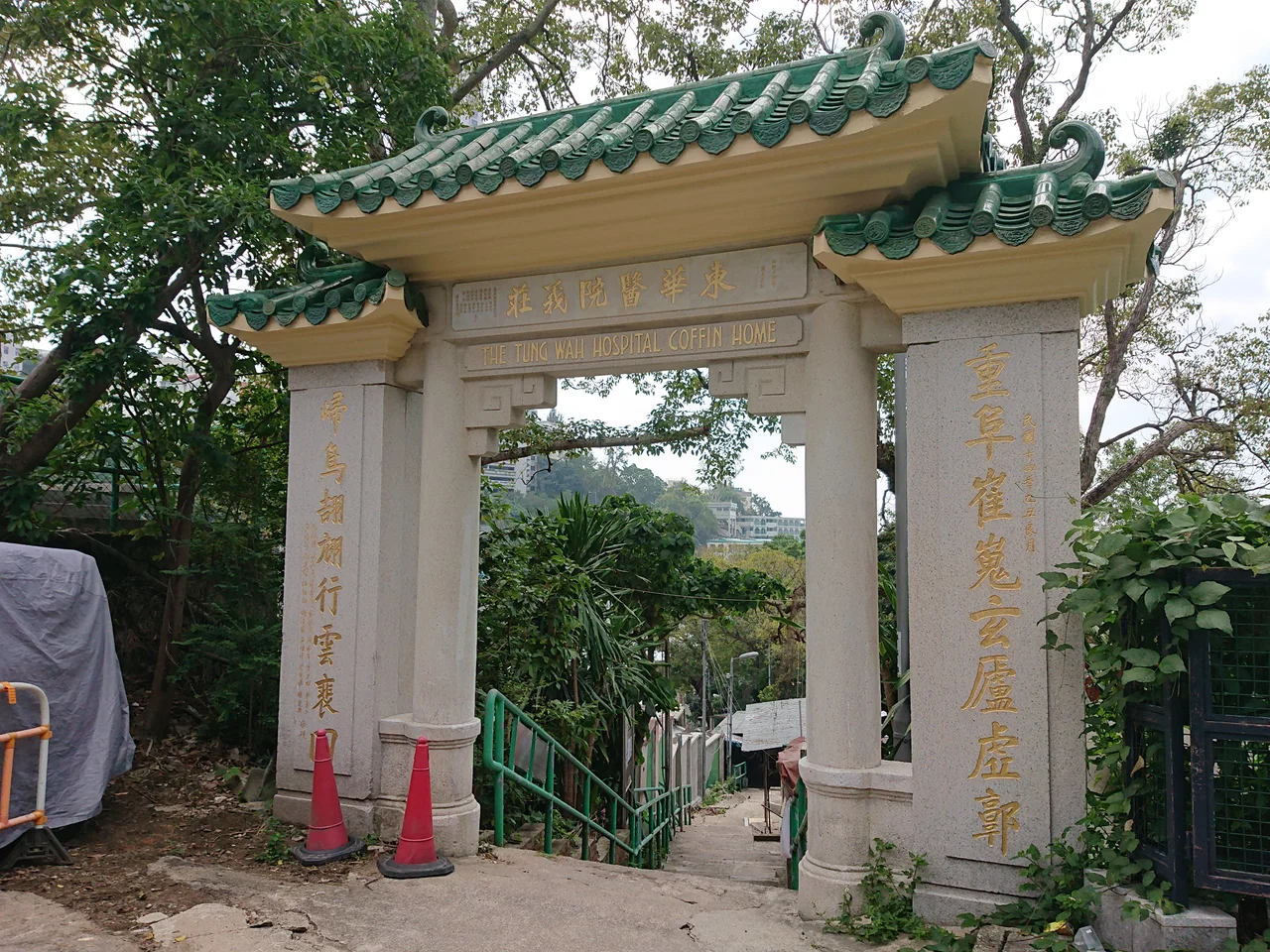

Tung Wah Coffin Home
For generations of Chinese laborers who left Guangdong for the gold fields of California, the rubber plantations of Malaya, or the railways of Canada, one thing remained constant: the wish to be buried at home. When they died abroad — far from their villages, their ancestral graves, their family altars — their families faced a problem. The Tung Wah Coffin Home, on a hillside above Sandy Bay on Hong Kong Island, existed to solve it. Since 1875, this institution has held the coffins and urns of overseas Chinese in temporary care, awaiting the arrangements needed to return them, eventually, to the soil of their birthplaces.
A Slaughterhouse Neighbor, Then a Hill Above Sandy Bay
The original Coffin Home was established in 1875 by the Man Mo Temple in Kennedy Town, on Hong Kong Island's western shore, near a slaughterhouse. The location was not incidental — in the city's geography of the time, the functions of death were grouped at the margins. In 1899, management passed to the Tung Wah Group of Hospitals, a major Chinese charitable institution, and the Home was rebuilt in a new location above Sandy Bay, where it received its current name. From that humble start — a temporary shed on a hillside — it grew steadily over the following century. In 1913, a designated storage space for cremated ashes was added. In 1926, the government allotted roughly 56,000 square feet of additional land, and Bing Yan Hall, a three-story building, went up. World War II interrupted the repatriation service: with Japan occupying Hong Kong, coffins could not be transported to mainland China and accumulated in storage, forcing the Tung Wah group to expand capacity through reconstructions in 1948, 1951, and 1957. By 1960, the compound held 670 coffins, 8,060 exhumed bodies awaiting re-interment, and 116 sets of cremated remains.
The People Who Waited Here
To understand the Coffin Home is to understand the scale of Chinese emigration from the nineteenth century onward. Men — and they were overwhelmingly men — left coastal Guangdong for Southeast Asia, North and South America, and the Caribbean in search of wage work that simply did not exist at home. They sent remittances back. They planned to return. Many did not. When they died, their families engaged the Tung Wah network to retrieve the body or the bones, hold them safely, and arrange eventual repatriation when passage and funds permitted. Among those who rested here while awaiting transfer were Cai Yuanpei (蔡元培), former chancellor of Peking University; Chen Jiongming (陳炯明), a significant figure in the early Republic of China; the merchant Lin Bai Xin (林百欣); and Chow Kwen Lim (周君任), founder of Chow Sang Sang Jewellery. Tang Kam Chi (鄧鑑之), one of the founders of the Tung Wah Group of Hospitals itself, has had his ashes kept in the Coffin Home for more than a hundred years, alongside his wife's. These were not anonymous dead: they were people with families, histories, and names — held in careful trust.
An Architecture of Crossing Worlds
What makes Tung Wah Coffin Home remarkable as a physical place is the way its buildings register the passage of time and the collision of cultures. The compound grew across more than a century of construction, and each phase layered a different architectural sensibility onto the hillside. The oldest rooms — Ning, Hong, and Sou — are more than a century old, with brick walls, tilted roofs, wooden strips, and Chinese clay tiles: pure vernacular architecture. The Reception Hall entrance is guarded by two classical Roman Doric columns. British-style blinds shade windows designed with a tropical colonial logic. The Yut Yuet Hall merges Chinese roof traditions with a colonial flat top. Somewhere in the mix stands a traditional Chinese pagoda. The compound's current area covers approximately 6,050 square meters, comprising a garden, gateway, pagoda, 91 rooms, and 2 halls. UNESCO's adjudicators, awarding the 2005 Asia-Pacific Heritage Award for Cultural Heritage Conservation, described it as spanning 'vernacular Chinese architecture to modern buildings' — a range that reflects, precisely, the span of history this institution has witnessed.
Restored, Recognized, Still in Use
By the early 2000s, demand for the Coffin Home's original service had diminished — fewer families needed to repatriate remains across a now-open border — and the compound had deteriorated. Between 2003 and 2004, a major restoration project unfolded in two phases, spanning eleven months total. Conservators worked with traditional local techniques to return the buildings to their historical appearances while meeting modern safety standards. In 2005, the project won UNESCO's Asia-Pacific Heritage Award (Award of Merit) and received the Hong Kong government's own Heritage Preservation and Conservation Award. UNESCO's citation praised the work for 'preserving a unique building typology and an important cultural institution which reflects the evolving social history of Hong Kong.' The Tung Wah Coffin Home remains in active use today, still providing the temporary depository service it has offered since the Qing dynasty, still a place where the distance between where someone lived and where they belong can be held, respectfully, in trust.
From the Air
Tung Wah Coffin Home sits at 22.272°N, 114.126°E above Sandy Bay on the western side of Hong Kong Island. From the air at 2,000–3,000 feet, approach from the harbor side: Sandy Bay is a small residential cove west of Kennedy Town, with the compound visible on the hillside above. The Stonecutters Island and Tsing Yi lie to the northwest. Hong Kong International Airport (VHHH) is approximately 25 kilometers due west on Lantau Island. The tiled rooftops and pagoda form of the compound distinguish it from surrounding residential development.
Nearby Stories
- Lok Ma Chau Loop 2.3 km away
- Portas do Cerco 2.3 km away
- Kweilin Incident 17 km away
- Wanshan Archipelago Campaign 34 km away
- Nanxiong Formation 115 km away
- Battle of Nanpeng Island 148 km away
- Heyuan 169 km away
- Cape Maobitou 632 km away