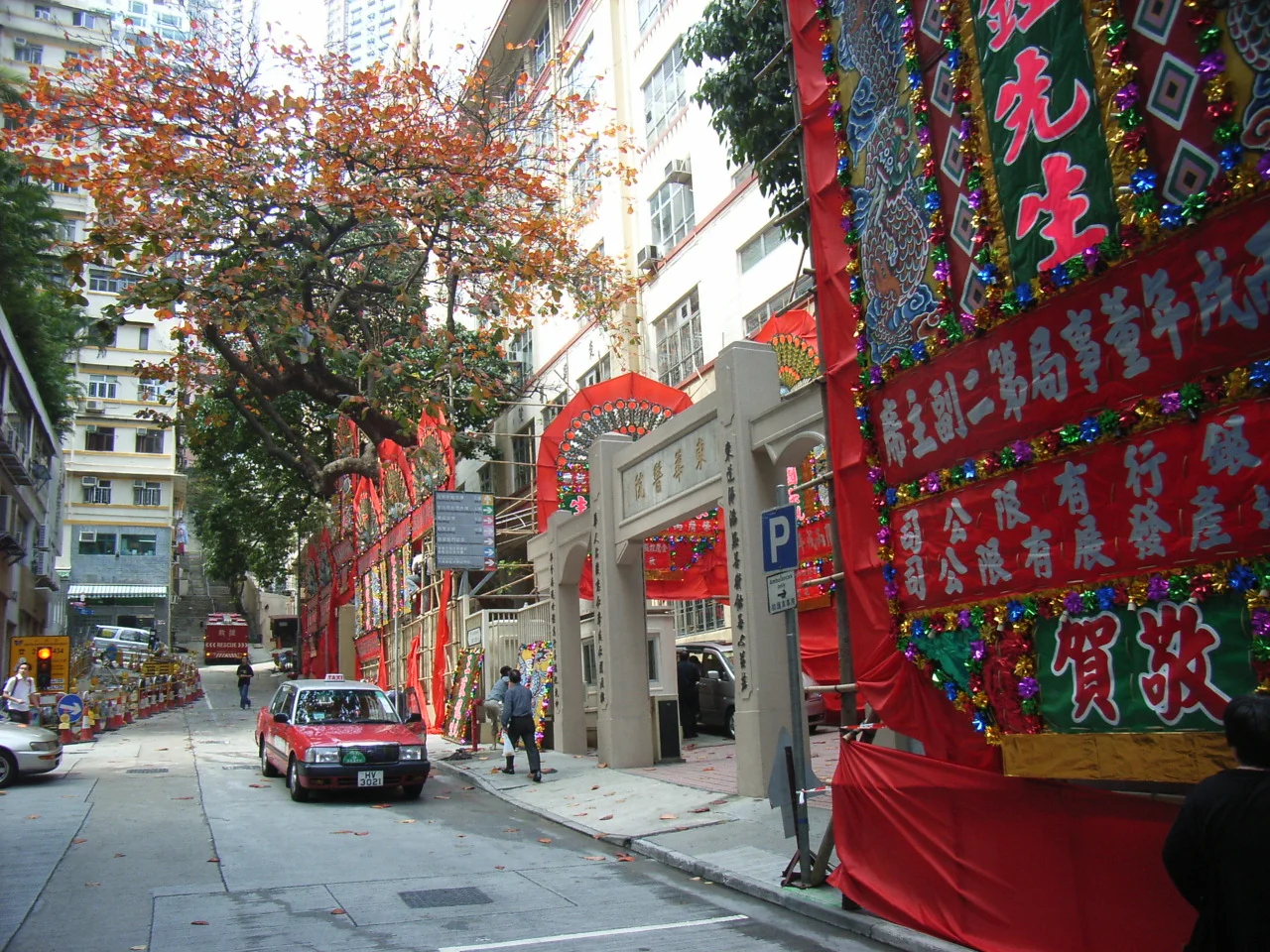

Tung Wah Hospital
When the British colony's registrar general walked into a small temple on Tai Ping Shan Street in the late 1860s, what he found was not prayer but desperation: the dead and the dying huddled together in the same cramped space, indiscriminately mixed, with no one to care for either. The scene galvanized action. Hong Kong had hospitals — but none that Chinese residents trusted enough to enter. The solution, born from that grim discovery, was Tung Wah Hospital: an institution founded not merely to treat illness, but to bridge two worlds that regarded each other with deep suspicion.
The Crisis That Built a Hospital
Colonial Hong Kong in the 1860s was a city divided by more than language. Chinese residents distrusted Western medical practices — surgery in particular — with a profound and not entirely unreasonable skepticism. Many would rather endure suffering at home, or in a crowded temple, than submit to the knife of a foreign doctor. The result was a public health crisis unfolding in plain sight. When the Tai Ping Shan Street temple revealed its grim population of the dying and dead, the colonial government recognized it could not simply open another Western clinic and expect people to show up. It needed something different.
On 26 March 1870, the "Tung Wah Hospital Incorporation Ordinance" was declared, authorizing the hospital's construction. Two years of planning and construction followed, and on 14 February 1872, Tung Wah Hospital opened its doors. The grand opening was described as the most spectacular event colonial Hong Kong had witnessed.
A Hospital the Community Could Call Its Own
The genius of Tung Wah was not architectural but cultural. It offered Chinese-style medical care within a formal institution — a space where traditional practices were respected rather than replaced. For a community that had watched Western medicine arrive alongside colonialism, the distinction mattered enormously. Tung Wah became not just a place to seek treatment but a symbol of Chinese community self-determination within a foreign-governed city.
The government subsidized the hospital and provided a land grant, but the institution's character was shaped by the community it served. Chinese merchants and civic leaders played central roles in its governance from the beginning. This model — charitable, community-rooted, Chinese in orientation — proved so successful that it seeded an entire network. Tung Wah Group of Hospitals, the umbrella organization that grew from this single building on Po Yan Street in Sheung Wan, today operates dozens of hospitals, clinics, and social service centers across Hong Kong.
Expanding With the Colony
As Hong Kong grew, so did the demands on its medical infrastructure. The population of Kowloon and the New Territories expanded through the late 19th and early 20th centuries, straining a system designed for a smaller, more concentrated colony. In 1911, the government enacted Ordinance No. 38 — the "1911 Expansion of Tung Wah Hospital Ordinance" — to address that growth, extending the network's reach alongside the establishment of Kwong Wah Hospital across the harbor.
The Main Block of the original Tung Wah Hospital still stands at 12 Po Yan Street, Sheung Wan, now graded as a Grade I historic building — the highest tier of architectural and historical significance in Hong Kong. It remains an active facility, the second largest general hospital in the Hong Kong West Cluster, with 633 beds: 494 for in-patients, 93 for day patients, and 46 rehabilitation places. The hospital is affiliated with the Li Ka Shing Faculty of Medicine at the University of Hong Kong.
History in Stone, Medicine in Practice
There is something quietly remarkable about a building that has served the sick for more than 150 years. The walls of Tung Wah Hospital have witnessed the Third Pandemic, two world wars, the transformation of Hong Kong from colonial outpost to global city, and the handover of sovereignty in 1997. Through all of it, the hospital has continued to receive patients.
To stand above Possession Point — named for the 1841 landing where Britain formally claimed Hong Kong — and look toward the old Main Block is to see two histories overlaid. One is the story of colonial ambition and the infrastructure it built. The other is the story of a community that refused to disappear into that infrastructure, and instead built something of its own that outlasted the colony itself. Tung Wah Hospital belongs to the second story.
From the Air
Tung Wah Hospital sits at 22.2852°N, 114.147°E in Sheung Wan, on the northwestern side of Hong Kong Island. From the air at 3,000–5,000 feet, the dense mid-rise streetscape of Sheung Wan is visible just west of the towering skyline of Central. Possession Point, the historic British landing site, is immediately below. Hong Kong International Airport (VHHH) lies about 25 miles to the northwest on Lantau Island. The Po Yan Street area is best distinguished by its relatively low rooflines compared to the glass towers of Central to the east.
Nearby Stories
- Lok Ma Chau Loop 2.3 km away
- Portas do Cerco 2.3 km away
- Kweilin Incident 17 km away
- Wanshan Archipelago Campaign 34 km away
- Nanxiong Formation 115 km away
- Battle of Nanpeng Island 148 km away
- Heyuan 169 km away
- Cape Maobitou 632 km away