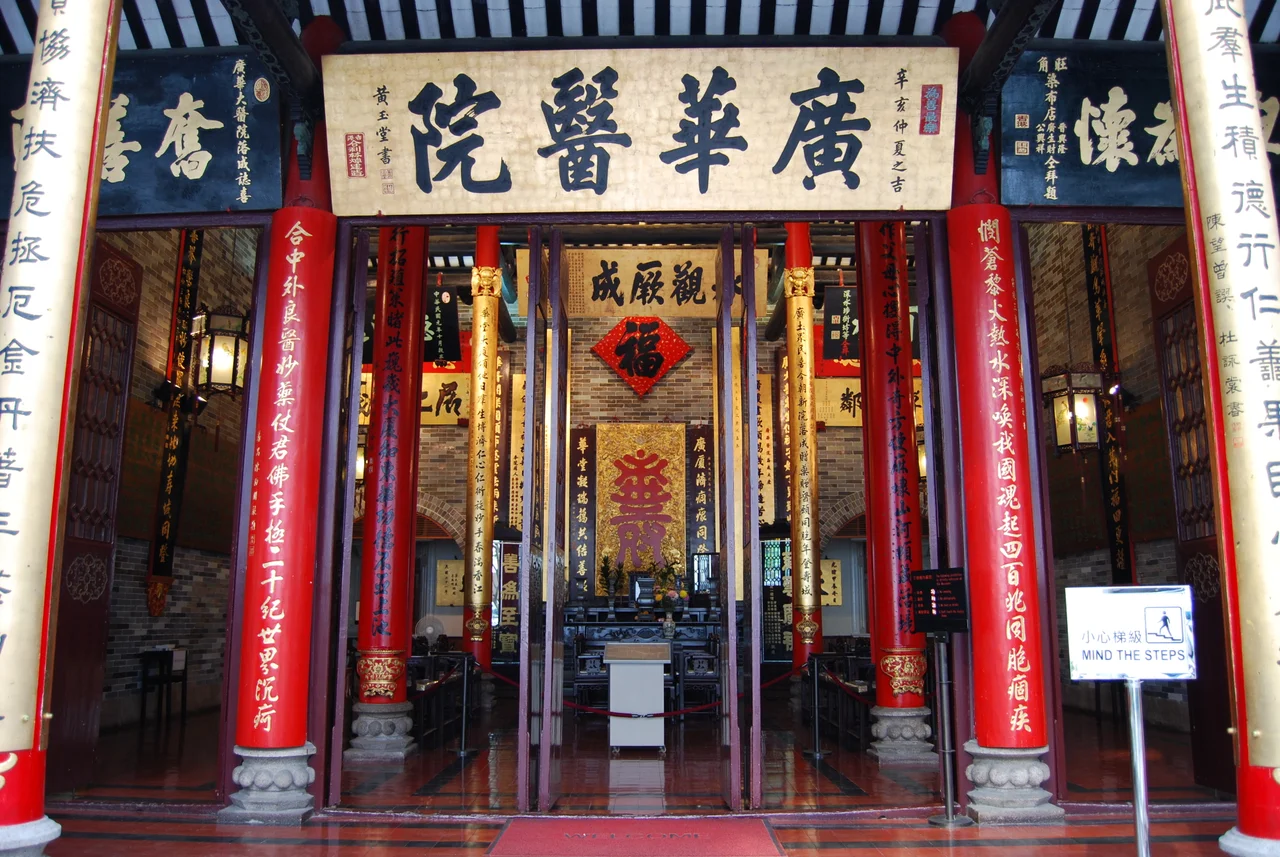

Tung Wah Museum
When Kwong Wah Hospital was redeveloped between 1958 and 1963, one building was spared the wrecking ball: the original Main Hall, constructed in 1911, the year of China's revolution. That decision to preserve a single structure now seems almost prophetic. The building that survived became the Tung Wah Museum — a repository of plaques, records, and imperial gifts that trace not just the history of a hospital network, but the social and political life of a Chinese community navigating between the Qing dynasty, the Republic of China, and the British colonial administration.
The Building That Outlived Its Hospital
Kwong Wah Hospital was established to serve the rapidly expanding population of Kowloon in 1911 — the same year the Qing dynasty fell and the Republic of China was proclaimed. The Main Hall Building at 25 Waterloo Road was built that year in a style that blended Chinese and colonial sensibilities, and it served as the administrative heart of the hospital for decades.
When the hospital underwent comprehensive redevelopment in the late 1950s, planners decided to preserve the Main Hall while replacing everything around it. That restraint was unusual for an era that generally prioritized efficiency over heritage. The building was classified as a Grade I historic building, acknowledging its architectural and historical significance. In 2010, recognition went further: it was declared a monument under Hong Kong's Antiquities and Monuments legislation — one of the city's highest heritage designations.
A Museum Born for a Centenary
The Tung Wah Museum opened in 1970 — the centenary year of the Tung Wah Group of Hospitals, which traces its origin to the founding of Tung Wah Hospital in 1870. The timing was deliberate. A hundred years on, the group chose to mark its anniversary not with a new building but with an act of memory: gathering the archives and artifacts that documented how a charitable hospital had become one of Hong Kong's most significant civic institutions.
What the museum holds reflects the network's remarkable reach across Chinese society during the late Qing and early Republican eras. Among the most striking exhibits is the plaque presented by Li Hongzhang in 1884, accompanied by three of his colleagues. Li was one of the most powerful officials of the late Qing period — a general, diplomat, and statesman who navigated China's fraught relationship with Western powers. That he and his associates would present a formal gift to a charitable hospital in a British colony says much about how seriously the Tung Wah network was regarded across the Chinese world.
Plaques, Gifts, and the Politics of Philanthropy
The museum's collection extends beyond the Li Hongzhang plaque to include gifts and honors from other Qing dynasty officials and from representatives of the early Republic of China. Each object carries its own political weight. Presenting a plaque to Tung Wah was an act of recognition — an acknowledgment that this charitable institution in colonial Hong Kong held genuine moral authority within the Chinese community.
The Tung Wah Group operated in a complicated space: it was Chinese in character and leadership, functioning within a British colonial system, serving a community that maintained deep ties to the mainland. Its hospitals were a form of cultural continuity as much as a medical service. The artifacts now in the museum's collection are traces of that complicated, carefully negotiated position — gifts that crossed political and geographic boundaries because the institution that received them had earned trust on all sides.
Visiting the Archive of a Century
The museum occupies a building that still reads as civic and formal — its architecture carrying the deliberate gravitas of an institution that understood it was building something meant to last. Inside, the display of archives and relics rewards patient attention. These are not objects chosen for spectacle but for meaning: documents, plaques, and ceremonial items that mark the milestones and relationships of a century of charitable work.
When open, the museum is accessible Monday through Saturday, 10 a.m. to 6 p.m., closed on public holidays, with Yau Ma Tei MTR station, Exit A2, providing the most direct access. Note that the museum has been temporarily closed in connection with the ongoing Kwong Wah Hospital redevelopment project; visitors should confirm current status before planning a visit. For those interested in Hong Kong's institutional and social history — in how communities organize themselves under foreign governance, and how civic institutions earn and maintain legitimacy — the Tung Wah Museum offers a quiet and uncommonly rich hour.
From the Air
The Tung Wah Museum sits at 22.31494°N, 114.17191°E on Waterloo Road in Kowloon, roughly 1.5 miles north of the Tsim Sha Tsui waterfront. From the air at 3,000–5,000 feet, Kowloon's dense urban grid is visible south of Lion Rock. The building is near the Yau Ma Tei district. Hong Kong International Airport (VHHH) is approximately 20 miles to the west on Lantau Island. The Victoria Harbour waterfront and the cluster of towers at Tsim Sha Tsui provide useful visual orientation from altitude.
Nearby Stories
- Lok Ma Chau Loop 2.3 km away
- Portas do Cerco 2.3 km away
- Kweilin Incident 17 km away
- Wanshan Archipelago Campaign 34 km away
- Nanxiong Formation 115 km away
- Battle of Nanpeng Island 148 km away
- Heyuan 169 km away
- Cape Maobitou 632 km away