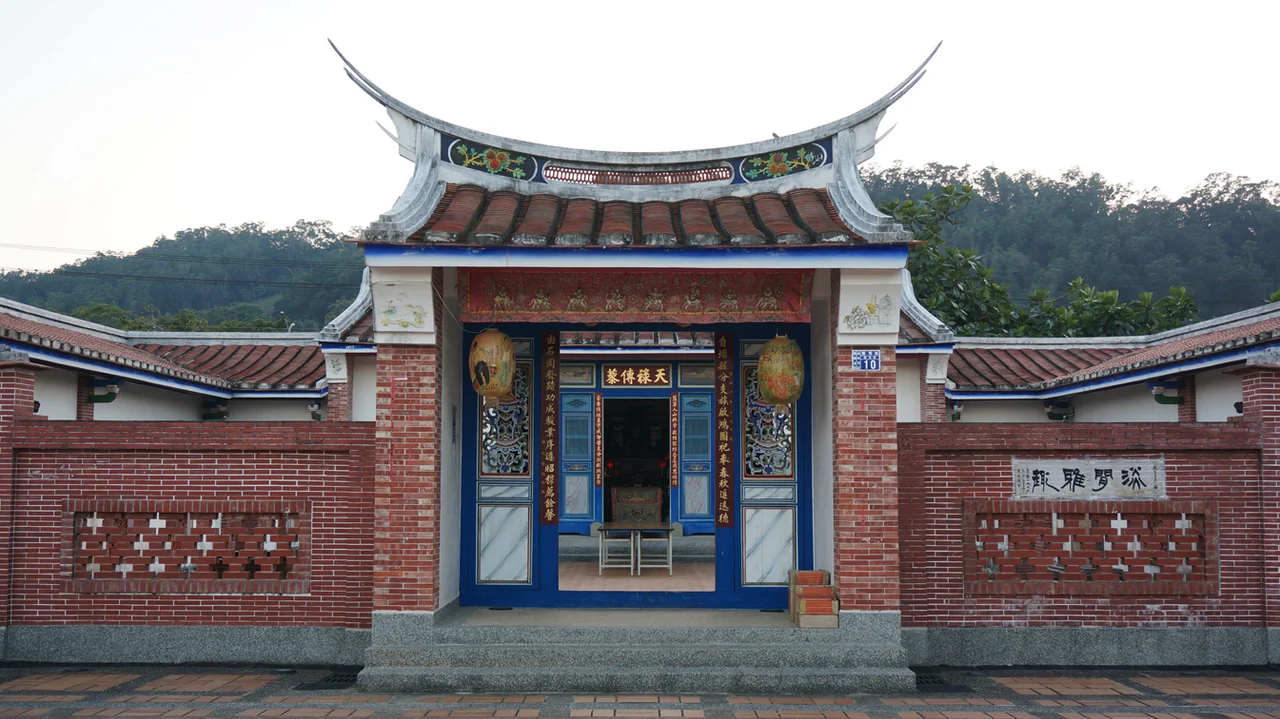

Tuniu Hakka Cultural Museum
The name of this place is older than the building, and the name tells a complicated story. "Tuniu" — 土牛 in Chinese, meaning earth oxen — refers to the earthen mounds and ditches that Qing dynasty authorities constructed across central Taiwan beginning in the 18th century to mark the boundary between areas where Han Chinese settlement was permitted and the territories of indigenous Taiwanese peoples. The line was enforced with varying degrees of success and violence, and the boundary itself shifted as colonial pressure and settlement pushed further into indigenous land. The museum in Shigang District, Taichung, sits near where one of those boundary markers once stood — a place that holds Hakka settler heritage and the memory of a frontier drawn at indigenous expense, both at once.
The Boundary That Was Called an Ox
During the Qing dynasty, Taiwan's administrators faced a persistent problem: Han Chinese settlers — among them many Hakka people from Guangdong province — were pushing into territories belonging to indigenous Taiwanese groups, leading to conflict. Beginning in the 1720s and continuing through the 18th and into the 19th century, the Qing government attempted to manage this by drawing what they called the Earth Ox Line: a series of earthen embankments, ditches, and markers running north to south across the island. Beyond the line, Han settlement was theoretically forbidden.
In practice, the line moved repeatedly as settlement expanded and colonial policy shifted. Indigenous peoples on the frontier — primarily groups from what are now called the Pingpu peoples — lost land, autonomy, and in many cases their communities as the boundary was redrawn to accommodate settlers. The earth oxen were the physical symbols of a system that dispossessed people while claiming to protect them.
A Hakka Family's House
Long after the Qing boundaries faded, the Shigang area became firmly Hakka territory. The Liu family built a home here, and that home became the seed of what would become the cultural museum. The Liu family building represented the kind of traditional Hakka architecture that characterized prosperous farming households in this part of Taiwan — courtyard-oriented, built to last, tied to the rhythms of agricultural life in the Taichung basin.
Hakka culture in Taiwan carries its own complexity: the Hakka were themselves migrants, people who had moved from various parts of China across centuries, often displaced, often settling in the territories between more established groups. In Taiwan, they arrived in significant numbers during the 17th and 18th centuries, and their communities developed distinctive architectural, culinary, and musical traditions. The Liu family home was an expression of that settled, rooted identity.
September 1999
On September 21, 1999 — the same morning the 921 earthquake ruptured the Chelungpu Fault and killed approximately 2,400 people across central Taiwan — the Liu family building collapsed. The earthquake caused enormous destruction throughout Shigang District and the surrounding area, and the old house did not survive it.
What followed required years of patience. The Liu family applied for government subsidy to reconstruct the building, and the reconstruction was careful: the goal was to rebuild at the original site with the original design and appearance. That kind of fidelity takes time. Six years after the earthquake, on May 9, 2006, the rebuilt structure opened as the Tuniu Hakka Cultural Museum. It was named not just for the family or the site but for the deeper historical context — the earth ox boundary that this corner of Taichung had once represented.
What the Museum Holds
The museum today comprises a main reception hall and four exhibition halls, with both static displays and multimedia presentations covering Hakka history, culture, and daily life. Visitors who come through the rooms encounter the material culture of a community that has been present in Taiwan for centuries: the tools, the clothing, the food traditions, the music. The Hakka language — distinct from Mandarin and from Taiwanese Hokkien — is part of what the museum works to keep visible.
But the name Tuniu does more than preserve Hakka heritage. It keeps in view the history of the boundary itself: the indigenous peoples who lived beyond it, the pressures that moved it, the complicated interplay of colonial authority, settler expansion, and resistance that shaped this landscape before the museum, before the Liu family house, before any of the structures that stand here now. The earth oxen are long gone. Their name, at least, remains.
From the Air
The Tuniu Hakka Cultural Museum is located at 24.265°N, 120.810°E in Shigang District, Taichung, in the low hill country east of Fengyuan and north of the Taichung basin. From the air at 3,000–5,000 feet, Shigang District appears as a patchwork of farmland and low hills at the transition zone between the Taichung plain and the foothills of the central mountain range. The Dajia River runs nearby to the north. Nearest major airport is RCMQ (Taichung International Airport), approximately 25 km to the southwest. Flying northeast from RCMQ over the Taichung basin, the terrain rises gradually into Shigang; the museum sits in the agricultural flats before the first significant ridgeline. Haze from the basin is common in summer; clearer conditions prevail in winter months.
Nearby Stories
- Wufeng Lin Family Mansion and Garden 6.5 km away
- Tapung Old Fort 9.4 km away
- 1991 Miaoli Train Collision 9.7 km away
- Taroko National Park 20 km away
- China Airlines Flight 204 21 km away
- Taiwan Strait 38 km away
- Taixi, Yunlin 43 km away
- China Airlines Flight 611 69 km away