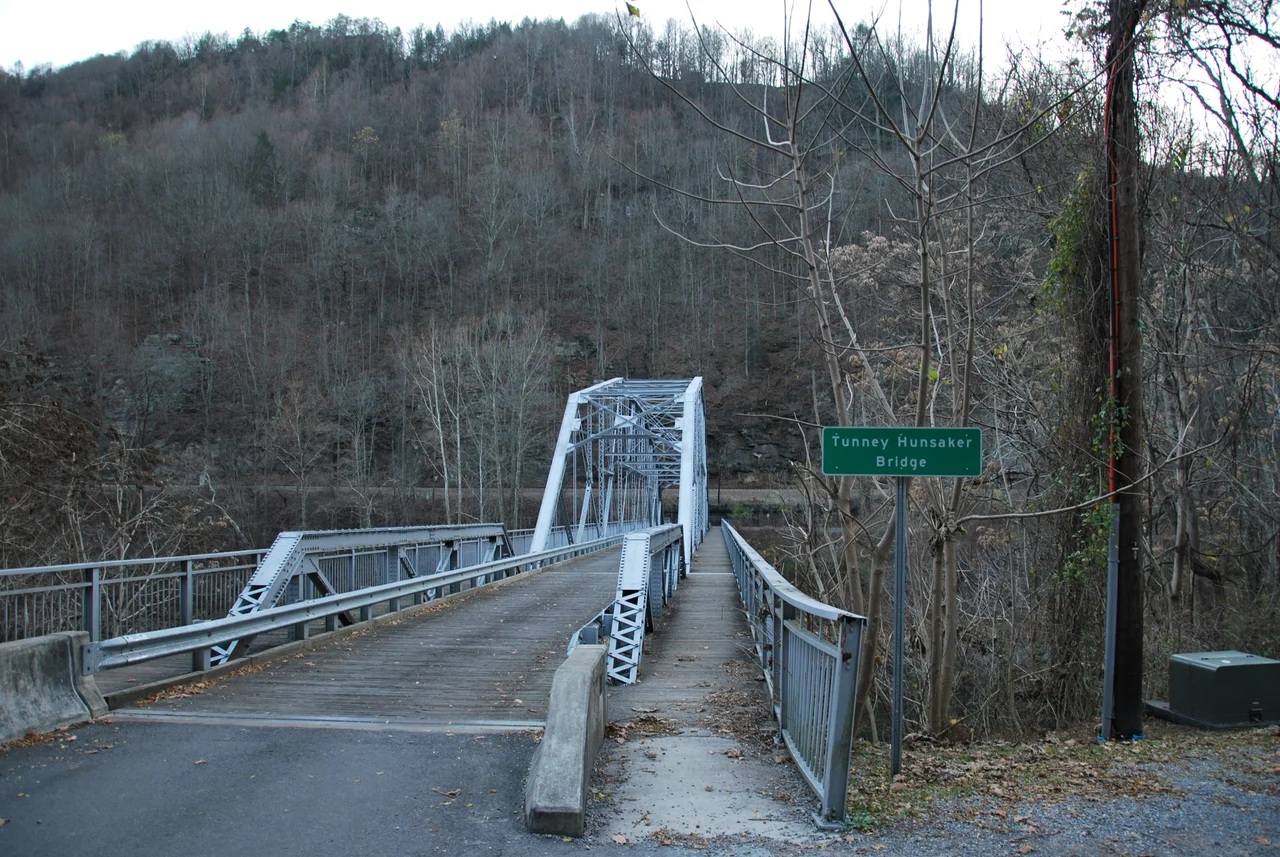

Tunney Hunsaker Bridge
Before the great steel arch of the New River Gorge Bridge made the trip across the canyon a 45-second affair, getting from one rim to the other meant a slow winding descent down Fayette Station Road, a careful crossing of a narrow iron truss bridge at the river, and an equally slow climb up the other side. The whole journey took about 45 minutes. That old crossing - completed in 1889 by the Virginia Bridge and Iron Company of Roanoke - still spans the New River about 600 feet below the modern bridge deck. Since 1998 it has carried the name Tunney Hunsaker, after the Fayetteville police chief and professional heavyweight boxer who once climbed into a ring in Louisville against an 18-year-old named Cassius Clay.
Fayette Station Road
The truss bridge was built to serve Fayette Station, a small railroad community at the bottom of the gorge where the Chesapeake and Ohio mainline ran. Visitors arriving by train could cross the bridge into Fayetteville proper, on the south rim. Local farmers from the plateau could bring produce to the C&O sidings. The bridge is a single-lane structure - 279 feet of main truss span with two approach spans on either side, totaling 421 feet end to end. Iron rivets, painted black, hold the trusses together. For 88 years it served as the principal road crossing of the New River in this part of West Virginia. The road that approaches it from both rims - Fayette Station Road, today County Route 82 - is a switchback hairpin descent that car-magazine writers still come to photograph.
The New Bridge and the Old Bridge
When the New River Gorge Bridge opened in 1977, the steel arch high above became the new primary route for US Route 19. Traffic on Fayette Station Road dropped dramatically. The old iron truss, in poor structural condition after nine decades of unbroken service, was closed for vehicular use shortly thereafter. For two decades it stood unused, an Victorian-era artifact in a national river corridor, while the modern arch carried 16,000 cars a day overhead. In 1997, the bridge was rehabilitated by the National Park Service and reopened to single-lane traffic. The Fayette Station Road descent now serves as a slow scenic alternative to the highway - one of the most popular driving routes in the New River Gorge National Park and Preserve. Visitors who take it can stop at the bottom and walk the bridge.
Tunney Hunsaker, Police Chief and Boxer
Orville Junior Hunsaker - everyone called him Tunney, after the heavyweight champion Gene Tunney - grew up in Beckwith, West Virginia, served as Fayetteville's chief of police, and made his name in the small world of West Virginia boxing in the 1950s. In 1960 he was asked to take a fight against a young Olympic gold medalist who was about to turn pro. Hunsaker took it. On October 29, 1960, Cassius Clay - who would later be known as Muhammad Ali - made his professional debut against Hunsaker in Louisville's Freedom Hall. Clay was 18 years old. The fight went six rounds. Clay won on points. Hunsaker, slowed and bloodied, said afterwards that Clay was the fastest fighter he had ever faced. The two stayed in touch for years. Hunsaker continued as Fayetteville's police chief, fought a few more bouts, and retired with his place in boxing history secured. The bridge across the New River, near the town he served, was renamed for him in 1998.
Standing on the Span
Today the old bridge sits in the river-level core of New River Gorge National Park and Preserve, accessible by car via the switchback road or on foot via trails that descend from the rim. It crosses water that once turned C&O locomotive wheels and now carries whitewater rafters by the thousands every summer. The historic American Engineering Record has documented the structure in detail; photographs in the Library of Congress show it as built and as restored. Standing on the iron deck of the Tunney Hunsaker Bridge, looking straight up at the steel arch of the New River Gorge Bridge 600 feet overhead, you get a clear sense of the gorge's scale and of the engineering generations that have crossed it. Two centuries, one canyon, both bridges still standing.
From the Air
The Tunney Hunsaker Bridge crosses the New River at 38.065 N, 81.077 W, at the bottom of the gorge in Fayette County, West Virginia, directly beneath the steel arch of the New River Gorge Bridge. Recommended viewing altitude is 2,000 to 4,000 feet AGL. The bridge appears as a thin line across the water; the switchback road descending from both rims is easy to identify from above. Nearest airports are Raleigh County Memorial (KBKW) in Beckley about 15 miles south and Yeager (KCRW) in Charleston about 40 miles northwest. Plan to look northwest if approaching from below the rim.
Nearby Stories
- West Virginia State Capitol 4.7 km away
- Greenbrier County, West Virginia 13 km away
- Beckley, West Virginia 13 km away
- Clay, West Virginia 16 km away
- The Greenbrier 18 km away
- Webster Sycamore 26 km away
- Kanawha State Forest 26 km away
- Welch, West Virginia 40 km away