
Tyne Theatre and Opera House
Beneath the stage of the Tyne Theatre on Westgate Road, the wooden bridges, sloats, and corner traps of 1867 still work. Four bridges that can raise actors from below, eight sloats for sliding scenery in from the wings, two staircase traps, three object traps, one grave trap, and a hemp fly floor on stage left with a drum-and-shaft system for the act drop. It is, by some margin, the most complete surviving example of an English wood stage from the Victorian era. English Heritage rates the building in the top four percent of all listed structures. The Theatres Trust gives it three stars - the highest - and calls it 'a very fine theatre of the highest theatrical and architectural quality.' The plaster ceiling above the stalls is Italianate. The machinery below the stage is the Industrial Revolution applied to spectacle.
1867: A Working Stage
The theatre opened in 1867, designed by the Newcastle architecture practice of William Parnell as a producing house - an institution that would mount its own productions rather than only host touring companies. The first manager, George Stanley, ran locally produced drama, opera, musical spectacle, and pantomime from 1867 until 1881. The stage machinery he commanded was state-of-the-art for its decade: a complete grid of drums and shafts overhead for synchronised scene changes, mechanical bridges and traps below for sudden appearances and disappearances, a deep fly tower for hoisting backdrops, and one of the earliest electric lighting switchboards in Britain. The building is the only one of the eight surviving Grade I listed original theatres in Great Britain that dates from the Victorian era.
The Father of Pantomime
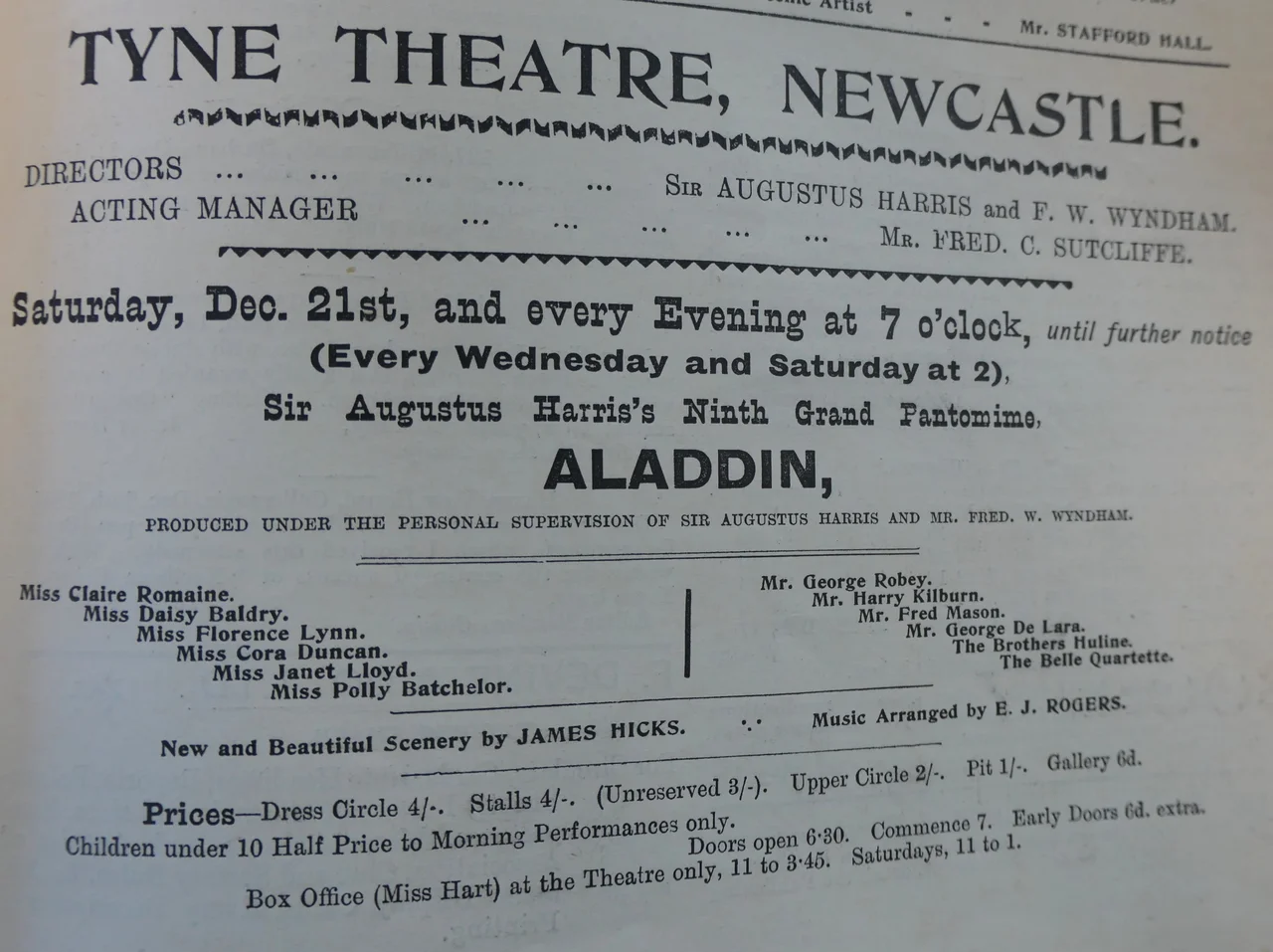
By the 1880s, the London star system made it harder for local producing companies to compete. Richard William Younge managed the theatre from 1881 to 1887, but when he died in June 1887 the lease passed to Augustus Henry Glossop Harris, who ran the Theatre Royal in Drury Lane and is sometimes called 'the Father of modern Pantomime.' Harris was knighted in 1891. Under his leadership, and the joint lease with Frederick Wyndham and James Brown Howard who also ran the Theatre Royal Newcastle, the theatre was substantially altered - the buildings that now house the Bistro Bar and the shops west of the theatre were added as a Grand Salon entrance. After 1895, Howard and Wyndham Ltd, founded by Michael Simons of Glasgow, took over both Newcastle theatres.
Gladstone, Bernhardt, La Bohème
The list of who stood on this stage reads like a survey of the late Victorian theatrical world. William Gladstone spoke from the boards in 1891, at eighty-two years old, near the end of his political career. Sarah Bernhardt performed at the Tyne Theatre three times from 1895. The Carl Rosa Opera Company gave Newcastle its first performance of Puccini's La Bohème in 1897. The world premiere of Wolf-Ferrari's opera The Jewels of the Madonna happened on this stage. In the twentieth century, Plácido Domingo sang Tosca here in May 1983; Dame Joan Sutherland performed in 1989; Richard Todd starred in 1978; Steve Harley and Cockney Rebel played a memorable concert in August 2018. The building has outlived several rounds of changing fashion in entertainment.
Cinema and Fire
The First World War broke the theatre's economics. In 1917, with audiences thinned by war and the movies eating the live-entertainment market, the building closed. By 1919, Sir Oswald Stoll had leased it and converted it into the Stoll Picture Theatre. The painted advertisement on the gable end - THE STOLL TYNESIDE'S TALKIE THEATRE - is still visible on Westgate Road. The Stoll was the first cinema in Newcastle to show talkies. It ran as a picture house for fifty-five years until closing in March 1974. Three years later, in July 1977, the building reopened as a theatre. A backstage fire in 1985 caused serious damage; the careful rebuilding that followed restored the Victorian stage machinery rather than replacing it with modern equivalents. The fact that the traps still work today is a result of that decision.
The Preservation Trust
The theatre is now run by Tyne Theatre and Opera House Ltd, a subsidiary of the Tyne Theatre and Opera House Preservation Trust. Both are charities; all funds raised go back into preserving the building. The Trust has plans for a major refurbishment, with the auditorium and stage machinery to be restored to their Victorian roots, alongside the creation of an education and heritage centre that will let visitors see the working stage from below. The north part of the building falls within the boundary of the Hadrian's Wall World Heritage Site - because everything in Newcastle eventually traces back to the Romans. Westgate Road runs along the line of the old Roman road. The theatre that has been a music hall, an opera house, a cinema, and a theatre again sits on a street that has carried traffic for nearly two thousand years.
From the Air
The Tyne Theatre and Opera House sits at 54.971 degrees N, 1.620 degrees W, on Westgate Road in central Newcastle upon Tyne, roughly 400 metres west-south-west of St James' Park football stadium and 500 metres north-west of the Theatre Royal. Newcastle International (EGNT) is 5 nautical miles north-west. From the air, look for the Italianate brick facade fronting Westgate Road in the heart of Grainger Town. The Tyne Bridge crosses the river 600 metres south. Best viewed at 1,500-2,500 feet AGL in clear conditions.
Nearby Stories
- Cresswell Lifeboat Station 5.2 km away
- Auckland Castle 5.7 km away
- Battle of Otterburn 7.1 km away
- Saltburn Pier 11 km away
- Hadrian's Wall Path 11 km away
- Battle of Stainmore 18 km away
- Saltburn-by-the-Sea 39 km away
- Alexander L. Kielland (Platform) 296 km away