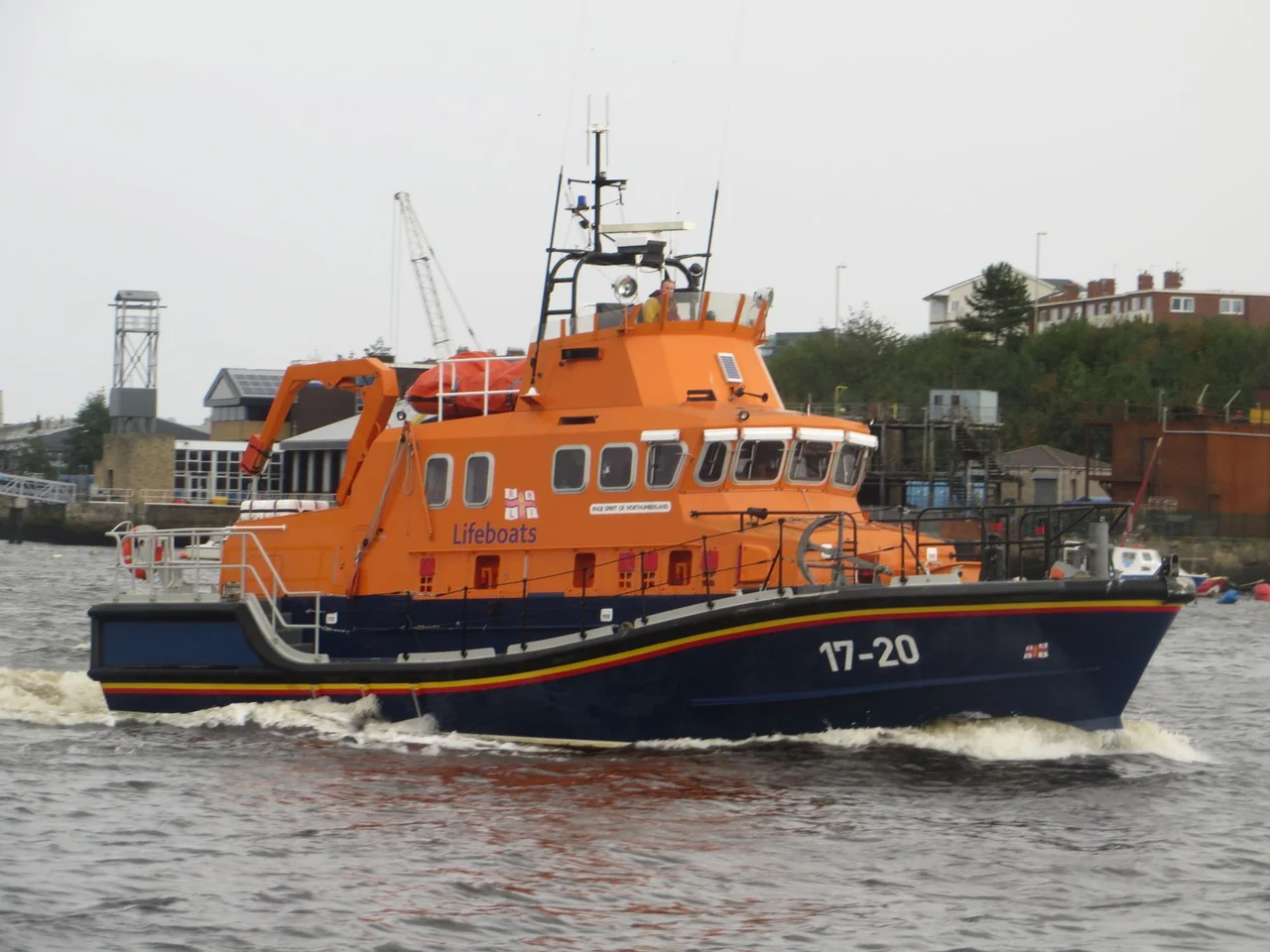

Tynemouth Lifeboat Station
On 4 December 1849, the Tyne Lifeboat Institution boat Providence pulled alongside the brig Betsy, run ashore at Herd Sands in a gale. The lifeboat had reached the wreck. Then she capsized. Twenty of the twenty-four men aboard the Providence drowned. The Tyne, launched in response, picked up the three survivors who were still clinging to the upturned hull. North Shields' Northumberland rescued the Betsy's crew. The disaster reverberated up the chain of patronage to Algernon Percy, 4th Duke of Northumberland and president of the Royal National Institute for the Preservation of Life from Shipwreck, who set a competition: design a lifeboat that would right itself if capsized. James Beeching of Great Yarmouth won. His self-righting design became the template for every lifeboat that followed.
Greathead's Boats
The first Tyne lifeboats predate any national institution. In 1789, a boat designed by Henry Greathead and shaped by the ideas of South Shields parish clerk William Wouldhave was placed at South Shields. A second followed at North Shields in 1798, both operated by the Tyne Lifeboat Institution. The mouth of the Tyne in those years was terrifying in heavy weather - a narrow opening between sandbars, with no piers to break the swell, and dozens of ships lost on the Black Middens or driven onto Herd Sands. Many lives were saved by Greathead's design. Many more were lost despite it. The lifeboatmen were local fishermen, pilots, and merchant seamen who pulled oars in conditions that would have justified anyone's refusal to go.
Disaster and Reform
The Original, the first lifeboat at the station, was wrecked in 1830. The Tyne Lifeboat Institution had no funds for a replacement until 1833. In October 1832, the Port of Newcastle Shipwreck Association asked the new national institute, the RNIPLS, to supply a boat. They sent a twenty-six-foot Palmer-type non-self-righting design that served for ten years before being damaged beyond repair in 1842. Then came Providence in 1849 and the loss of twenty men in front of the people they had set out to save. The Northumberland family had patronised lifeboat work for decades; the Duke's competition produced Beeching's self-righting boat, which the rebranded Royal National Lifeboat Institution adopted as its standard. Tynemouth's tragedy made every subsequent rescue at sea safer.
Two Stations, One Job
In November 1862, after a series of shipwrecks in Prior's Haven, a 33-foot self-righting ten-oared lifeboat called Constance arrived at Tynemouth. Two years later, after the wreck of the Stanley in 1864, the RNLI built a second station at Black Middens. From then until the early twentieth century, two separate lifeboat services operated alongside each other at the Tyne mouth, often responding to the same shipwreck - one standing by while the other made the rescue, then swapping if necessary. Volunteers from both services died doing this work. On 24 November 1864, James Grant and E. Robson were washed out of the Constance during a service to the schooner Friendship and the steamship Stanley. On 17 December 1872, Robert Thirlaway Arkley, a sixteen-year-old Customs Officer and lifeboat crew member, was washed off the pier attempting to rescue the barque Consul. The next day, James Watson and John Wheatley, both twenty-one, were lost when the lifeboat Northumberland was hit by a heavy wave while attending the brig Gleaner.
Motors and Modern Rescue
Everything changed in 1905. The RNLI placed a motor-powered lifeboat at Tynemouth - one of the first in Britain - and the long-delayed North and South Piers, begun in 1854 and finally completed in 1910, calmed the river mouth. A motor lifeboat could reach a casualty in minutes rather than hours, and could leave the protected harbour even when wind and tide would have blocked an oared boat. Rescues became fewer because the piers reduced the wrecks. The TLI rebranded as the Tyne Lifeboat Society and kept volunteer crews until the 1940s. The RNLI No. 2 station at Black Middens was closed. In 1965, the first inshore lifeboat arrived - boat number D-12, one of the earliest in the new fleet. In 1997 a new boathouse for the inshore boat and a mooring for the all-weather lifeboat were built at Fish Quay.
Osier and the Honour Roll
Today the station operates the all-weather Severn-class 17-34 Osier, on station since 2021, and the inshore D-class Little Susie, since 2018. The list of medals awarded to Tynemouth crews fills its own page - Gold Medals to Captain Herbert Burton and Coxswain Robert Smith in 1914, Silver Medal clasps for repeat acts of bravery, Bronze Medals reaching back to 1926, Letters of Thanks in 2022 for the crew of Coxswain Michael Nugent. The restored Tyne lifeboat of the original Tyne Lifeboat Institution is on display at South Shields. The Bedford, another Tyne Institution boat, has been restored and waits in storage for a display home. The lifeboatmen who drowned in 1849, 1864, and 1872 are remembered on plaques at the station. The crews who currently sit at Fish Quay are watching the same water that took them.
From the Air
Tynemouth Lifeboat Station sits at 55.009 degrees N, 1.433 degrees W, on the Fish Quay at North Shields, on the north bank of the River Tyne mouth. Newcastle International (EGNT) is 10 nautical miles west. From the air, the Tyne mouth is unmistakable, with the massive North and South Piers extending into the North Sea and the Fish Quay a curving riverside terrace just inside the river entrance. Tynemouth Priory and Castle rise on the headland 800 metres east of the station; South Shields' Arbeia Roman Fort is 1.5 nautical miles south across the river. Best viewed at 2,000-3,500 feet AGL.
Nearby Stories
- Cresswell Lifeboat Station 5.2 km away
- Auckland Castle 5.7 km away
- Battle of Otterburn 7.1 km away
- Saltburn Pier 11 km away
- Hadrian's Wall Path 11 km away
- Battle of Stainmore 18 km away
- Saltburn-by-the-Sea 39 km away
- Alexander L. Kielland (Platform) 296 km away