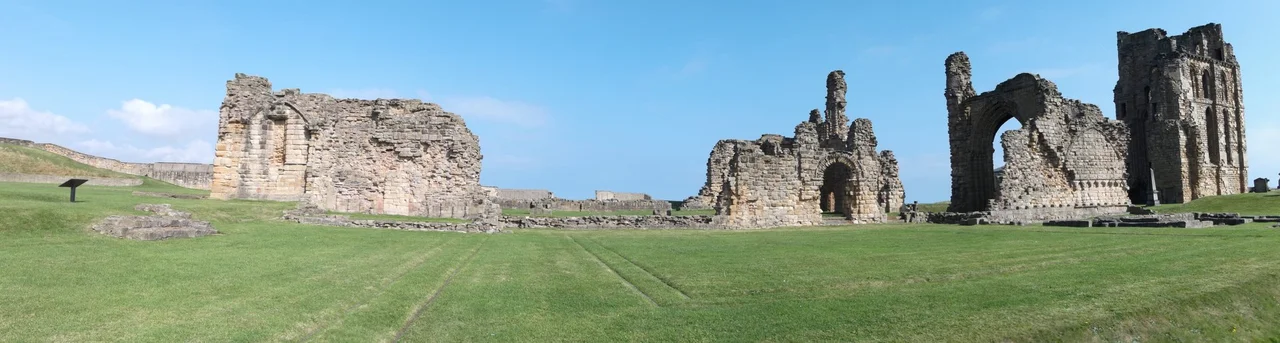

Tynemouth Priory and Castle
A medieval monk once wrote home from this place, begging his brother not to follow him here. Day and night, he warned, the waves break and roar and undermine the cliff. Thick sea frets wrap everything in gloom. Shipwrecks are frequent, and the grey birds nesting in the rocks prey upon the drowned. In the spring, the salt air blights what few apples grow on the stunted trees - if you find one, it will set your teeth on edge. Yet the church is of wondrous beauty, he conceded, and within it rests the martyr Oswine, in a silver shrine. This is Tynemouth Priory and Castle, on the rock where the River Tyne meets the North Sea.
A Rock Confined
The promontory has been occupied since the Iron Age. Trace remains of two circular wooden houses survive - one typical of the Votadini tribe, two centuries before the Romans arrived in AD 43, and a smaller one from the Roman period itself. By the medieval era, St Albans Abbey was using Tynemouth as a place of exile, sending recalcitrant monks north to live on the wind-scoured rock as punishment. The letter from one such exile, written in the mid-14th century, is the earliest written description we have of life here. The house, he wrote, is confined to the top of a high rock and is surrounded by sea on every side but one. The approach passes through a gate cut into the stone, so narrow that a cart can hardly pass through. He named the cliff-roosting seabirds that screamed before storms. He named the shipwrecks. And he named what kept him there: the martyr Oswine, whose silver shrine drew pilgrims who believed he could heal what no doctor could.
Three Crowns
The heraldry of the metropolitan borough of North Tyneside carries three crowns, commemorating three kings buried in the priory. Their bodies have made this rock holy ground for more than a thousand years. In 1095, when Robert de Mowbray revolted against William II, he and thirty followers took refuge in Tynemouth after his stronghold at Bamburgh fell. They held out for six days before being captured - evidence the monastery was defended, perhaps by an early motte-and-bailey. The site would become a true castle in the centuries that followed, its medieval gatehouse still standing today as the only intact survivor of the original defences. In 1564, Henry Percy, 9th Earl of Northumberland, was born here while his father served as the castle's guardian. The Percy chapel inside the priory church remains completely intact, an early Gothic ghost of the family that ruled this coast.
Keeping the Light
By 1582, a coal-fired brazier burned through the night on top of one of the priory church's eastern turrets - a navigation light for ships running the dangerous coast. The Earl of Northumberland, as Governor of Tynemouth Castle, was responsible for maintaining it, and his successors collected dues from passing vessels in return. In 1559 the stairs to the turret had collapsed and the fire could not be lit, with predictable cost. A proper lighthouse followed, first coal-fired, then converted to an oil-fired Argand lamp under an Act of George III. Sold to Trinity House in 1841 and altered to show a revolving red light, the Tynemouth lighthouse kept its watch until 1898, when the new St Mary's Lighthouse at Whitley Bay made it redundant. The old light was then demolished, its work done.
The Last Garrison
At the end of the 19th century, the priory's precinct was rebuilt as a barracks, and the castle returned to the soldiering it had begun with. During the Second World War the position covered the mouth of the Tyne with naval guns, and suffered heavy air raids in 1941. The army did not finally depart until 1956. Today only the Warrant Officer's house and a few concrete gun emplacements survive from that era - one of them rebuilt with a modern installation representing the earlier BL 6-inch Mk VII gun that once watched the sea. Of the medieval walls that once enclosed the whole promontory, more than 3,200 feet in length, the north and east sides have long since fallen into the sea. The west wall and part of the south wall, with its original wall-walk, still stand. English Heritage manages the site now, and visitors pay to walk where exiled monks once prayed.
From the Air
Tynemouth Priory and Castle sits at 55.0175 N, 1.4189 W, on a prominent headland at the mouth of the River Tyne where it meets the North Sea. Newcastle International Airport (EGNT) lies roughly 10 nm west. The ruins are visible from 2,000-4,000 feet AGL as a distinctive cliff-top profile - look for the lone Gothic arch standing against the sea. St Mary's Lighthouse on Whitley Bay sits 2 nm north along the coast. Watch for marine fog rolling in from the North Sea, which can obscure the site within minutes.
Nearby Stories
- Cresswell Lifeboat Station 5.2 km away
- Auckland Castle 5.7 km away
- Battle of Otterburn 7.1 km away
- Saltburn Pier 11 km away
- Hadrian's Wall Path 11 km away
- Battle of Stainmore 18 km away
- Saltburn-by-the-Sea 39 km away
- Alexander L. Kielland (Platform) 296 km away