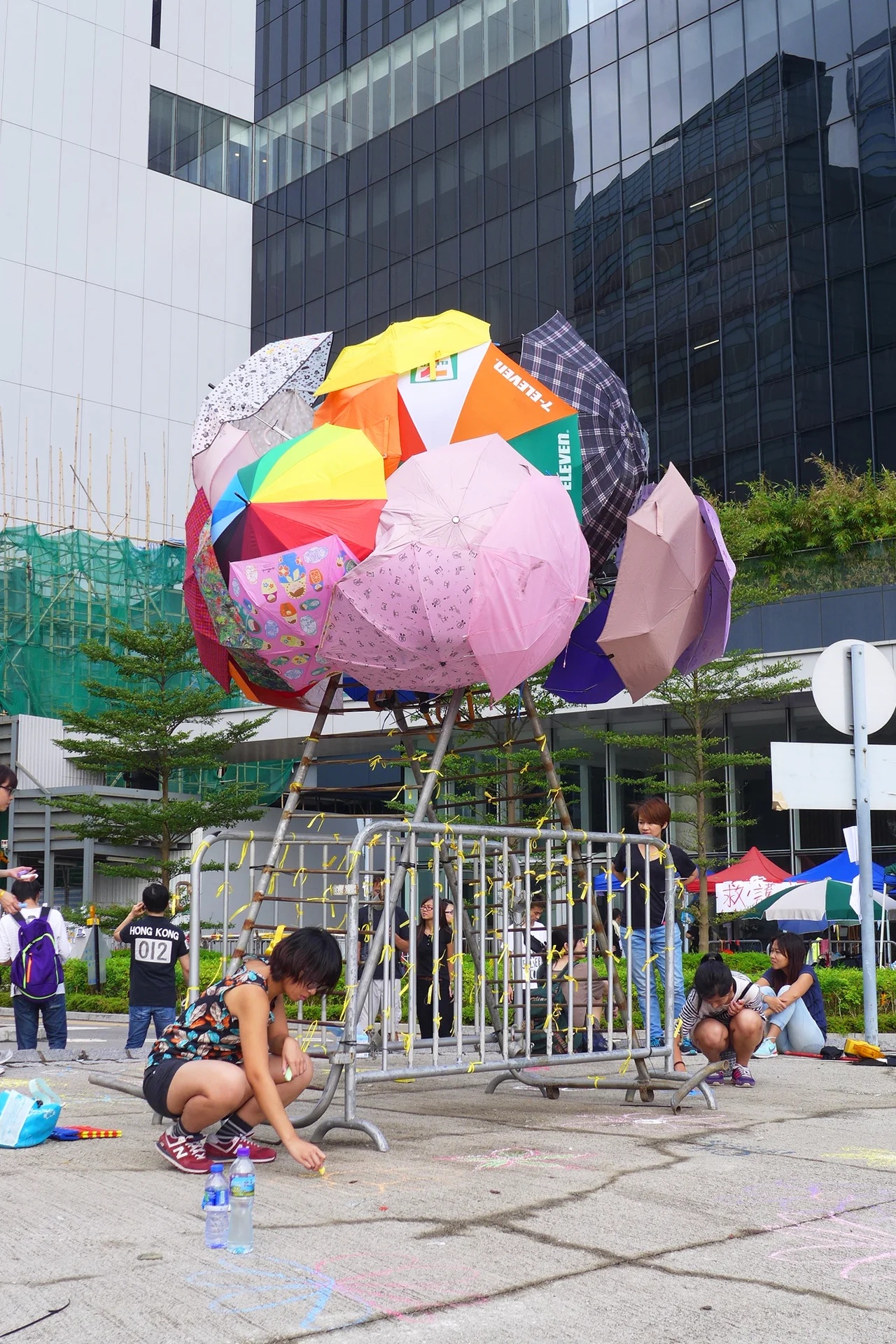

Umbrella Square
Tear gas was not supposed to happen on 28 September 2014. The police deployed it against peaceful protesters near Government Headquarters, and that decision transformed the mathematics of the movement entirely. What had been a demonstration became an occupation. Hundreds of thousands of people poured into the streets of Admiralty. They brought tents, art supplies, extension cords, and guitars. Within days, the stretch of Harcourt Road that would become known as Umbrella Square had stopped being a thoroughfare and started being something Hong Kong had never seen: a temporary city built on democratic aspiration.
A Road Becomes a Plaza
Harcourt Road is one of the main arteries of Admiralty, Hong Kong's government district, carrying traffic between Central and Wan Chai beneath elevated walkways and office towers. On the night of 28 September 2014, it was empty of cars. Protesters had taken it — and Tim Mei Avenue beside it — in the hours after police deployed tear gas, and they had no intention of leaving.
The occupation that followed was both spontaneous and extraordinarily organized. Barricades went up at 21 points, sealing the area from vehicle traffic. The residents — because that is what the people who stayed became — named their territory Umbrella Square, after the umbrellas protesters had raised against tear gas and pepper spray. Some barricades were given formal addresses. Hong Kong Post officially denied delivering mail to the square's tent addresses, though reports suggested otherwise. The name stuck because the symbol was right: an umbrella held up against state force, ordinary in material, defiant in purpose.
The Utopia Built on Asphalt
Jonathan Kaiman, writing for The Guardian, described entering Umbrella Square as feeling like walking into an art fair or a music festival. Protesters sat cross-legged on the pavement, strumming guitars and checking their phones. Tourists wandered through with cameras. At night, speeches and performances drew hundreds, sometimes thousands.
But the square was more than aesthetic. Infrastructure accumulated rapidly: showers were erected, composting stations established, electrical charging points set up for phones. More than a hundred tents were available, with a stated condition that they be kept clean. There was a central podium for nightly talks and rallies, a press compound, and the Study Zone — where students sat at improvised desks, keeping up with coursework in the middle of a political occupation. Time magazine called the organized chaos "classical political anarchism: a self-organizing community that has no leader." Teams of volunteers ran garbage collection, recycling, security, and medical care in rotating shifts.
The Lennon Wall, a staircase near the government offices covered in thousands of colorful Post-it notes carrying messages of hope, became the encampment's most iconic image.
The People Who Were There
The movement that filled Umbrella Square was fractious and deliberately leaderless. Members and supporters of the Labour Party, the Democratic Party, the Civic Party, the Confederation of Trade Unions, the League of Social Democrats, and People Power all moved through the space. No single organization controlled what happened there, and that structural openness was both the encampment's strength and its vulnerability.
The people who occupied Umbrella Square were students, workers, professionals, retirees, and tourists who stopped and stayed. They were young people who had grown up in post-handover Hong Kong, who had been promised a degree of democratic self-governance, and who had watched that promise narrow. They held their ground — literally, on a strip of urban road — for 74 days, sleeping in tents, attending teach-ins, making art, and calling for genuine universal suffrage in Hong Kong's elections. Dark Corner, one of the encampment's named areas, became the site of something uglier: it was where the beating of a handcuffed protester by seven police officers was filmed and broadcast on television.
The Clearing, and What Remained
On 11 December 2014, police cleared the Admiralty site. Tents were dismantled, barricades removed, and Harcourt Road reopened to motorized traffic. The occupation had lasted 74 days. The Lennon Wall was taken down. The Study Zone, the podium, the showers — all of it was gone within hours.
What remained was harder to clear. The Umbrella Movement had documented itself extensively — in photographs, video, academic papers, and journalistic accounts. Its art was preserved where it could be. The political demands that drove it went unmet, and the subsequent years brought increasing constraints on Hong Kong's political freedoms. But the memory of those 74 days — of a stretch of road turned into a community, of ordinary people refusing to simply go home — persists in the city's contested civic identity. Today, Harcourt Road carries traffic again. The asphalt shows no sign of what happened there.
From the Air
Umbrella Square occupied Harcourt Road and Tim Mei Avenue at 22.2795°N, 114.164°E in Admiralty, Hong Kong — the government district on the north shore of Hong Kong Island. From the air at 3,000–5,000 feet, the area is identifiable by the cluster of government towers and the elevated walkways connecting them, sitting between the dense financial towers of Central to the west and the sports venues of Wan Chai to the east. Victoria Harbour stretches to the north. Hong Kong International Airport (VHHH) is approximately 22 miles to the northwest on Lantau Island. The former site is now once again a busy urban road, indistinguishable from altitude from any other.
Nearby Stories
- Lok Ma Chau Loop 2.3 km away
- Portas do Cerco 2.3 km away
- Kweilin Incident 17 km away
- Wanshan Archipelago Campaign 34 km away
- Nanxiong Formation 115 km away
- Battle of Nanpeng Island 148 km away
- Heyuan 169 km away
- Cape Maobitou 632 km away