
United States Botanic Garden
On June 9, 1842, the U.S. Navy ship Vincennes dropped anchor in New York harbor after a four-year voyage that had taken her around Cape Horn, across the South Pacific, along the coast of Antarctica, up the Columbia River, across to Japan, and home around the Cape of Good Hope. Charles Wilkes had set out in 1838 with five other ships and 346 men on what Congress had funded as the United States Exploring Expedition. The Vincennes was one of two ships that completed the circumnavigation. Wilkes had lost 28 men to disease, drowning, and one Fijian attack. In the holds of his ships were the dried plant specimens that became the National Herbarium and the living plants - kept alive on long ocean voyages in newly invented Wardian cases, a sealed glass terrarium - that needed somewhere to live in Washington. Congress reopened the dormant Botanic Garden to receive them. Two of those plants, or their direct descendants, are still alive.
The Wilkes Plants
Four plants in the current collection have direct ties to the 1842 expedition. The Vessel Fern (Angiopteris evecta), growing in the Jungle room, is believed to be a direct descendant - genetically identical, propagated from spores or rhizomes across nearly two centuries - of the original fern Wilkes brought back. The fern's lifespan makes it unlikely to be the original specimen, but the lineage is unbroken. Two Queen Sagos (Cycas circinalis), a male and a female in the Garden Court, are believed to be the original 1842 plants themselves - cycads can live for centuries, and these have grown only modestly. The fourth plant, a Ferocious Blue Cycad (Encephalartos horridus), may or may not be original; the early records are incomplete enough that botanists are not certain. To stand in front of the male Queen Sago and consider that it was already on this earth when Polk was president, when the Mexican War was fought, when Lincoln took office, when slavery was abolished, when both world wars were fought and ended - is to encounter, in a federal greenhouse on the National Mall, a witness to most of American history.
Columbian Institute Origins
The idea of a national botanic garden came not from Congress but from the Columbian Institute for the Promotion of Arts and Sciences - a learned society that met in Washington beginning in 1816 with John Quincy Adams, Andrew Jackson, Henry Clay, and other prominent men as members. The Institute persuaded Congress in 1820 to set aside land west of the Capitol, between First and Third Streets and Pennsylvania and Maryland Avenues, for botanical purposes. The Institute fell dormant in 1837 when its members stopped meeting. The garden the Institute had created went with it. When Wilkes returned in 1842 with the largest plant collection ever brought to North America, Congress had no facility to receive it. The dried specimens were sent to the Old Patent Office; the living plants were kept in greenhouses around the city. By 1850 Congress had built a new garden on the Mall to house the Wilkes collection. That garden, with the modifications that followed, has operated continuously ever since.
The Photius Fisk Donations
Charles Wilkes was not the only U.S. naval officer collecting plants for the Botanic Garden in the nineteenth century. Photius Fisk, a Greek-born abolitionist who had emigrated to Boston and become a U.S. Navy chaplain, spent the 1850s collecting seeds and rare plants for the garden during voyages on the frigate Raritan to South America and the Pacific. Fisk brought back vanilla plants, dendrobiums, cattleyas, epidendrums, stanhopeas, and other orchids from Brazil. He also obtained the rare Oncidium Papilio - the butterfly orchid - from Saint Thomas in the Danish West Indies, transporting it carefully back across the Atlantic. In February 1853 he traveled directly from his ship to Washington and delivered his collection to W. D. Breckenridge, the garden's botanist, with his own careful field notes attached. Fisk was a serious naturalist as well as an abolitionist who had served as a regimental chaplain at the Battle of Buena Vista in the Mexican War. His donations laid the foundation of the garden's orchid collection.
The Lord and Burnham Conservatory
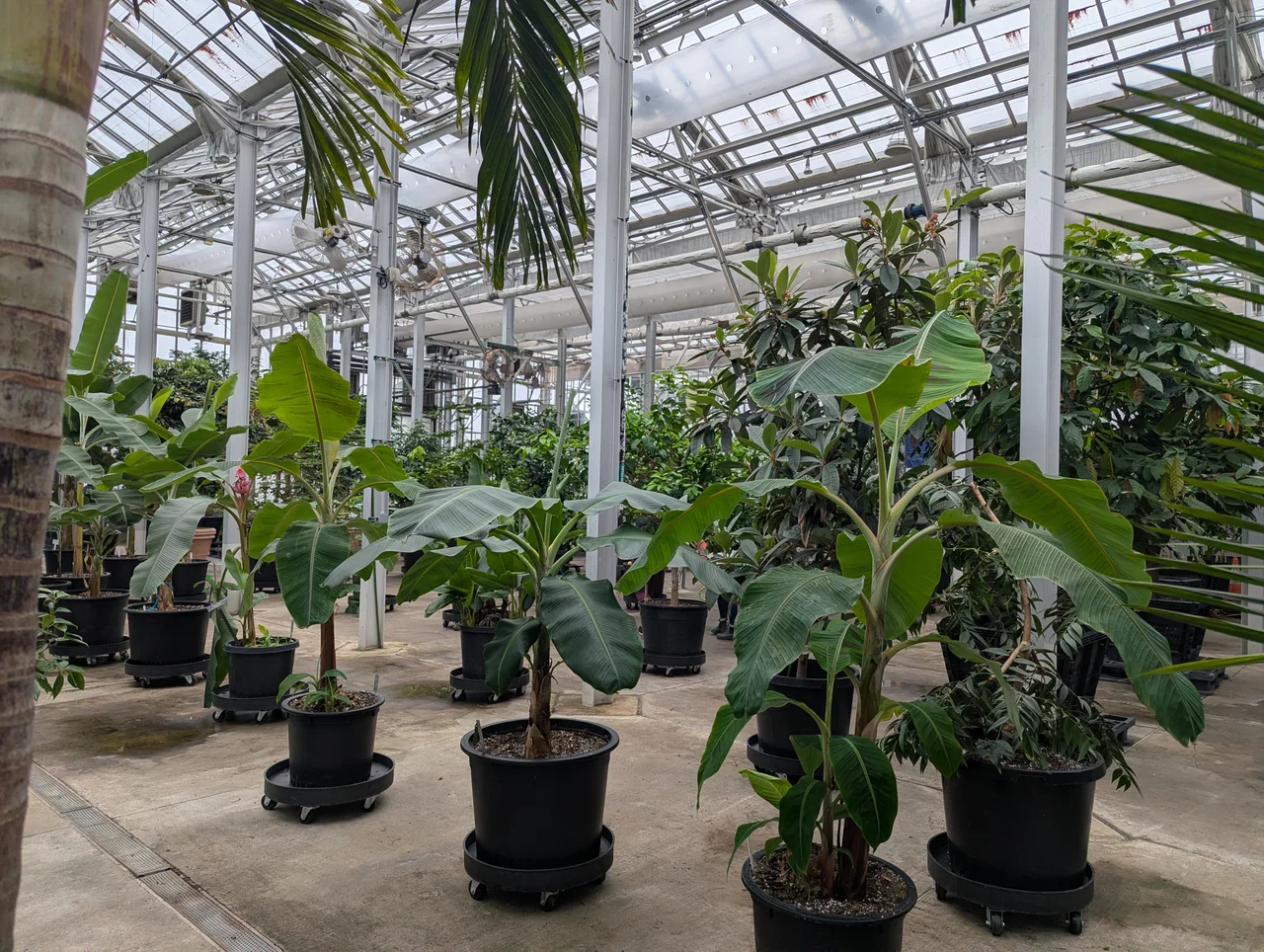
The current Botanic Garden building, opened in 1933 just southwest of the Capitol, is a Lord and Burnham greenhouse - the New York firm that built most of the major American botanical conservatories in the late nineteenth and early twentieth centuries. The structure is divided into eleven rooms simulating different habitats: Garden Court, Rare and Endangered Plants, Plant Exploration, the Orchid House, Medicinal Plants, Desert, Hawaii, Garden Primeval, Plant Adaptation, the Jungle (the largest room, with a second-story catwalk for viewing the canopy from above), and the Children's Garden. Most rooms lack air conditioning. Each is regulated by computer-monitored sensors controlling misting systems, retractable shades, and operable windows. The plants are watered daily by hand. The garden closed for renovations on September 1, 1997, and reopened on December 11, 2001 - four years that allowed the plants to be sorted, with some sent to greenhouses in Florida, some retired to the Production Facility in Southwest, and some, sadly, composted. The garden is supervised by the Architect of the Capitol on behalf of Congress, and is open every day of the year including federal holidays.
Bartholdi and the National Garden
Across Independence Avenue south of the Conservatory lies Bartholdi Park, named for the Bartholdi Fountain at its center. Frederic Auguste Bartholdi, the French sculptor who would later design the Statue of Liberty, made the fountain for the 1876 Centennial Exhibition in Philadelphia. The federal government bought it after the fair, moved it to Washington, and made it the centerpiece of what became the Botanic Garden's outdoor display garden. Bartholdi Park is designed to give home gardeners practical ideas - small structured gardens, color and shape themes, sections certified as a National Wildlife Federation backyard wildlife habitat. The newer National Garden on the Conservatory's west border, completed in October 2006, holds a regional garden of plants native to the Atlantic Coastal Plain and Piedmont, a rose garden, a butterfly garden, and the First Ladies Water Garden, dedicated to the First Ladies of the United States. The Garden also participates in CITES, the international treaty on endangered species, which means the U.S. Customs and Border Protection sends rescued plants - mostly seized orchids and succulents - to the Botanic Garden's expert care.
From the Air
The United States Botanic Garden sits at 38.8881 degrees N, 77.0117 degrees W, on the southwest grounds of the U.S. Capitol, bordered by Maryland Avenue on the north, First Street on the east, Independence Avenue on the south, and Third Street on the west. From the air the glass-roofed Lord and Burnham Conservatory and the adjoining Bartholdi Park are immediately south of the Capitol Reflecting Pool. Best viewed at 1,500 to 3,000 feet AGL; the entire site lies within the Washington FRZ and the prohibited area P-56A. Nearest airports are Ronald Reagan Washington National (KDCA) 3 nm south, College Park (KCGS) 7 nm northeast, and Washington Dulles (KIAD) 24 nm west.
Nearby Stories
- Gunston Hall 1.1 km away
- 2023 Baltimore Shooting 4.9 km away
- Battle of Middleburg 6.6 km away
- Crownsville Hospital Center 10 km away
- Battle of Loudoun Heights 13 km away
- First Battle of Rappahannock Station 20 km away
- Howard County, Maryland 21 km away
- Harriet Tubman Underground Railroad 50 km away