
United States Capitol rotunda
In 1862, while the Civil War was killing Americans by the thousands every month, a Greek-Italian fresco painter named Constantino Brumidi climbed a scaffolding 180 feet above the floor of the United States Capitol rotunda and began painting a 4,664-square-foot fresco called The Apotheosis of Washington. The dome above him was still being built - Lincoln had insisted that construction continue through the war as a sign that the Union would endure. Below him in the rotunda, Union soldiers wounded at Antietam and Fredericksburg were being treated on cots laid out across the marble floor. The Capitol was simultaneously a hospital and a construction site and the highest temple of American civic life. Brumidi finished the fresco in 1865, the year the war ended and Lincoln was assassinated. The Apotheosis is still there. The dome was finished in 1866. The hospital became the rotunda again.
Thornton, Bulfinch, and Walter
William Thornton, a Scottish-trained physician and self-taught architect, won the 1793 competition to design the Capitol with a sketch that included a central rotunda - a circular hall under a dome, modeled on the Roman Pantheon. Funds, slow construction, and the British army's burning of Washington in August 1814 delayed everything. Work on the rotunda did not begin until 1818. It was completed in 1824 under the fourth Architect of the Capitol, Charles Bulfinch, in time for the visit of the Marquis de Lafayette, who toured the United States that summer and fall as the last living Revolutionary War general. The original rotunda was a low-ceilinged sandstone room rising 48 feet from floor to the top of its walls. The dome above it was redesigned in 1854 by Thomas U. Walter, who replaced the original wooden dome with a cast-iron one that rose to 180 feet at the canopy. Walter also extended the Capitol with the north and south wings that today house the Senate and House chambers. The Statue of Freedom on the dome's top was placed there in December 1863, during the Civil War.
The Apotheosis
Brumidi, who had emigrated to America in 1852 after participating in the failed 1848 revolutions in Italy, became the Capitol's resident artist. In 1862 Walter asked him to paint a fresco on the concave canopy at the top of the new dome - sixty-five feet in diameter, 4,664 square feet in area. Brumidi designed The Apotheosis of Washington, showing the first president seated among the gods, flanked by figures representing Liberty and Victory, with thirteen maidens (one for each original colony) and six allegorical groups around the perimeter representing American agriculture, mechanics, commerce, war, science, and the sea. Brumidi painted the fresco in eleven months in 1865. The dome was finished the following year. Looking up at the Apotheosis from the rotunda floor today, the figures appear nearly life-size; in fact most are fifteen feet tall, designed to read correctly from 180 feet below. The whole composition is a 19th-century American answer to the dome of the Pantheon, except that the Pantheon's oculus is open to the sky and the Capitol's is sealed with paint.
Eight Paintings
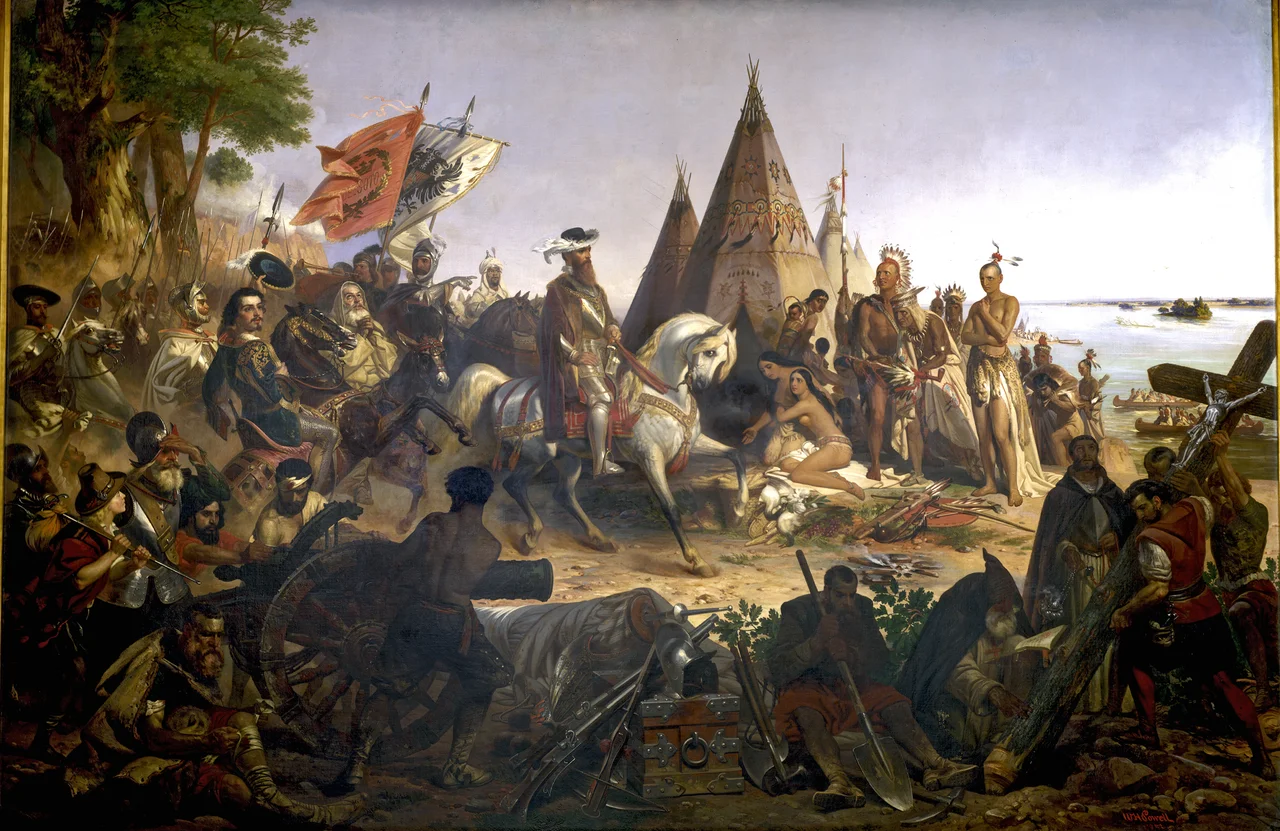
Eight niches in the rotunda walls hold large oil-on-canvas history paintings, each twelve by eighteen feet. Four were commissioned from John Trumbull in 1817 to depict the founding of the United States: the Declaration of Independence, the Surrender of General Burgoyne at Saratoga, the Surrender of Lord Cornwallis at Yorktown, and General Washington Resigning His Commission. Trumbull, the soldier-painter who had served as Washington's aide-de-camp during the war, had been collecting portraits of the actual participants for decades; the Declaration painting includes recognizable likenesses of forty-two of the fifty-six signers. The four paintings were installed in the Rotunda in 1826, on the fiftieth anniversary of the Declaration of Independence. Between 1840 and 1855, four more paintings filled the remaining niches, depicting Spanish, Italian, English, and indigenous figures in the European colonization of the Americas: the Landing of Columbus by John Vanderlyn, the Discovery of the Mississippi by William Henry Powell, the Baptism of Pocahontas by John Gadsby Chapman, and the Embarkation of the Pilgrims by Robert Walter Weir. The 1840s-50s set has aged less gracefully than the Trumbull paintings; Vanderlyn's Columbus and Chapman's Pocahontas in particular have been criticized in recent decades for the way they frame colonization.
The Frieze and the Death of Brumidi
Above the niches and below the dome's windows runs the Frieze of American History - a band of trompe-l'oeil grisaille fresco that appears to be carved stone bas-relief but is actually painted to look like it. Brumidi designed the frieze in 1859, sketched its nineteen scenes from American history, and began painting in 1878 at the age of 73. He worked alone on a scaffolding suspended dozens of feet above the rotunda floor. In October 1879, while painting the scene of William Penn and the Indians, the scaffolding shifted and Brumidi nearly fell. He caught himself on a rail and clung there for fifteen minutes until he was rescued. He never recovered. He died on February 19, 1880, having painted seven and a half scenes. Filippo Costaggini, his student, was commissioned to finish according to Brumidi's drawings. Costaggini completed eight and a half more scenes by 1889, then discovered that Brumidi's design had been miscalculated and that a thirty-one-foot gap remained in the band. The gap stood unpainted for over sixty years. Allyn Cox finally finished the frieze in 1953 with three new scenes of his own design - the Spanish-American War, the Wright brothers' first flight, and the birth of aviation.
Lying in State
Both houses of Congress can authorize, by concurrent resolution, the use of the rotunda for ceremonial purposes. The most solemn of these is the tradition of lying in state - the public display of a casket on a catafalque originally built in 1865 for Abraham Lincoln. The same catafalque has supported every other person who has lain in state in the Capitol: James Garfield (1881), William McKinley (1901), Warren Harding (1923), William Howard Taft (1930), John F. Kennedy (1963), Hubert Humphrey, Douglas MacArthur, J. Edgar Hoover (the only non-elected official, by special resolution), Lyndon Johnson, Ronald Reagan, Gerald Ford, John McCain (lying in state by concurrent congressional resolution, as senators are eligible by custom), George H.W. Bush, Ruth Bader Ginsburg (the first woman, in 2020), and Jimmy Carter (2024-25). Capitol Police Officers Brian Sicknick and William Evans have also lain in honor in the rotunda. The crypt one floor below was originally intended to hold the body of George Washington, and a marked tomb still sits empty there. Washington's will, as it turned out, asked for him to be buried at Mount Vernon. He was, and remains so.
From the Air
The U.S. Capitol Rotunda sits at the center of the Capitol building at 38.8899 degrees N, 77.0091 degrees W, with the dome rising 288 feet above ground level to the top of the Statue of Freedom. From the air the dome is the city's most recognizable landmark - cast iron painted white, with the bronze Statue of Freedom at the peak, located at the eastern end of the National Mall. Best viewed at 1,500 to 4,000 feet AGL; the entire site lies within the Washington FRZ and the prohibited area P-56A, with rigorous airspace restrictions. Nearest airports are Ronald Reagan Washington National (KDCA) 3 nm south, College Park (KCGS) 6 nm northeast, and Washington Dulles (KIAD) 24 nm west.
Nearby Stories
- Gunston Hall 1.1 km away
- 2023 Baltimore Shooting 4.9 km away
- Battle of Middleburg 6.6 km away
- Crownsville Hospital Center 10 km away
- Battle of Loudoun Heights 13 km away
- First Battle of Rappahannock Station 20 km away
- Howard County, Maryland 21 km away
- Harriet Tubman Underground Railroad 50 km away