.jpg)
University Museum and Art Gallery
Walk through the East Gate of the University of Hong Kong and you step almost immediately into a different century. The Fung Ping Shan Building stands at 90 Bonham Road in the kind of quiet that museums earn slowly: red-brick walls, ornamental columns, a pediment above the entrance. It was built in 1932 as a library for Chinese books. Today it houses the University Museum and Art Gallery — UMAG — and inside its galleries sits one of the most surprising collections in Asia: the world's largest assembly of Yuan dynasty Nestorian crosses.
A Library That Became a Museum
The Fung Ping Shan Building was named for its donor, a wealthy businessman whose contribution helped anchor Chinese cultural education at HKU in the 1930s. For thirty years it served as a library. In 1962, the Chinese books collection moved to the university's Main Library, and the building quietly transformed into something else entirely — a museum for Chinese art and archaeology. The transition was gradual and deliberate. In 1996, the lowest three floors of the adjacent TT Tsui Building were joined to the old structure by a bridge, creating the two-building configuration that visitors walk through today. The Fung Ping Shan Building was graded as a Grade II Historic Building in 1981, and its exterior is now a declared monument under Hong Kong's Antiquities and Monuments Ordinance — a recognition that the building itself is part of the collection.
Sixty Years of Accumulation
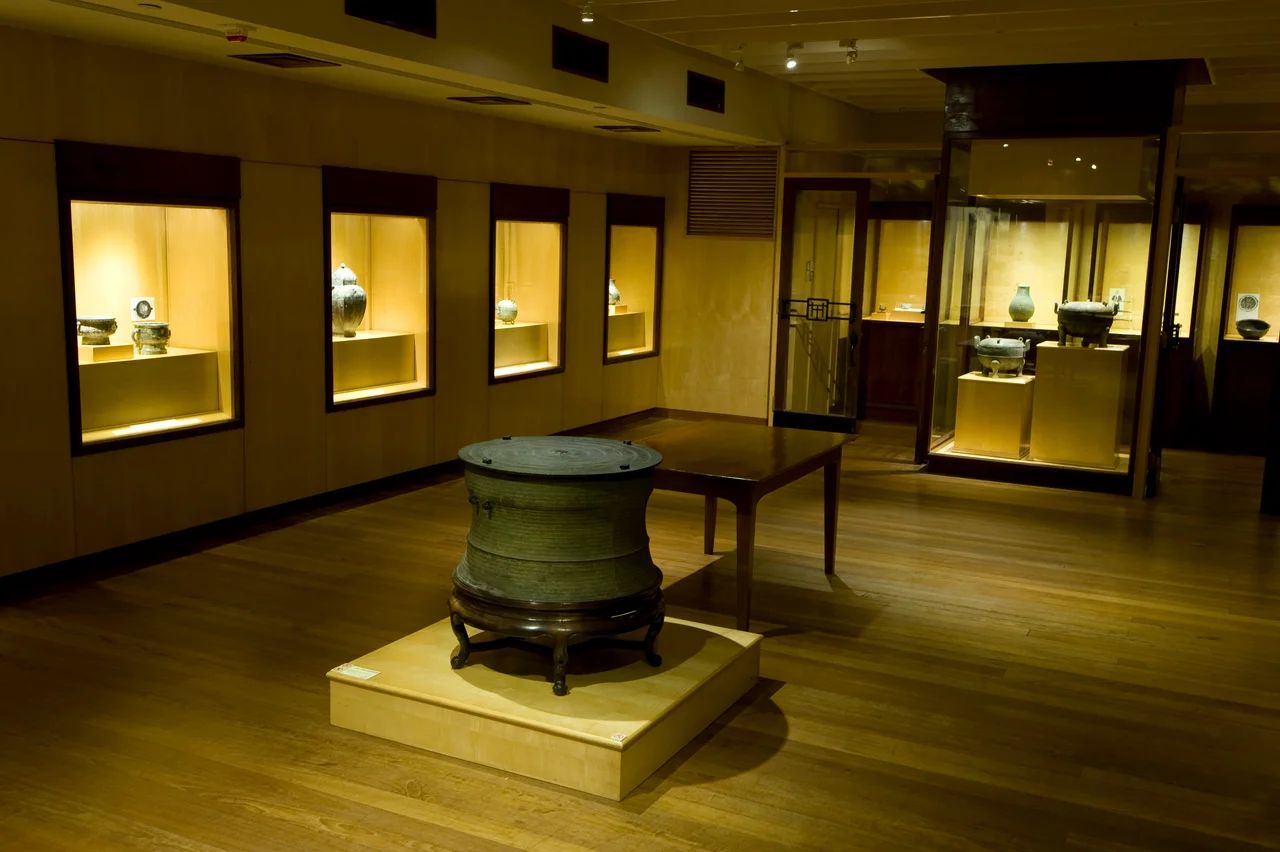
UMAG's holdings did not arrive all at once. They accumulated over six decades through acquisition and donation, building outward from a core of Chinese antiquities into a collection spanning Neolithic tools to contemporary works. The bronze collection anchors it: pieces from the Shang through Tang dynasties, spanning nearly two thousand years of Chinese metallurgy. The ceramics collection is comprehensive. There are carvings in jade, wood, and stone, a representative group of Chinese oil paintings, and in recent years, historical photographs of Hong Kong and items of popular culture that document a city in rapid transformation. What ties it together is the arc of time — artworks from before recorded history arranged in the same institution as photographs taken within living memory.
The Nestorian Crosses
The most singular objects in UMAG's collection are its Yuan dynasty Nestorian crosses. UMAG holds the world's largest collection of them — bronze crosses produced during the Mongol-ruled Yuan dynasty (1271–1368) by communities of Nestorian Christians who had settled across Central Asia and into China. Nestorianism, a branch of Christianity that spread east along the Silk Road, left only fragmentary traces in East Asia. These crosses are among the most tangible survivors. Their presence in a Hong Kong university museum — far from the monasteries of Persia, far from Rome — makes them something stranger and more interesting than the usual museum highlight. They are evidence of a world more connected, and more unexpected, than most people imagine.
Science, Technology, and the Arts
In 2020, UMAG launched a new initiative called UMAG_STArts, dedicated to exploring the relationship between science, technology, and the arts through interdisciplinary study. Conservation science, art history, and emerging forms of technology are brought together with the intention that they illuminate each other. It is a recognition that the museum's work is not purely archival — that objects four thousand years old still have things to reveal when examined with contemporary tools. The University of Hong Kong Museum Society, founded in 1988 by Margaret Wang, whose husband Wang Gungwu served as vice-chancellor of HKU from 1986 to 1996, provides ongoing community support. Volunteer-run and non-profit, the Society funds acquisitions, sponsors exhibitions, and organizes heritage walks, studio visits, and overseas trips that extend the museum's reach beyond the campus gates.
A Quiet Place on a Busy Hill
UMAG asks for something increasingly rare in Hong Kong: stillness. The Mid-Levels rush and noise of the city recede a little here. The galleries are unhurried. Visitors move through rooms where Tang bronzes catch the light beside contemporary works, where Neolithic ceramics sit under the same roof as photographs of streets that no longer exist. The museum is free to enter. It exists because donors in the 1930s believed that a Chinese university needed a place to house Chinese art — and because generations since have continued to give, to acquire, and to care. The result is a collection that grows stranger and richer the longer you look.
From the Air
UMAG sits at approximately 22.284°N, 114.139°E on the mid-slope of Hong Kong Island, in the Mid-Levels district just above Central. The campus of the University of Hong Kong is visible as a cluster of older red-brick buildings among the dense urban hillside. Approach from the south over the island's spine at 2,000–3,000 feet to pick out the campus. The nearest major airport is Hong Kong International Airport (VHHH) on Lantau Island, approximately 20 nautical miles to the west. Victoria Harbour glitters to the north; Victoria Peak rises to the southwest.
Nearby Stories
- Lok Ma Chau Loop 2.3 km away
- Portas do Cerco 2.3 km away
- Kweilin Incident 17 km away
- Wanshan Archipelago Campaign 34 km away
- Nanxiong Formation 115 km away
- Battle of Nanpeng Island 148 km away
- Heyuan 169 km away
- Cape Maobitou 632 km away