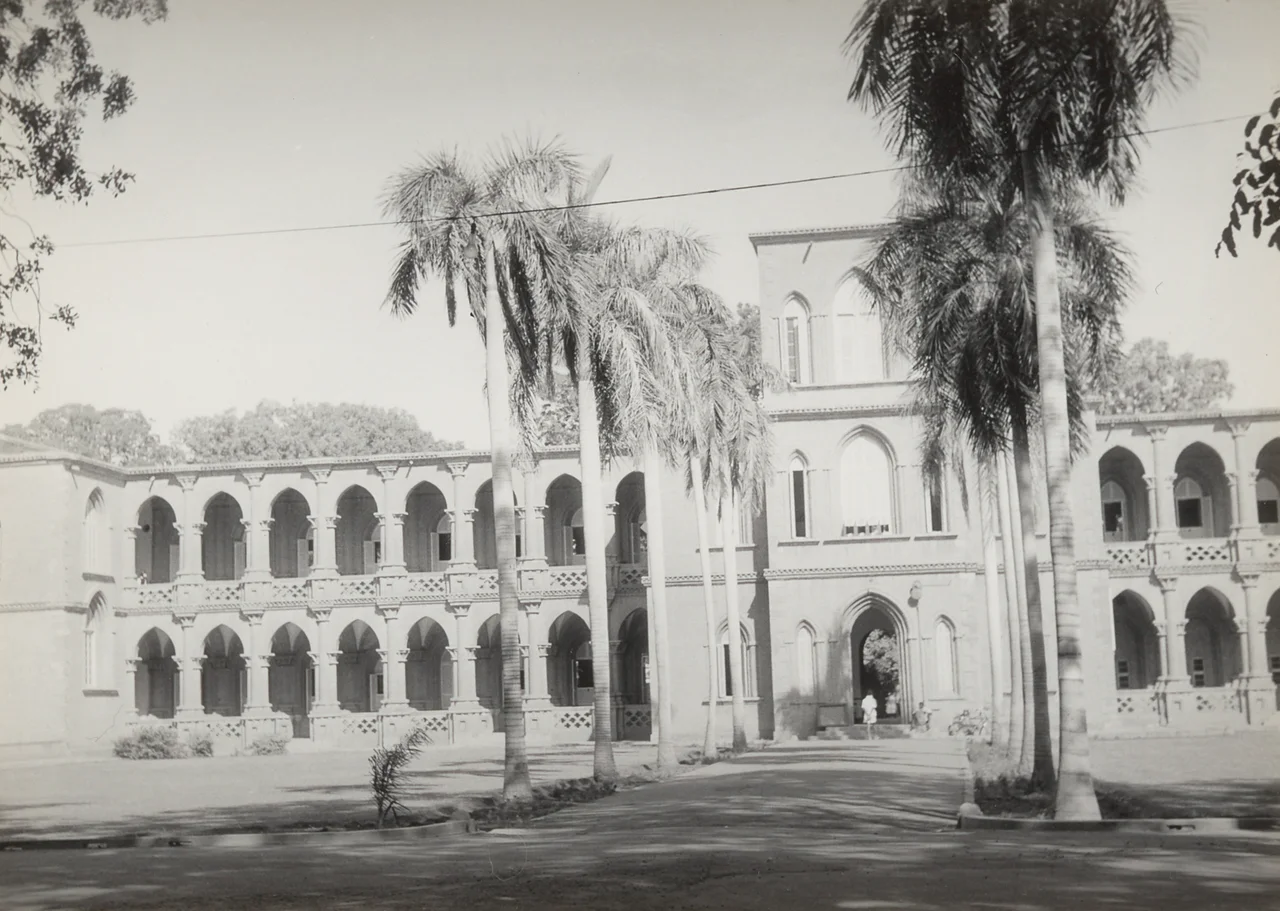
University of Khartoum
In six weeks, Britain raised £100,000. The year was 1898, Kitchener had just won the Battle of Omdurman, and the donations - public and private - came in faster than anyone expected. The purpose was a memorial to Charles Gordon, the British officer killed at Khartoum thirteen years earlier. What Britain built with that money turned out to be something neither the donors nor Kitchener had quite imagined: the institution that would train most of independent Sudan's political, scientific, and literary leaders for the next century. Gordon Memorial College opened in 1902. Today it is the University of Khartoum, and every revolution in modern Sudan has started somewhere near its gates.
Gordon's Name, Sudan's Students
The college that opened in 1902 was modest - three schools, mostly primary and vocational. A small teachers' training centre. An industrial school. A bacteriological analysis laboratory added in 1905 through donations from Henry Wellcome, the pharmaceutical entrepreneur. Through the 1910s and 1920s, as the Anglo-Egyptian Sudan consolidated, the college quietly became the country's pipeline for technically trained Sudanese. In 1924, the Kitchener School of Medicine opened as the first medical school in Sudan - part of a reorganization that shifted Gordon College from primary to secondary and professional education. By 1940, five new schools had been added: Law (1936), Agriculture and Veterinary Science (1938), Science and Engineering (1939), Arts (1940). The faculty list reads like a scaled-down Oxford adapted to the Nile: British vice-chancellors, Sudanese students, palm-lined courtyards built in arcaded colonial style.
Independence
On 24 July 1956, seven months after Sudan became independent, the new parliament passed a bill elevating Khartoum University College to full university status. The institution shed its memorial name and became simply the University of Khartoum. The British classicist Michael Grant served as vice-chancellor from 1956 to 1958, bridging the handover. The horticultural scientist John Pilkington Hudson founded the department of horticulture during his visiting professorship from 1961 to 1963. The British anthropologist Wendy James lectured in social anthropology from 1964 to 1969 before her long career at Oxford. But the University's real identity was forming elsewhere: in the students, most of them Sudanese, who would graduate into the state apparatus, the press, the judiciary, and the political movements of the country they were building. Abdalla Hamdok, who would become Prime Minister of Sudan in 2019, studied here. So did Hassan al-Turabi, the architect of Bashir's Islamist state. So did John Garang, who led the Sudan People's Liberation Army. The same campus produced the men who would spend the next half-century arguing, sometimes violently, about what Sudan should be.
A Tradition of Protest
The University of Khartoum has been a staging ground for political change from the moment it became a university. Every Sudanese revolution of the postcolonial era has had its roots, at least partly, on these grounds. In October 1964, student protests triggered the uprising that ended Ibrahim Abboud's military rule - a general Abboud had himself been Shaigiya. In April 1985, students were again at the center of the protests that brought down Nimeiry. On 5 April 1984, the government had announced the closure of all faculties; they reopened on 1 August. After Bashir's 1989 coup, the university was closed repeatedly because students joined pro-democracy rallies, and kept joining them. Writers like the novelist Tayeb Salih, whose Season of Migration to the North became a foundational text of modern Arabic literature, emerged from this campus. So did the poet Meena Alexander. So did the women's rights activist Bahjaa Abdelaa Abdelaa, later killed in Darfur. Freedom of expression - declared as a central value of the university - was not decorative. It was earned, and it had costs.
The Campus in Wartime
When war broke out in Khartoum in April 2023 between the Sudanese Armed Forces and the Rapid Support Forces, the University of Khartoum was suddenly in a battlefield. In the first days of fighting, at least one student was killed by gunfire on campus; he was buried on campus days later. Dozens of people trapped on the grounds pleaded for evacuation. The RSF took the central campus and used it. The Sudanese Armed Forces took it back in September 2024 and used it too - as barracks, as headquarters. Buildings were ransacked. The 400,000-volume Main Library, with its irreplaceable Sudan Collection and Newbold Collection, was caught in the fighting. The Mycetoma Research Center - the world's only research center devoted to the neglected tropical skin disease - was reported destroyed in April 2025. Students and faculty were scattered across Sudan and the diaspora. What the university had spent 120 years building was in crisis.
What Continues
At the time of writing, the University of Khartoum is a ruin and a rallying point. Faculty continue to teach online and from refuge in Cairo, Addis Ababa, and elsewhere. The student body - 16,800 undergraduates in its last normal year, 55 percent female, drawn from across Sudan and beyond - remains attached to an institution that has survived closures after every coup since 1958. The Main Library held special collections that traced the institutional memory of colonial and postcolonial Sudan: the Sudan Collection, the Newbold Collection. Some of it has been reported lost. Some of it was digitized before the war, and some will be recovered. The University's notable alumni list is a map of modern Sudan itself - Tayeb Salih, Leila Aboulela, Abdalla Hamdok, John Garang, Francis Deng, Hassan al-Turabi, dozens of ministers and poets and scientists. When Sudan rebuilds - and the history of this university says that Sudan does, eventually, rebuild - the University of Khartoum will be rebuilt too. Probably with protests at the gates.
From the Air
The University of Khartoum's main campus sits at 15.612°N, 32.542°E in central Khartoum, on the south bank of the Blue Nile roughly 1 km east of the Republican Palace. From altitude the palm-lined main avenue of the central campus is sometimes visible in clear weather. Other campuses are distributed: the agriculture and veterinary faculty at Shambat in Khartoum North, the education faculty in Omdurman 15km west, and a medical campus at Suba, 20km south. Nearest airport is Khartoum International (HSSS), about 4km south of the central campus. Wadi Seidna Air Base (HSSW) lies to the north beyond Omdurman.
Nearby Stories
- Esh Shaheinab 27 km away
- Naqa 56 km away
- Mahdist War 65 km away
- Musawwarat es-Sufra 100 km away
- Gezira State 101 km away
- Northern Sudan 215 km away