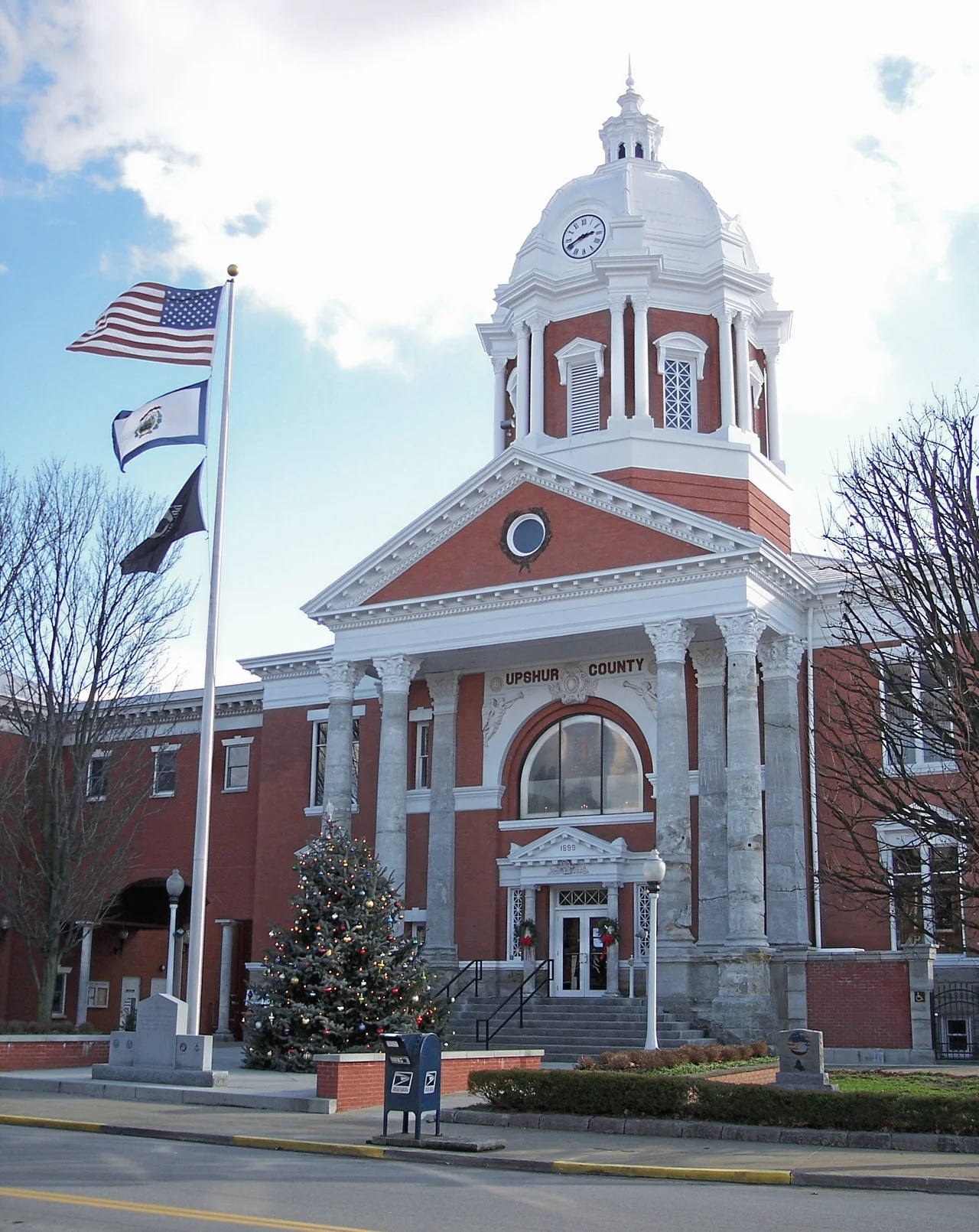

Upshur County, West Virginia
Abel Parker Upshur was on a pleasure cruise down the Potomac River with President Tyler and most of the cabinet when the Navy's largest experimental cannon, the Peacemaker, exploded during a demonstration salute on February 28, 1844. The Secretary of State was killed instantly. So was the Secretary of the Navy and several others. Tyler himself, below decks at the moment of the blast, was unhurt. Seven years later, when Virginia's legislature carved a new county out of Randolph, Barbour, and Lewis, they named it for the dead diplomat. Upshur had been a Tidewater jurist who had never set foot in the rough mountain country that took his name - which puts him in the company of most Virginia governors and statesmen whose names ended up on western counties.
Carved Out in 1851
The county was formed by the Virginia General Assembly in 1851, when westward population growth was steadily fissioning the existing counties into smaller, more manageable units. Upshur ended up at 355 square miles - small by West Virginia standards - with Buckhannon as its only incorporated community and county seat. The Buckhannon River cuts through the county roughly north to south, with U.S. Route 33 running east to west, U.S. 119 north to south, and a network of smaller state and county roads filling in the spaces. The land is rolling rather than truly mountainous, with the highest point - 3,160 feet, on the Randolph County line near Sugar Run - barely reaching what counts as elevation in the broader Allegheny system.
The Strange Stubbornness of a Republican County
Upshur County's political history is one of the more interesting in West Virginia. Most of the state's rural counties have followed a long arc from Democratic dominance through Civil War realignment to renewed Democratic strength in the early twentieth century, then to the rapid Republican shift of the past three decades. Upshur did not. Since 1864 - the first national election after West Virginia statehood - it has voted Republican in nearly every presidential contest. Only Lyndon Johnson in 1964 has broken through, and he won by just 168 votes. Jimmy Carter in 1976 and Bill Clinton in 1996 are the only other post-Civil War Democrats to break forty percent. The reason runs back to the Civil War itself: Upshur was strongly Unionist when most of the surrounding country was divided, and the county's voters drew a long-standing association between the Democratic Party and the Slave Power that pushed yeoman farmers like themselves into a war they had no interest in fighting. The Republican loyalty that emerged from that experience has held for 160 years.
Inside the Radio Quiet Zone
Upshur County lies inside the United States National Radio Quiet Zone, a 13,000-square-mile area in West Virginia and Virginia where radio transmissions are restricted to protect the radio astronomy observatory at Green Bank, several counties to the southeast. Inside the zone, certain kinds of wireless transmitters are limited or prohibited; cellular service has historically been spottier than elsewhere; even ordinary household electronics that produce radio-frequency noise are subject to a degree of monitoring. The arrangement gives the western edges of the zone - including Upshur - a quiet, unwired feeling that visitors from urban areas often notice within hours of arriving. Whether this is preserved old-fashioned silence or imposed federal regulation depends on which side of the cell-tower debate you sit on.
The Sago Mine
Upshur County entered international news on January 2, 2006, when an explosion in the Sago Mine - a small underground coal operation just east of the unincorporated community of Sago - trapped thirteen miners about two and a half miles inside the mine. For almost two days, the world followed the story. Reporters camped at the Sago Baptist Church, families waited for word, and at one point a miscommunication caused the families to be told that twelve of the men had been rescued alive. The opposite turned out to be true: only one miner, Randal McCloy Jr., survived. The other twelve died of carbon monoxide poisoning. The disaster led to federal mine safety legislation - the MINER Act of 2006 - that required enhanced communication systems, more breathable air reserves, and other reforms inside coal mines. For Upshur County, Sago is a wound that has not fully closed. The miners are remembered at a small memorial near the mine entrance, and the families' brief, terrible night of believing they had received good news is woven permanently into the county's modern history.
Wesleyan, Wildlife, and a Strawberry Festival
Beyond the dramas of disaster and politics, Upshur County's economy and identity rest on three substantial anchors. Buckhannon hosts West Virginia Wesleyan College, a private Methodist liberal arts college and a steady source of cultural energy and employment. The West Virginia State Wildlife Center at French Creek, originally established in 1923 as a game refuge and now operated as a public zoo of native species, draws tourists from across the state. And the annual West Virginia Strawberry Festival each May in Buckhannon - one of the oldest and best-attended civic festivals in the state - briefly fills the county roads with traffic and the small downtown with crowds. Coal and timber, the traditional resource extraction industries, still contribute to the economy but are no longer dominant. The county's center of gravity has been quietly shifting toward education, tourism, and healthcare for at least a generation.
From the Air
Centered around 38.90 N, 80.23 W in central West Virginia. Best viewed at 3,000-5,000 feet AGL; the rolling Allegheny foothills, Buckhannon at the county's center, and the Buckhannon River valley provide the clearest visual references. Nearest airport: Upshur County Regional (KW22) at Buckhannon. The county lies within the National Radio Quiet Zone, which limits some radio transmissions in the broader area. US-33 traces an east-west line through the county; US-119 runs north-south. Stonewall Jackson Lake to the west provides a major water-feature landmark.
Nearby Stories
- Holly River State Park 0.8 km away
- Quiet Dell School 3.9 km away
- West Virginia Maneuver Area 5.2 km away
- Cedar Creek State Park 6 km away
- North Bend Rail Trail 14 km away
- Camp Bartow Historic District 16 km away
- End of the World Turn 17 km away
- Cathedral State Park 27 km away