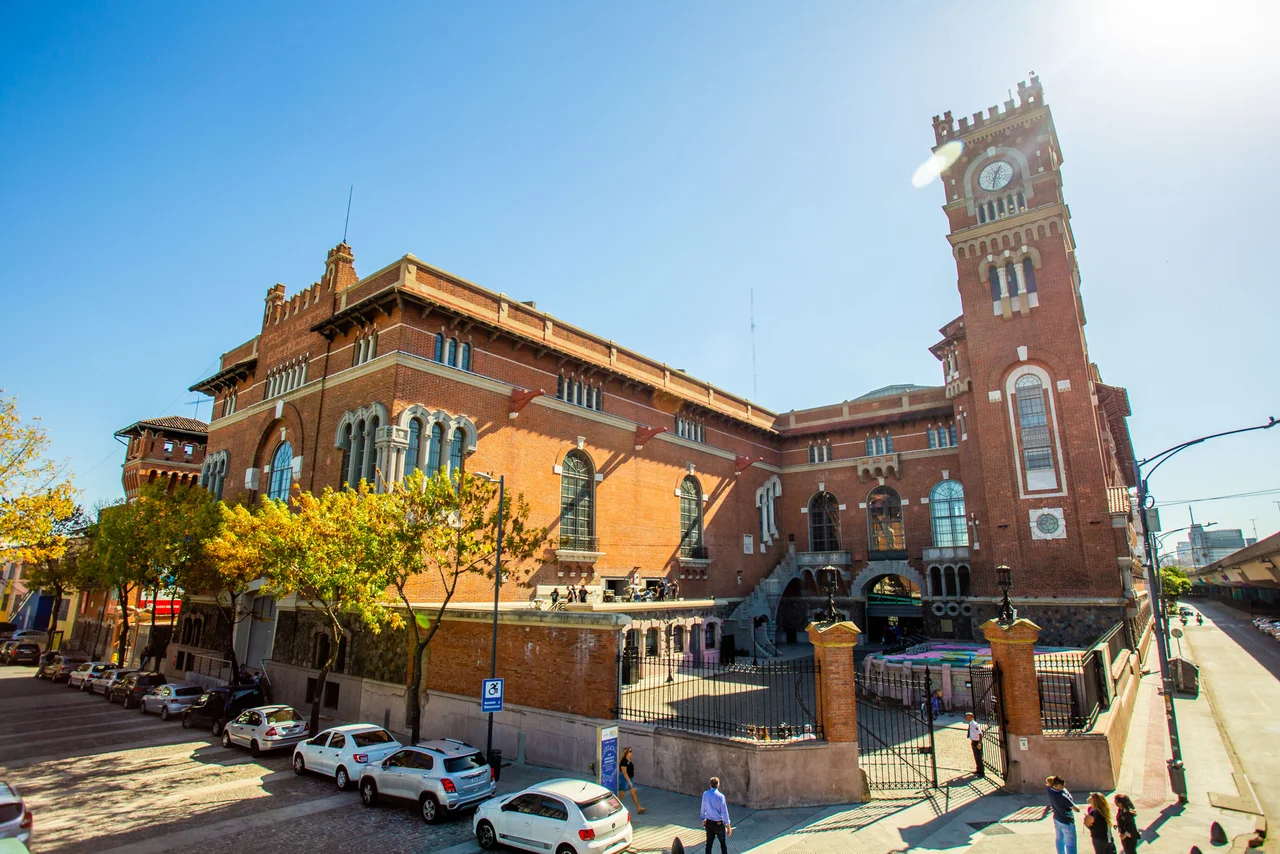

Usina del Arte
Approach La Boca along the elevated freeway and a Florentine palace seems to rise out of working-class Buenos Aires, complete with a battlemented clock tower lifted almost directly from the Palazzo della Signoria in Florence. It is a beautiful deception. Behind that medieval Italian facade was never a noble court but a machine: a power station, built to pour electricity into a hungry, growing city. The Usina del Arte spent eight decades humming with generators, then a decade rotting in silence, before being reborn as one of the finest concert halls in Argentina.
Power Dressed as a Palace
The Italian architect Giovanni Chiogna designed the building, and the firm Martignone and Sons raised it between 1912 and 1916 for the Italo-Argentine Electricity Company, known by its Spanish initials CIAE. Chiogna gave all the company's buildings a shared signature: exposed brick walls, rounded and segmental arches, friezes and moldings, the company's heraldry worked into the stonework, and here and there a tower. The look deliberately echoed the European twelfth century, dressing industrial infrastructure in the costume of a Renaissance city-state. This power plant was the grandest of the lot, its square tower crowned with battlements, gargoyles jutting from its walls, plaster molded to imitate cut stone. Inside, the romance fell away. The great halls were raw working spaces for electric generators, roofed with iron trusses and sheets of zinc.
Eight Decades of Current
From its inauguration in 1916, the powerhouse did exactly what it was built to do. Between 1919 and 1921 it was enlarged to keep pace with the surging demand of Buenos Aires, and for roughly eighty years it fed current into the streetlights, homes and workshops of the city. Then the electricity service was nationalized in the 1990s, and the building's purpose evaporated. The state company walked away, and the grand brick palace of La Boca was left to decay, its generators silent, its halls empty, slowly falling apart behind that ornamental face.
A Second Life in Sound
After a decade of abandonment, the national and city governments agreed in 2000 to rescue the structure and turn it into the permanent home of the city's auditorium and its National Symphony and Philharmonic orchestras. The foundation stone for the conversion was laid in 2007 under the working name Usina de las Ideas, the Powerhouse of Ideas. The first phase finished in 2011, and the official reopening in 2012 carried a new name and a fitting tribute: La Usina del Arte, the Arts Powerhouse, inaugurated with a concert honoring the tango genius Astor Piazzolla. The cavernous spaces once filled with the throb of machinery were reshaped around a main symphonic hall seating around 1,200 people and a smaller one for around 500, linked by a transversal route designed to unite the building's two entrances. Around them went offices, cafes and shops, even a place to buy instruments and sheet music. A chamber music hall opened in 2013, and where generators had once roared, audiences now settle into their seats and wait for the first note.
The Powerhouse and Its Neighborhood
There is something right about where this building stands. La Boca is the old immigrant port quarter at the mouth of the Riachuelo, a neighborhood built largely by Italian newcomers, the same community whose company once raised this Italianate powerhouse. The brightly painted tin houses of the Caminito are a short walk away. Now, instead of sending power out into the grid, the Usina draws people in, its clock tower still visible from a distance, its halls trading the hum of generators for the swell of an orchestra tuning up. Few buildings have changed their work so completely while changing their walls so little.
From the Air
The Usina del Arte stands at roughly 34.63 degrees south, 58.36 degrees west, in the La Boca neighborhood at the southeastern edge of the city of Buenos Aires, near the mouth of the Riachuelo river where it meets the Rio de la Plata. From the air, look for its distinctive square clock tower beside the elevated La Plata freeway, with the curving channel of the Riachuelo and the colorful rooftops of La Boca and the Caminito nearby. The closest airport is Aeroparque Jorge Newbery (ICAO SABE), the riverfront city airport a short distance north along the estuary. The main international gateway is Ezeiza's Ministro Pistarini International (ICAO SAEZ), southwest of the city. A sightseeing altitude of 1,500 to 3,000 feet keeps the tower, the river mouth and the surrounding grid in clear view. River haze and occasional morning fog can reduce visibility over the estuary.
Nearby Stories
- Martín García Island 12 km away
- Cathedral of La Plata 25 km away
- Luján, Buenos Aires 36 km away
- Nueva Helvecia 48 km away
- Lobos 55 km away
- Atucha Nuclear Power Plant 57 km away
- Tronador (rocket) 91 km away
- Battle of Sarandí 156 km away