.jpg)
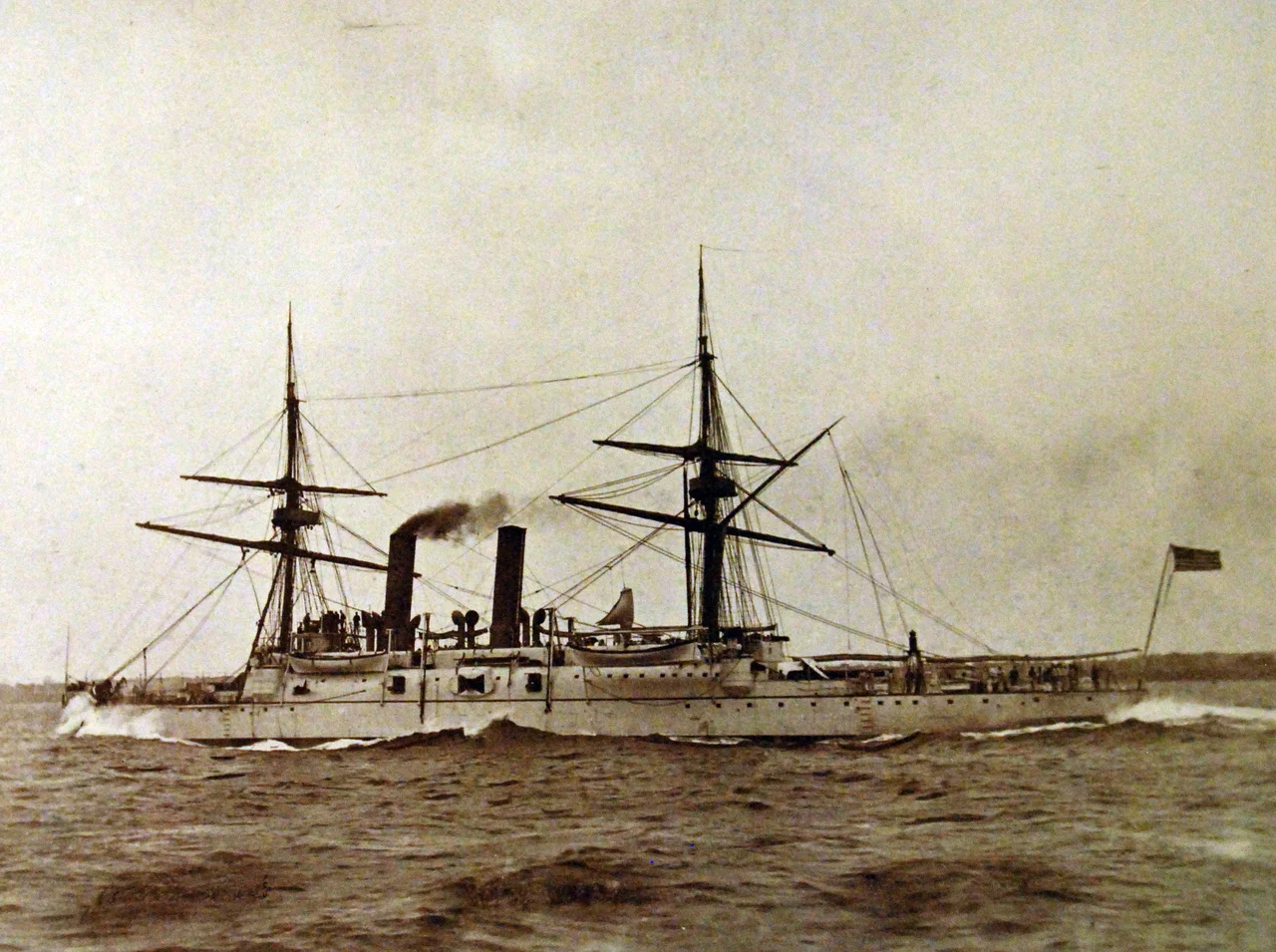
USS Boston (1884)
The fifth ship to carry the name Boston was built of steel at a time when the U.S. Navy was still transitioning from wood and sail. Launched in 1884, the protected cruiser USS Boston was part of the ABCD ships -- the first steel warships authorized by Congress as the foundation of the 'New Navy' that would transform the United States from a coastal defense force into a blue-water power. Her career took her from the shipyards of the East Coast to the Hawaiian revolution and the Spanish-American War, marking the arc of American imperial ambition in the late 19th century.
Steel and Steam
The USS Boston belonged to a small group of pioneering warships -- sometimes classified with her sister ship Atlanta, sometimes as a separate class -- that represented a fundamental shift in American naval design. These ships were built of steel rather than wood, powered by steam engines rather than sail, and armed with modern breech-loading guns. They were not battleships; as a protected cruiser, the Boston carried a thin armored deck but no belt armor. Her role was speed, patrol, and commerce protection rather than ship-to-ship combat. But she represented something larger than her displacement: the Congressional commitment to building a modern navy capable of projecting power beyond the Western Hemisphere.
The Hawaiian Overthrow
In January 1893, the USS Boston was stationed in Honolulu Harbor when American sugar planters, with the support of the U.S. Minister to Hawaii, overthrew Queen Liliuokalani. Marines from the Boston were landed to maintain order -- a euphemism for providing armed backing to the conspirators. The role of U.S. military forces in the overthrow of a sovereign government remains controversial. The Boston's presence lent the coup the appearance of American government sanction, though President Grover Cleveland later condemned the overthrow and attempted, unsuccessfully, to restore the queen. Hawaii was annexed by the United States in 1898.
From Manila Bay to the Breakers
The Boston served in the Spanish-American War, participating in operations in the Pacific. After decades of service, the aging cruiser was decommissioned and eventually scrapped. Her career spanned the transformation of the United States from a continental power to an imperial one -- from the first steel warships to the acquisition of overseas territories in Hawaii, the Philippines, Guam, and Puerto Rico. The Boston was not the most powerful ship in the fleet, but she was there at the turning points, a steel witness to the moment when America decided it wanted an empire.
From the Air
The USS Boston's final resting area is approximately 37.74N, -122.58W, off the San Francisco coast. The ship was associated with operations throughout the Pacific. Nearest airport: KSFO 12nm east.
Nearby Stories
- The Nonprofit That Saved Marin's Movie Palaces 0.8 km away
- Alviso, San Jose 2.2 km away
- From Ammunition Bunkers to Cattle Country 2.9 km away
- Purisima Creek 9.2 km away
- Niles Canyon Railway 15 km away
- Cordell Bank: The Invisible Island 30 km away
- The Hole in the Head 67 km away
- ʻAkaka Falls State Park 3665 km away