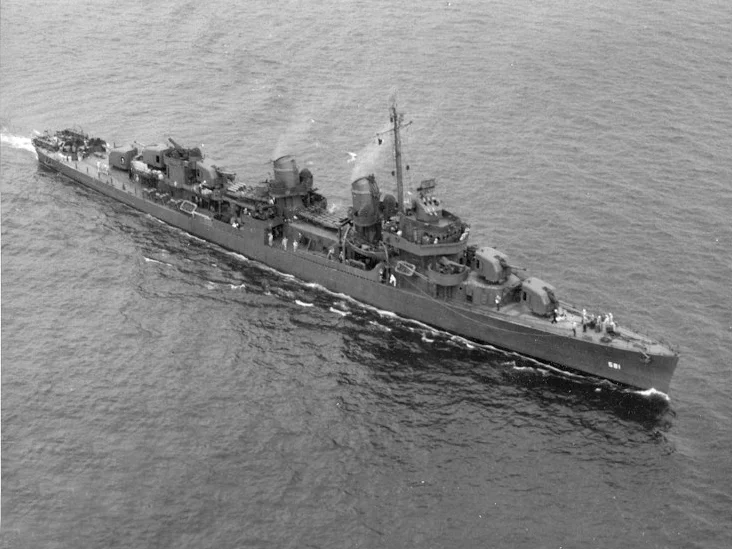
_underway_off_Boston,_Massachusetts_(USA),_on_4_August_1943_(80-G-74846).jpg)
USS Charrette / Velos
At midday on 25 May 1973, a Greek destroyer was at sea between Italy and Sardinia, 85 nautical miles southwest of Rome, taking part in a NATO exercise with allied vessels. By radio, Commander Nikolaos Pappas and his officers had learned that naval officers in Greece had been arrested and tortured by the military junta ruling the country. Pappas was part of a group of democratic officers who had sworn their allegiance to the Greek constitution, not to the men who had seized the government. He concluded that there was no longer any hope for change from inside Greece. He mustered his crew on the stern, announced what he intended to do, and left formation. He sailed for Rome.
Built for a Different War
The ship that became famous for what it refused to do began as USS Charrette (DD-581), a Fletcher-class destroyer launched at the Boston Navy Yard on 3 June 1942, named for Lieutenant George Charrette, who had been awarded the Medal of Honor for heroism during the Spanish-American War. She was commissioned on 18 May 1943 and spent the next two years in the Pacific, accumulating a combat record that few destroyers could match. She screened aircraft carrier task forces during strikes on Japanese bases in the Marshall Islands and helped prepare the landings at Makin and Tarawa. In February 1944 she helped track and attack a Japanese submarine — possibly the first to be sunk by the Hedgehog anti-submarine weapon. She screened the carriers through the Marianas campaign and the Battle of the Philippine Sea in June 1944, flashing beacon lights in the dark during night recovery operations to help aviators who were forced to ditch when their planes ran out of fuel. She fought at Leyte Gulf, bombarded Chichi Jima, supported the Lingayen landings. By the time the war ended, she had earned 13 battle stars. She was placed in reserve in 1947.
A New Name, A Different Sea
In June 1959 the ship was transferred to Greece. She was accepted by Commander G. Moralis of the Royal Hellenic Navy on 16 July 1959 in Long Beach, California, and arrived in Greece that October. Renamed Velos — the Greek word for arrow — she became hull number D16 in the Hellenic Navy and spent the next three decades as a working warship, participating in nearly every Greek and NATO exercise and actively involved in the crises with Turkey in 1964, 1967, the Cyprus crisis of 1974, and 1987. She was a capable ship with a full operational life. Then came the afternoon of 25 May 1973.
The Mutiny off Fiumicino
When Commander Pappas finished speaking, the crew responded with enthusiasm. He signalled his intentions formally to the squadron commander and to NATO Headquarters, quoting the preamble of the North Atlantic Treaty, which declares that member governments "are determined to safeguard the freedom, common heritage, and civilization of their peoples, founded on the principles of democracy, individual liberty, and the rule of law." Then he sailed for the Italian coast. That afternoon, Velos anchored about 3.5 nautical miles off Fiumicino. Three officers — Ensigns Gortzis, Matarangas, and Stratos — went ashore by whaleboat and telephoned international press agencies from Fiumicino Airport, then arranged a press conference for the next day. The action attracted immediate international attention to conditions in Greece. In the end, the captain, six officers, and 25 petty officers requested asylum and remained in Italy as political refugees. The rest of the crew — 170 men had initially signed a request to follow Pappas — were advised by their officers to return to Greece, out of fear of retaliation against their families. Velos sailed back to Greece a month later under a replacement crew. After the junta fell on 24 July 1974, some of the officers returned to naval service. Commander Pappas eventually reached the rank of vice admiral and served as chief of the Hellenic Navy General Staff from 1982 to 1986.
An Arrow Still in Commission
Velos was decommissioned on 26 February 1991, having sailed 362,622 nautical miles in her 48-year career. In 1994 the Hellenic Navy General Staff formally designated her a Museum of the Struggle against the Dictatorship. After restoration work at Salamis Naval Base, she was anchored in the Naval Tradition Park at Palaio Faliro in Athens from 2002 to 2019, where visitors could board her. Since September 2019 she has been moored on the waterfront of Thessaloniki, near the city's concert hall, and remains open to the public. The Hellenic Navy regards her as still in commission. In November 2023, strong winds caused damage to her stern at her moorings; she was towed to the city's harbour the same day. She is a ship with a history of surviving difficult circumstances.
From the Air
The ship now known as Velos is moored on the Thessaloniki waterfront (approximately 40.63°N, 22.94°E) but its Athens-area history is centred on Palaio Faliro, at approximately 37.934°N, 23.685°E — just south of the Athens city centre along the coast of the Saronic Gulf, visible from the air as a thin coastal strip between the sea and the Athens urban grid. The Acropolis is clearly visible to the northeast. Athens Eleftherios Venizelos International Airport (LGAV) lies approximately 23 km to the east. Recommended viewing altitude when approaching from the west over the Saronic Gulf: 2,000–3,000 ft AGL. Clear-weather visibility from this altitude typically extends across the full sweep of the gulf, from Piraeus to Cape Sounion.
Nearby Stories
- Parnitha 3.4 km away
- Kea (island) 7.3 km away
- Sanctuary of Apollo Maleatas 11 km away
- Sousaki Volcano 12 km away
- Battle of Leuctra 14 km away
- Great Sand Beach 18 km away
- Agios Georgios (island) 23 km away
- Skyros 84 km away