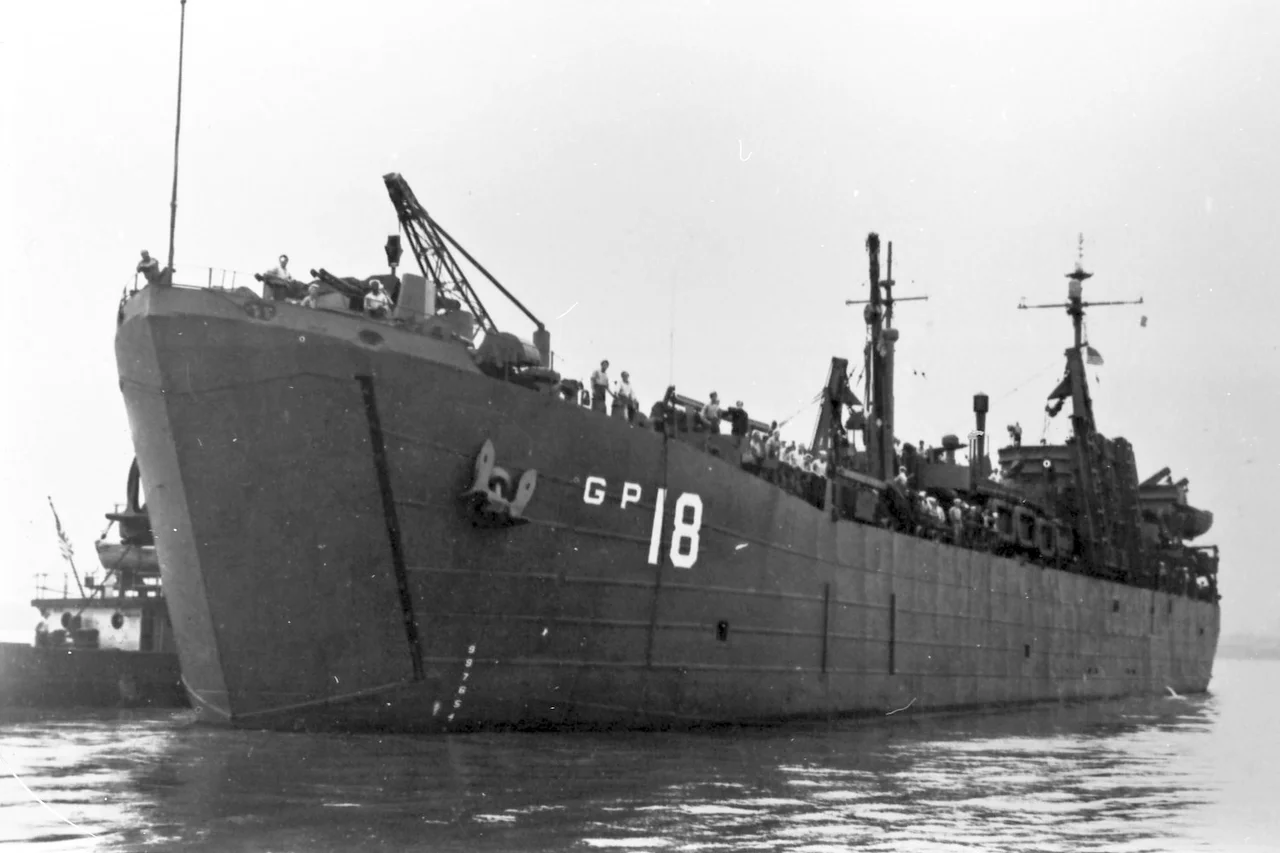
,_circa_in_1945.jpg)
USS Chiron
Some warships serve for decades. USS Chiron served for five months and twenty-seven days. Laid down in an Illinois river town in the last winter of World War II, she arrived in the fleet just as the fleet stopped needing her. Her story is not one of battle honors. It is the quieter story of a ship built for a war that ended before she could reach it - and the unlikely second act that carried her, under a different flag and a different name, to a reef off the coast of Brazil.
Built on the Illinois River
Chiron began life as USS LST-1133, a tank landing ship ordered as part of the vast construction program that put thousands of amphibious hulls into the water during World War II. Before she could be completed as an LST, the Navy reclassified her as a motor torpedo boat tender - a support ship for the small, fast PT boats - and assigned her the hull number AGP-18. On 14 August 1944 she was renamed Chiron, after the wise centaur of Greek myth. The Chicago Bridge and Iron Company laid her keel at Seneca, Illinois, on 16 December 1944. Seneca is a long way from salt water; LSTs built there were floated down the Illinois and Mississippi Rivers to sea. Chiron launched on 10 March 1945, sponsored by Mrs. T. S. Tillman, and entered reduced commission on 23 March for the trip to her conversion yard. She was decommissioned again on 17 April to be rebuilt as a tender at the Maryland Drydock Company in Baltimore.
A Short Peacetime Career
By the time conversion was finished, the war in Europe was over and Japan had surrendered. Chiron was recommissioned, sent south from Norfolk on 1 November 1945, and reached Miami on 4 November to support the PT boats of Motor Torpedo Squadron 42. She tended them for a month - servicing engines, resupplying torpedoes, providing fuel and quarters - until 8 December. Then she got underway for New York City, where on 20 February 1946 she was decommissioned after only five months and twenty-seven days in naval service. On 28 March, her name was struck from the Naval Vessel Register. Fifteen months had passed between her keel-laying and her final decommissioning. She had never fired a shot in anger. The Portunus-class tenders as a group had been built for a campaign that the atomic bomb had ended before they arrived.
A Second Life Under Argentina's Flag
What happens to a warship the Navy no longer wants? Chiron's answer was the standard postwar answer: she was sold for commercial service. On 19 May 1947 she was transferred to Argentine owners, and by 1948 she was sailing under the Argentine flag as the motor vessel Altamar. Her tank-deck origins made her useful for bulk cargo. For twelve years she worked the coastal trade of South America, a refitted merchantman with a Navy hull below the paint. There is not much written record of those years - the quiet, unremarkable career of a working ship is rarely news. She carried what was needed where it was needed. Then, on 30 March 1960, she didn't.
The Wreck on Manoel Luís Reef
On that spring voyage, Altamar was carrying a cargo of grain from Cabedelo, on Brazil's northeastern coast, toward Belém at the mouth of the Amazon. Her route took her across Manoel Luís Reef, a shallow coral complex off the coast of Maranhão that has been a mariner's hazard for centuries. The reef rises abruptly from deep water and sits just below the surface at low tide. On 30 March she struck and sank. Her wreck was later located on the reef, about 0.8°S, 44.3°W, and today sits within a Brazilian state marine park established in part to protect the coral system that claimed her. In her short career she earned the American Campaign Medal and the World War II Victory Medal - modest honors for a ship that never saw combat, but earned them simply by being built and commissioned during that war.
Small Ship, Long Story
Chiron is not a famous name in naval history. She did not fight at Leyte Gulf or cover the beaches at Okinawa. Her place in the record is as a small example of a large pattern: the American industrial surge that built warships faster than the war could consume them, and the long afterlife those ships found once the shooting stopped. Thousands of LST-hulled vessels left Navy service and reappeared as ferries, cargo carriers, and oil rigs in ports around the world. Some still float today. Chiron's particular route took her from an Illinois shipyard to a Brazilian reef, by way of Baltimore, Miami, New York, and the River Plate. It was not the career her designers imagined. But it was a career, and in the end it is the one she had.
From the Air
The wreck of USS Chiron / MV Altamar lies on Manoel Luís Reef at approximately 0.77°S, 44.33°W, roughly 86 km off the coast of Maranhão state in Brazil's northeastern waters. The reef complex sits within Parcel de Manuel Luís State Marine Park. The nearest coastal airport is São Luís-Marechal Cunha Machado International (SBSL / SLZ), about 130 km south-southwest. The Parcel de Manuel Luís is a well-known visual feature from low altitude in clear weather - light reef water against deeper blue ocean. Tropical maritime conditions prevail year-round.
Nearby Stories
- Maranhão mangroves 71 km away
- Ilha de Santana Lighthouse 140 km away
- Lençóis Maranhenses 215 km away
- São Miguel do Guamá 283 km away
- Santa Inês 323 km away
- Saint-Georges (French Guiana) 951 km away
- Nadir Crater 3172 km away